
Species guide
Common Juniper Compressa Bonsai Care
Juniperus communis 'Compressa'
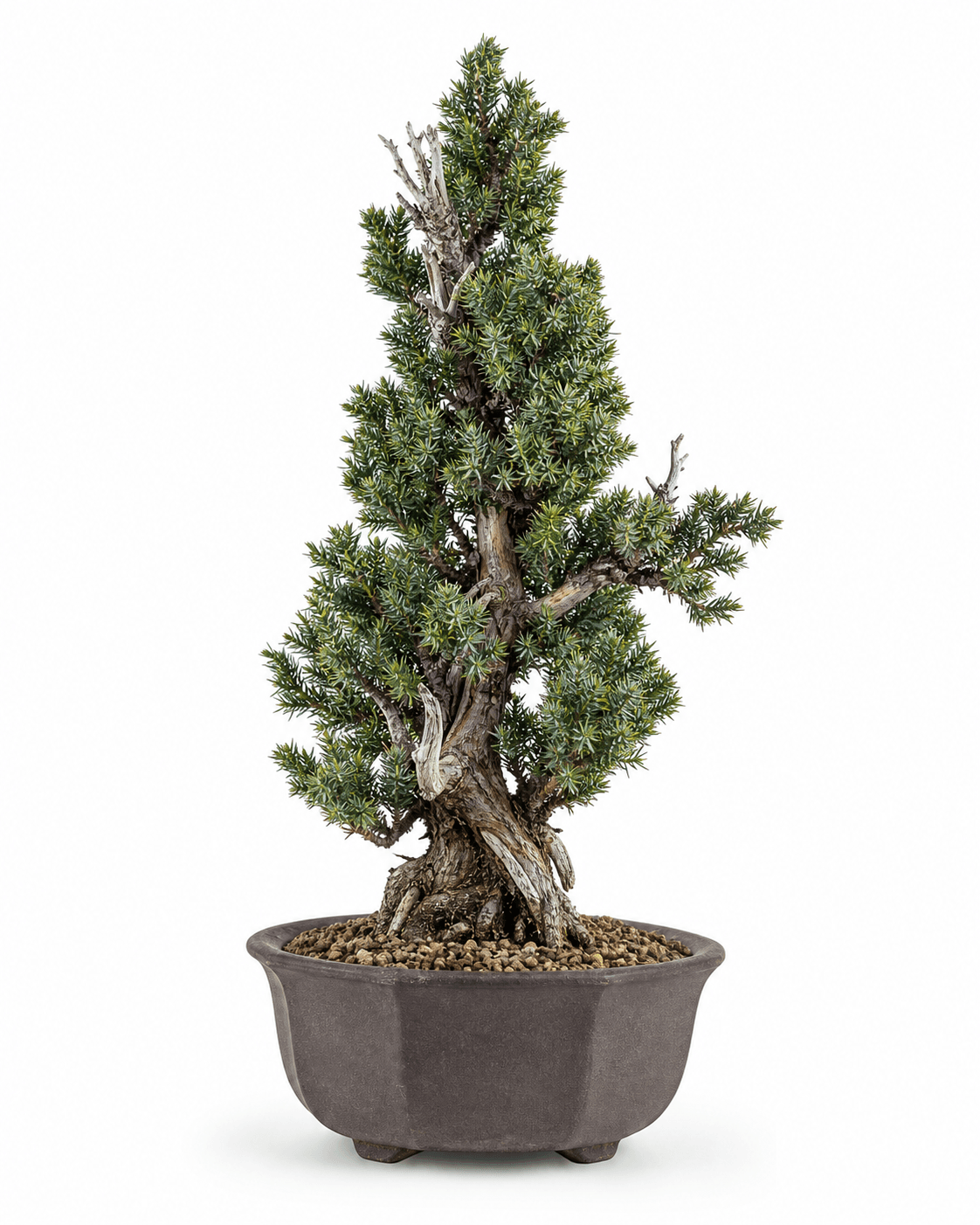
Common juniper Compressa is a narrow, upright cultivar of Juniperus communis with permanent needle foliage, a compact columnar habit, and strong potential for small outdoor bonsai when the design respects its vertical compression. Grow confirmed Compressa outdoors, use pumice-led mineral soil, repot very late after shoot elongation, and protect the small root mass from peak summer heat.
The local Mirai corpus has no dedicated Compressa episode. This guide transfers the direct Juniperus communis and true needle-juniper method from Mirai, then uses NC State, Oregon State, Flora of North America, Kew, American Conifer Society, and UC IPM for cultivar identity, size, habit, hardiness, foliage, cones, disease, and pest context.
Separate Compressa from species-level common juniper, Sentinel or Pencil Point labels, Blue Star, Blue Pacific, procumbens, needle juniper, San Jose, Blaauw, Foemina, eastern red cedar, and generic blue groundcover junipers before applying timing. The cultivar changes design and pot choice, while the parent species still controls soil, heat, and root timing.
Updated June 10, 2026. Written by EntGrove Editorial. Last verified June 10, 2026.
Care fingerprint
Read the species through its shared care pattern.
Open pads for light, avoid stripping all low growth, and understand that cheap starter junipers still need outdoor recovery. Use this as the starting point before local conditions and tree strength refine the calendar.
Keep foliage strong
Junipers recover through active foliage, so styling choices should leave enough healthy tips to power the tree.
Protect live veins
Old junipers often depend on narrow live veins between roots and foliage; root work and carving should respect that path.
Do not stack major work
Heavy bending, major foliage reduction, carving, and repotting belong in a staged plan rather than the same weekend.
Care cadence
The calendar starts with the tree's seasonal state.
Placement
Timing: Grow outdoors year round with strong light and airflow. Use morning sun with afternoon shade during hot spells, after repotting, or when the pot is very small.
Watch for: Indoor display, reflected pavement heat, tiny dark pots, dry winter wind, weak old nursery roots, and assuming Zone 2 ground hardiness protects a shallow bonsai pot.
NC State Extension: Juniperus communis CompressaOregon State Landscape PlantsBonsai Mirai LibraryWatering
Timing: Water in repeated passes until the whole rootball drains, then wait for oxygen to return before watering again.
Watch for: Water channeling around a dry center, wet peat under a dry surface, bronzing tips, sandpapery needles, and drought-tolerant landscape advice copied into a bonsai pot.
Bonsai Mirai LibraryFeeding
Timing: Feed healthy trees moderately during active growth. Hold fertilizer 4 to 6 weeks after repotting and restart lightly after new growth confirms recovery.
Watch for: Force-feeding weak roots, lush extension that ruins a compact design, and fertilizer on a wet organic core.
Bonsai Mirai LibraryPruning
Timing: Let spring growth elongate and harden. Then shorten with scissors to living side growth, preserving enough foliage to power roots.
Watch for: Pinching, shearing into a cone, cutting to bare stems, overcleaning the interior, and removing all low shoots before the trunk line is chosen.
Bonsai Mirai LibraryRepotting
Timing: Repot very late for a conifer, after visible shoot elongation proves water movement and photosynthesis are active.
Watch for: Bud-swell repotting, bare-rooting a nursery plant, loose tie-downs, old peat left hydrophobic, and akadama added out of habit.
Bonsai Mirai LibraryWiring
Timing: Wire hydrated, vigorous trees after growth has hardened. Set the line once, check wire often, and protect the narrow branch bases.
Watch for: Crushed vertical shoots, wire hidden in dense needles, repeated bending, dry brittle tissue, and forced movement beyond the columnar structure.
Bonsai Mirai LibraryBonsai Mirai / AsymmetryPests and disease
Timing: Inspect dense foliage through wet springs, humid spells, hot dry weather, and the first season after nursery-stock reduction.
Watch for: Juniper blight, Phomopsis or Kabatina twig blight, cedar-apple rust, mites, borers, scale, bagworms, wet roots, and shaded interior dieback.
NC State Extension: Juniperus communis CompressaUC IPM JuniperUC IPM Juniper Twig BlightsPropagation
Timing: Use cuttings or layering to preserve Compressa. Seed from common juniper produces variable seedlings with unpredictable habit.
Watch for: Seedlings sold as Compressa, mixed Pencil Point or Sentinel labels, undocumented graft unions, and cuttings stripped of too much foliage.
NC State Extension: Juniperus communis CompressaOregon State Landscape PlantsBonsai Mirai LibraryWinter protection
Timing: Keep dormant outdoors and cold. Protect shallow pots from hard freeze, drying wind, and thaw-refreeze cycles.
Watch for: Warm indoor overwintering, frozen dry roots, wet protected shelves without airflow, and recent root work exposed to sudden cold.
NC State Extension: Juniperus communis CompressaOregon State Landscape PlantsBonsai Mirai LibrarySpecies guide
Apply the species profile before copying another tree's calendar.
At a glance
Compressa is a narrow common-juniper cultivar with true needle-juniper roots and timing.
Record this plant as Juniperus communis Compressa when the tag, source, or propagation record supports it. NC State treats Compressa as a dwarf, dense, erect cultivar with narrowly upright branches and silvery-blue, somewhat prickly foliage. NC State Extension: Juniperus communis Compressa
For bonsai, the useful headline is narrow upright common juniper. The cultivar supplies the columnar design and small scale, while the species supplies permanent needle foliage, late repot timing, pumice soil, and heat sensitivity. Bonsai Mirai LibraryOregon State Landscape Plants
The source caveat belongs at the top. Mirai names Juniperus communis directly in true needle-juniper and soil guidance, while this cultivar treatment is transferred from those species-level files. Bonsai Mirai Library
Wild context
Use the parent species for ecology, then adjust design for a nursery column.
Compressa is a cultivated form, so there is no wild Compressa habitat. The parent species, Juniperus communis, has a broad northern range and FNA describes shrubs or small trees that can be decumbent or rarely upright. Flora of North AmericaKew POWOOregon State Landscape Plants
Oregon State describes common juniper as sun adapted, tolerant of poor soils, and hardy to Zone 2, while Mirai adds the bonsai-specific constraint: common juniper benefits from afternoon shade during peak summer heat. Oregon State Landscape PlantsBonsai Mirai Library
For care, translate that ecology into outdoor light, airflow, a cool root zone, full hydration, and fast oxygen return. The narrow canopy can hide a root problem until the small column browns from the inside. Bonsai Mirai LibraryNC State Extension: Juniperus communis Compressa
For design, translate the cultivar habit into vertical compression, small voids, tight branch rhythm, and a pot that supports a column. Compressa usually reads best as a quiet upright with its own scale and proportion. Bonsai Mirai / AsymmetryNC State Extension: Juniperus communis Compressa
Reading the tree
Read identity, rootball behavior, needle firmness, and interior light before any styling.
Begin with identity. Compressa should be separated from Sentinel, Pencil Point, Hibernica, low common-juniper mats, Blue Star, Blue Pacific, procumbens, and juvenile Chinese junipers before applying timing. NC State Extension: Juniperus communis CompressaOregon State Landscape PlantsBonsai Mirai Library
Read strength through extension and needle firmness. Mirai teaches that needle junipers must become energy-positive before pruning, so green color alone is too weak a signal. Bonsai Mirai Library
Read the rootball with water. A narrow nursery plant can have a dense center that sheds water around the edges or stays wet long after the surface looks dry. Bonsai Mirai Library
Read the interior before cleaning. Compact upright shoots shade each other quickly, so keep interior buds that can shorten the column and remove only dead or clearly unusable congestion. Bonsai Mirai LibraryNC State Extension: Juniperus communis Compressa
Needle work
Prune after hardening and keep the column from becoming a sheared landscape cone.
Skip spring pinching. Mirai identifies early pinching of elongating needle-juniper shoots as a major cause of delayed branch loss because the new growth is feeding fine roots. Bonsai Mirai Library
After the flush hardens, shorten with sharp scissors to living side growth. Hide cuts inside the foliage and avoid cutting into bare stems that lack visible growth. Bonsai Mirai Library
Compressa needs more selective pruning than a landscape shrub. Preserve branch hierarchy, remove only the clutter that blocks light or wiring, and leave enough exterior foliage to keep the root system active. Bonsai Mirai LibraryBonsai Mirai / Asymmetry
Maintain bonsai shape with selective cuts. Hedge shearing creates a hard shell, starves the interior, and pushes the plant back toward nursery topiary. Bonsai Mirai LibraryNC State Extension: Juniperus communis Compressa
Roots
Repot late, tie firmly, and convert nursery cores without stripping the tree.
True needle junipers are among the last conifers repotted. For common juniper, wait until new shoots have elongated and the tree is clearly moving water. Bonsai Mirai Library
Most Compressa candidates are nursery plants, so expect organic media, a tight central core, and roots arranged for a landscape container. Correct the core over staged repots and keep the root plan health-first. NC State Extension: Juniperus communis CompressaBonsai Mirai Library
Tie-down discipline matters. A tall narrow canopy catches wind, and a moving rootball tears new fine roots exactly when the tree is trying to recover. Bonsai Mirai Library
After repotting, use morning sun, afternoon shade, wind protection, and light foliage misting for about 7 to 10 days when conditions are dry. Wait 4 to 6 weeks before fertilizing. Bonsai Mirai Library
Soil and pot
Use pumice for the roots and a narrow container that makes the column believable.
Mirai common-juniper guidance is unusually specific: long-term Juniperus communis culture should use 100 percent pumice, while akadama-heavy juniper mixes belong to other juniper species. Bonsai Mirai Library
Screen particle size to match pot scale, roughly 1/16 to 1/4 in for small material, and keep the surface open enough that water reaches the center before it drains along the walls. Bonsai Mirai Library
Pot pairing should reinforce the upright habit. Narrow rectangles, small rounds, hexagons, modest ovals, and rock pockets can work when they provide enough root volume and keep the tree in scale. Bonsai Mirai / AsymmetryNC State Extension: Juniperus communis Compressa
Delay very shallow pots. A slender nursery cultivar needs root recovery and interior density before the container becomes visually strict. Bonsai Mirai Library
Climate
Cold tolerance is real, while heat, wind, and small-pot exposure still decide bonsai survival.
NC State lists a broad Zone 2a to 9b range for Compressa, and Oregon State lists common juniper hardy to Zone 2. Treat those as landscape references; shallow pots still need protection through hard freezes. NC State Extension: Juniperus communis CompressaOregon State Landscape Plants
In cold regions, heel small pots into mulch, group them, or use an unheated cold frame once hard freezes arrive. Keep dormant trees cold and ventilated. Bonsai Mirai LibraryOregon State Landscape Plants
In hot regions, morning sun and afternoon shade are often safer than all-day exposure. Watch pot temperature, dry wind, and reflected heat because common juniper foliage can lag behind root stress. Bonsai Mirai Library
In wet maritime climates, airflow and soil oxygen matter more than drought tolerance. Dense upright foliage, old organic soil, and wet nights invite twig blights and root problems. UC IPM JuniperUC IPM Juniper Twig Blights
Pests
Dense upright foliage makes inspection more important than the plant tag suggests.
NC State names juniper blight as a major issue for Compressa and lists cedar-apple rust, wilt, mites, borers, scale, and bagworms as possible problems. NC State Extension: Juniperus communis Compressa
UC IPM lists juniper pest categories that include aphids, bark beetles, cypress bark scale, borers, sawflies, scales, spider mites, twig blights, Phytophthora, rusts, cankers, scorch, and water-stress disorders. UC IPM Juniper
Twig blights often start at tender or wounded tips, especially with wet foliage and dense interiors. Remove infected tips, clean debris, improve airflow, and avoid unnecessary pruning while the tree recovers. UC IPM Juniper Twig BlightsBonsai Mirai Library
Inspect with light and magnification before spraying. Mites, scale, interior shading, dry roots, and old-foliage shedding can look similar from the outside of a compact column. UC IPM JuniperBonsai Mirai Library
Wiring
Wire for small rhythm and branch placement within the existing column.
The trunk is usually already upright and narrow, so wiring should refine branch rhythm, create small offsets, and open light channels while leaving large trunk bends out of the plan. NC State Extension: Juniperus communis CompressaBonsai Mirai / Asymmetry
Wire only when the tree is hydrated and vigorous. Dense needles hide wire quickly, so check often and remove before bite scars become the main visual feature. Bonsai Mirai Library
Support branch bases with guy wires or hand pressure when needed. Repeated bending is expensive on brittle needle-juniper tissue. Bonsai Mirai Library
Keep the apex soft. A rigid spear shape reads as a landscape conifer, while a slightly irregular top makes the narrow cultivar feel older and more tree-like. Bonsai Mirai / AsymmetryNC State Extension: Juniperus communis Compressa
Propagation
Use clone-preserving methods if the goal is Compressa.
Seed from common juniper can produce useful material and variable seedlings. Compressa should be propagated by cuttings or layering when the goal is the narrow habit. NC State Extension: Juniperus communis CompressaNC State Extension
Keep enough foliage on cuttings to feed the new roots, but reduce excess mass that would desiccate before roots form. Rooting speed is slower than with many tropical and broadleaf species. Bonsai Mirai LibraryNC State Extension
Air-layering can preserve an interesting upright section when foliage health is strong. Layer only after the plant has enough remaining foliage to support both the parent and the future layer. Bonsai Mirai Library
Approach grafting is rarely the first plan for Compressa, but it can solve missing roots or branch placement on strong material. Match vigor carefully and keep the graft union protected. Bonsai Mirai Library
Buying
Buy the narrow habit, then verify roots and interior life before styling.
Good Compressa material has a clear label, live interior shoots, firm needles, an interesting base, a trunk line that benefits from verticality, and a rootball that accepts water evenly. NC State Extension: Juniperus communis CompressaBonsai Mirai Library
Red flags include fresh shearing, brown interior columns, a dry hydrophobic core, sour peat, no visible base, severe wire scars, scale insects, mite stippling, and tags that drift between Compressa, Sentinel, Pencil Point, and generic common juniper. NC State Extension: Juniperus communis CompressaOregon State Landscape PlantsUC IPM Juniper
Landscape stock is useful when the price reflects the work still required. Pay a premium only for age, root work, branch options, cultivar certainty, and evidence that the tree has recovered from prior reductions. Bonsai Mirai / AsymmetryBonsai Mirai Library
Collect wild common juniper only where legal and with a recovery plan. For a cultivar page, nursery-origin Compressa is the normal sourcing path. USDA Forest Service FEISNC State Extension: Juniperus communis Compressa
Troubleshooting
Start with roots, recent work, identity, and interior density.
Symptom: the outside stays blue-green while the interior browns. Likely cause: shaded inner foliage, twig blight, mites, scale, or natural old-foliage shedding. Fix: inspect closely, clean gradually, and restore airflow. NC State Extension: Juniperus communis CompressaUC IPM JuniperUC IPM Juniper Twig Blights
Symptom: tips brown after spring pinching. Likely cause: loss of the same new growth that was feeding fine roots. Fix: stop pruning, stabilize water and light, and wait for hardened extension before more work. Bonsai Mirai Library
Symptom: the column wilts after watering. Likely cause: water channeling around a dry center or old organic media staying wet without oxygen. Fix: manage surface wetting now and plan staged late repotting. Bonsai Mirai Library
Symptom: the tree declines after a cold snap. Likely cause: exposed bonsai roots, freeze-dry wind, or recent root work. Fix: protect the pot, keep it cold but sheltered, and avoid warm indoor rescue. Bonsai Mirai LibraryOregon State Landscape Plants
Symptom: the design looks stiff. Likely cause: every shoot was preserved as a symmetrical cone. Fix: choose a front, a defining branch, smaller voids, and a softer apex while preserving enough foliage for health. Bonsai Mirai / AsymmetryNC State Extension: Juniperus communis Compressa
Design
Use vertical compression, small asymmetry, and restraint.
Start with the base, then decide whether the tree wants to be a formal upright, a narrow informal upright, a literati column, or a small rock-pocket tree. The best Compressa designs use the cultivar habit directly. Bonsai Mirai / AsymmetryNC State Extension: Juniperus communis Compressa
The defining branch can be subtle. On a compact cultivar, a small side branch, a slight lean, or a carefully opened void may do more than a large dramatic bend. Bonsai Mirai / Asymmetry
Deadwood should stay in scale. Fine jins, a small shari, or a revealed strip of age can work, but massive carved deadwood usually overwhelms the slender common-juniper character. Bonsai Mirai / AsymmetryBonsai Mirai Library
Refinement is mostly subtraction and light management. Preserve interior shoots, shorten exterior extension after hardening, and create spaces that let the column breathe. Bonsai Mirai LibraryBonsai Mirai / Asymmetry
Forms and labels
Compressa belongs inside a wider group of common-juniper cultivars.
Oregon State lists common-juniper cultivars that include Alpine Carpet, Blueberry Delight, Compressa, Depressa Aurea, Effusa, Gold Cone, Green Carpet, Pioneer, Repanda, and Sentinel or Pencil Point. Oregon State Landscape Plants
NC State uses Noahs Ark juniper and Pencil Point juniper as common names on its Compressa page. Because Pencil Point can also appear around Sentinel-type material, keep the nursery label and plant habit in the record. NC State Extension: Juniperus communis CompressaOregon State Landscape Plants
Low common-juniper forms such as Repanda or Green Carpet call for different design decisions even though the species-level physiology remains similar. Oregon State Landscape PlantsBonsai Mirai Library
Separate true common-juniper cultivars from Juniperus squamata Blue Star, Juniperus conferta Blue Pacific, procumbens nana, and juvenile Chinese junipers before using this page. Bonsai Mirai LibraryOregon State Landscape Plants
History
Compressa is humble nursery material, so the bonsai value comes from selection.
The public history of Compressa is horticultural and nursery-led. It is a compact common-juniper cultivar sold for narrow spaces, rock gardens, and small landscape use. NC State Extension: Juniperus communis CompressaOregon State Landscape Plants
That accessibility is useful for bonsai. Compressa can teach true needle-juniper timing, rootball conversion, compact upright design, and the difference between sheared nursery shape and intentional branch structure. Bonsai Mirai LibraryBonsai Mirai / Asymmetry
A credible Compressa bonsai should feel deliberately quiet: a secure base, a narrow but living crown, visible branch hierarchy, clean interior light, and a pot that gives the roots enough space. Bonsai Mirai / Asymmetry
The exhibition standard is scale-appropriate. The tree succeeds when it reads as an old compact juniper with deliberate structure and interior light. Bonsai Mirai / AsymmetryNC State Extension: Juniperus communis Compressa
Species questions
Answer the beginner questions before styling.
Can common juniper Compressa be used for bonsai?
Yes. Compressa can be used for outdoor bonsai, especially small upright, narrow clump, literati, rock-pocket, and accent-scale designs.
Can Compressa juniper live indoors?
Compressa needs outdoor sun, airflow, seasonal temperature change, and winter dormancy. Indoor display should be brief.
Is Compressa the same as common juniper?
Compressa is a named cultivar of common juniper, Juniperus communis. Track it separately because the narrow upright habit changes design, sourcing, and pot choice.
What soil is best for Compressa juniper bonsai?
Use 100 percent pumice for long-term Juniperus communis culture, with particle size adjusted for pot size and water retention.
When should Compressa juniper be repotted?
Repot very late for a conifer, after new shoots have elongated and the tree shows active water movement. Preserve foliage and tie the rootball firmly.
Should Compressa juniper be pinched?
Skip spring pinching. Let the new growth harden, then prune with scissors to living side growth while preserving enough foliage to power the roots.
Why is my Compressa juniper brown inside?
Likely causes include shaded interior foliage, twig blight, mites, scale, old foliage shedding, or uneven water in the root core. Inspect before spraying or pruning harder.
How big does Compressa juniper get?
NC State lists 2 to 3 ft tall by 1 to 2 ft wide in the attribute table and also notes mature landscape size of 2 to 6 ft tall with a narrow 1 to 1.5 ft spread.
Is Compressa beginner friendly?
It is manageable for careful growers, but it is less forgiving than many starter junipers because common-juniper soil, late repotting, and heat management matter.
How is Compressa different from Blue Star or Blue Pacific juniper?
Compressa is an upright Juniperus communis cultivar with true needle-juniper physiology. Blue Star is Juniperus squamata, and Blue Pacific is a trailing Juniperus conferta cultivar.
Sources
Species advice needs source discipline.
Next decisions
Plan the operation before copying the calendar.
A good care note for Common juniper 'Compressa' records the tree's stage, the work done, and the aftercare used. That record matters more than a month-name rule.
Related species
Compare nearby trees before transferring advice.
Procumbens nana
Juniperus procumbens 'Nana'
Green mound juniper
Juniperus procumbens 'Nana'
Blue Star juniper
Juniperus squamata 'Blue Star'
Shore juniper
Juniperus conferta
Blue Pacific shore juniper
Juniperus conferta 'Blue Pacific'