
Species guide
Texas Ebony Bonsai Care
Ebenopsis ebano
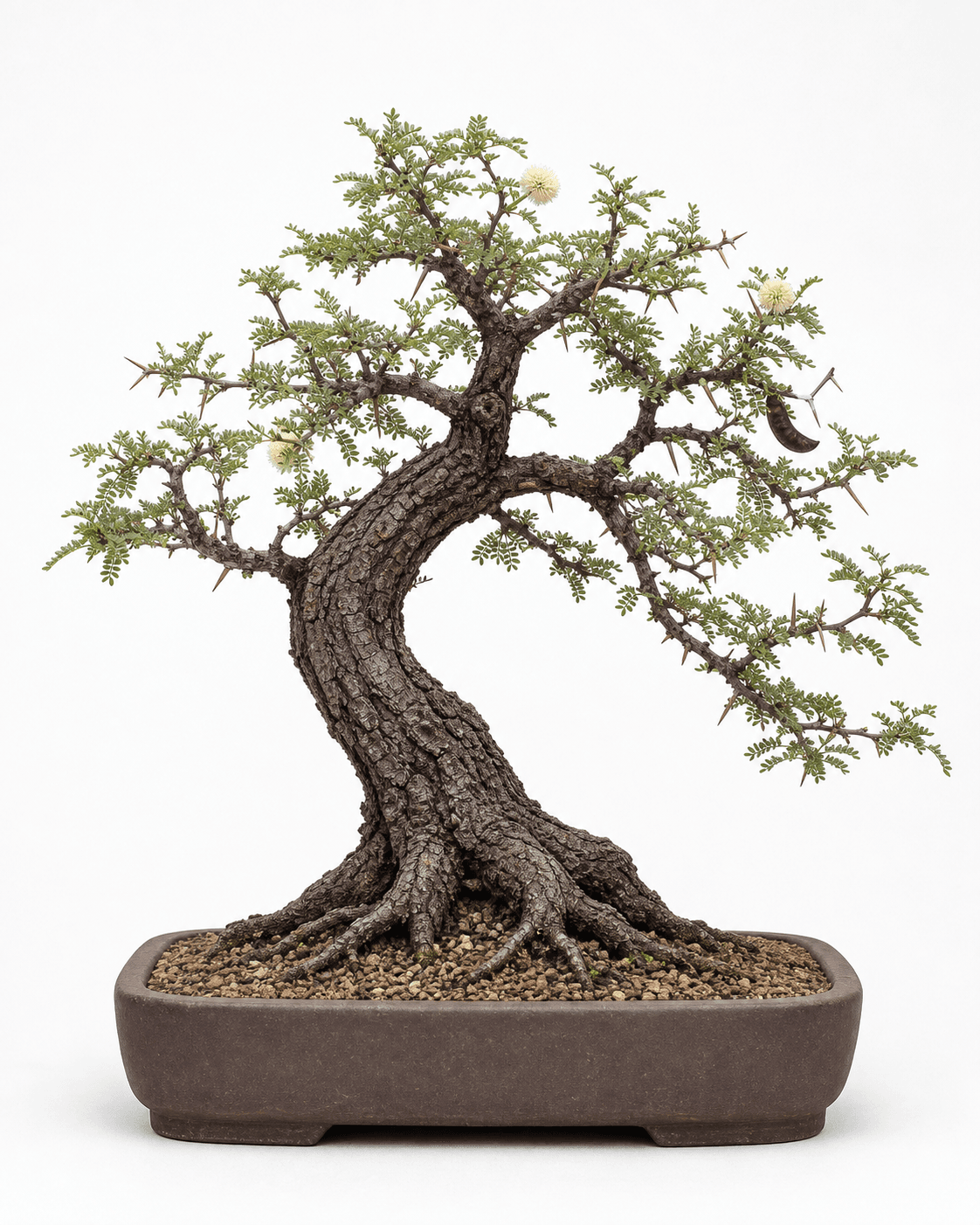
Texas ebony bonsai care starts with full sun, warm active growth, and a dryland tropical calendar. Ebenopsis ebano is a thorny Fabaceae shrub or small tree from southeastern Texas into Mexico, with tiny compound leaflets, dark dense wood, fragrant pale flowers, and woody pods.
Treat Texas ebony as Broadleaf > Tropical in EntGrove, with extra attention to root oxygen, thorn management, clip-and-grow pruning, and winter protection outside warm climates. Let strong shoots extend before cutting back, avoid working the roots and canopy hard in one session, and protect container roots before cold nights arrive.
The local Mirai corpus has no dedicated Texas ebony file. This guide transfers Mirai tropical, Brazilian rain tree, dwarf powderpuff, compound-leaf, watering, soil, repotting, wiring, propagation, energy, and design method transparently, while Kew, GBIF, USDA, Lady Bird Johnson Wildflower Center, and public summaries ground taxonomy, range, labels, and morphology.
Updated June 14, 2026. Written by EntGrove Editorial. Last verified June 14, 2026.
Care fingerprint
Read the species through its shared care pattern.
Treat indoor culture as a light-management problem first; prune and repot when the tree is actively growing and warm enough to recover. Use this as the starting point before local conditions and tree strength refine the calendar.
Read the foliage first
Broadleaf stress usually shows in leaf color, leaf size, wilt, scorch, or delayed hardening before it becomes a branch problem.
Match work to dormancy
Deciduous, evergreen, tropical, succulent, and flowering broadleaf trees recover on different calendars.
Protect fine roots
Root work should preserve enough active fine roots for the tree to rehydrate quickly after the operation.
Care cadence
The calendar starts with the tree's seasonal state.
Placement
Timing: Grow in full sun during warm weather, with a gradual transition from greenhouse or indoor conditions. Protect before cold nights stall metabolism.
Watch for: Large soft leaflets, long internodes, folded or stressed foliage after abrupt exposure, cold drafts, and pots that stay wet in shade.
Bonsai Mirai LibraryKew POWO: Ebenopsis ebanoWatering
Timing: Water deeply when the mix is ready during active growth, then wait for oxygen to return. Reduce water sharply in cool protection or after leaf drop.
Watch for: Yellowing in wet soil, sour organic media, folded leaflets in heat, dry pockets in old root cores, and watering by calendar.
Bonsai Mirai LibraryFeeding
Timing: Feed during active extension and strong light. Use lighter fertilizer after repotting, during refinement, or when the tree is heat-stressed.
Watch for: Coarse internodes from heavy nitrogen, weak pale growth from underfeeding, and fertilizer applied before new roots or leaves confirm recovery.
Bonsai Mirai LibraryPruning
Timing: Let shoots extend and harden, then cut back to a directional bud, internode, or branch fork. Preserve some tip growth after heavy cuts to keep sap moving.
Watch for: Shearing the crown into a hedge, cutting every runner on a weak tree, removing all foliage around fresh wounds, and leaving thorns where they block wire or handling.
Bonsai Mirai LibraryBonsai Mirai / AsymmetryLeaflet work
Timing: Use partial leaflet reduction only on strong refined trees after a flush hardens. Keep foliage on branches that need thickening, healing, or recovery.
Watch for: Full defoliation during development, stripping weak branches, and expecting leaf work to replace sunlight and mature roots.
Bonsai Mirai LibraryRepotting
Timing: Repot after nights are reliably above about 60 F / 16 C. In cold-winter regions, late spring to early summer is usually safer than early spring.
Watch for: Bare-rooting a leafed tree, combining heavy root work with heavy top reduction, burying the crown, and leaving an old anaerobic nursery core untouched forever.
Bonsai Mirai LibraryWiring
Timing: Set trunk and primary branches while wood is still flexible, then inspect often. Clip-and-grow should do much of the secondary and tertiary work.
Watch for: Wire bite on fast warm growth, brittle older branches, thorns under wire, and bends that ignore the natural dryland trunk rhythm.
Bonsai Mirai LibraryBonsai Mirai / AsymmetryWinter protection
Timing: Move the tree into bright protection before cold nights create stalled roots. Keep it warm, ventilated, and on a slower watering cycle.
Watch for: Routine summer watering indoors, cold root balls, leaf drop followed by panic feeding, mites or scale in stale rooms, and pruning during cold recovery.
Bonsai Mirai LibraryPest and disease inspection
Timing: Inspect after import, during winter storage, after warm flushes, and whenever leaflets become sticky, pale, webbed, or distorted.
Watch for: Scale, mites, aphids, mealybug, seed weevils in pods, root rot, fungal spots in stagnant air, and thorn wounds that invite dieback.
Bonsai Mirai LibraryPublic species summary: Ebenopsis ebanoSpecies guide
Apply the species profile before copying another tree's calendar.
At a glance
Texas ebony is a warm dryland legume with tiny leaflets and slow, durable character.
Use this page for Ebenopsis ebano, the Texas ebony of South Texas and Mexico. Kew accepts the name, places it in Fabaceae, and lists the native range from southeastern Texas to Mexico. Kew POWO: Ebenopsis ebano
Older labels matter because bonsai and native-plant sources may still say Pithecellobium ebano, Pithecellobium flexicaule, Chloroleucon ebano, Mimosa ebano, or Acacia flexicaulis. GBIF also lists Texas ebony and ebony blackbead among common labels. GBIF: Ebenopsis ebano
EntGrove places Texas ebony in Broadleaf > Tropical. The practical care pattern is full sun, warm active growth, oxygen-rich roots, patient pruning, and frost protection in a bonsai container. Bonsai Mirai LibraryKew POWO: Ebenopsis ebano
The source-depth caveat is explicit. The local Mirai corpus has no dedicated Texas ebony file, so this page transfers only relevant tropical, thorny legume, compound-leaf, water, soil, root, wiring, energy, propagation, and design method. Bonsai Mirai LibraryGBIF: Ebenopsis ebano
Habitat
Texas ebony comes from hot thornscrub and dry shrubland with high light.
Kew describes Ebenopsis ebano as a shrub or tree that grows primarily in desert or dry shrubland biomes. Its native range reaches from southeastern Texas into multiple Mexican regions. Kew POWO: Ebenopsis ebano
Public summaries describe the tree in Tamaulipan matorral, dry forest, and warm coastal-plain settings, with dense foliage, paired spines, dark bark, small compound leaflets, pale flowers, and woody pods. Public species summary: Ebenopsis ebanoLady Bird Johnson Wildflower Center: Texas ebony
Care should copy the habitat pattern without starving the pot: high light, heat, deep watering, fast oxygen return, and protection from cool wet soil. Bonsai Mirai LibraryKew POWO: Ebenopsis ebano
Design should honor dryland density and age. The best images read as thornscrub trees with compact shade, dark wood, hard pods, paired spines, and a base that suggests weather rather than lush tropical softness. Bonsai Mirai / AsymmetryPublic species summary: Ebenopsis ebano
Reading
Read Texas ebony by light response, leaflet scale, thorn rhythm, and root oxygen.
A strong Texas ebony shows compact leaflets, firm green extension, visible buds near old nodes, quick drying after water, and a root crown that stays dry between waterings. Bonsai Mirai Library
A weak tree shows oversized soft leaflets, stalled shoots, yellowing in wet soil, dropped leaves after cold stress, pests on protected foliage, or dieback behind recent cuts. Bonsai Mirai Library
Development means building trunk, base, primary branches, and root maturity in a larger container. Refinement means shorter extensions, selected thorns, smaller leaflets, repeated cutback, and clean twig transitions. Bonsai Mirai LibraryBonsai Mirai / Asymmetry
Compound leaves require restraint. Mirai compound-leaf guidance supports partial leaflet reduction on strong trees, but the tree still needs foliage to feed wounds, roots, and new buds. Bonsai Mirai Library
Pruning
Build Texas ebony with extension and cutback, then simplify thorns for handling and design.
Let shoots extend during warm active growth, then cut back after the flush hardens. Directional pruning should select the bud or branch fork that continues the intended line. Bonsai Mirai Library
Texas ebony carries paired thorns along shoots. Keep thorns where they add species character, and remove or shorten them where they interfere with wiring, branch placement, or safe handling. Public species summary: Ebenopsis ebanoBonsai Mirai Library
Avoid treating pruning as hedge clipping. Choose the trunk line, defining branch, and apex first, then let each cut support taper, movement, light penetration, and smaller branch structure. Bonsai Mirai / Asymmetry
After a large cut, keep enough foliage nearby to pull water and sugars through the wound. Mirai tropical and rain-tree method warns against combining heavy defoliation with major cuts on warm broadleaf material. Bonsai Mirai Library
Repotting
Repot Texas ebony only in warmth and protect the root crown from stale wet soil.
Repot after nights are consistently around or above 60 F / 16 C. Warm roots drive recovery, while cool wet aftercare turns root work into a rot problem. Bonsai Mirai Library
Avoid bare-rooting a leafed Texas ebony. Leave part of the root mass intact, reduce old nursery soil in stages, and keep foliage available to maintain transpiration while new roots form. Bonsai Mirai Library
If the original soil is fine, black, sour, or water-resistant, correct it over more than one repot. The goal is a root system that accepts water evenly and then returns to oxygen quickly. Bonsai Mirai Library
Set the root crown slightly proud. Burying the bark and thorny base under wet soil increases crown-rot risk and hides one of the best visual features of the species. Bonsai Mirai LibraryBonsai Mirai / Asymmetry
Soil and pot
Use a fast granular mix and a restrained pot that lets the dark trunk lead.
A development mix can start near equal parts akadama, pumice, and lava, with a small organic or bark fraction only where heat and watering demand require it. In humid climates, keep the mix more oxygen-forward. Bonsai Mirai Library
For refined trees, increase the water-retentive mineral fraction only if the pot still dries and breathes predictably. Texas ebony should not sit in houseplant peat or decomposed nursery mud. Bonsai Mirai Library
Pot pairing should stay quiet: unglazed brown, warm gray, muted green, or a dark restrained glaze can support the bark, leaflets, pods, and thornscrub image. Bonsai Mirai / Asymmetry
Use ovals, rectangles, and shallow training containers only after the roots are ready. A too-small show pot slows trunk building and makes summer water management harder. Bonsai Mirai LibraryBonsai Mirai / Asymmetry
Climate
Grow Texas ebony like a sun-loving warm tree, then engineer protection when the pot gets cold.
In South Texas, the Gulf Coast, and hot subtropical collections, Texas ebony can spend a long warm season outdoors and may tolerate repeated pruning cycles after flushes harden. Kew POWO: Ebenopsis ebanoBonsai Mirai Library
In cold-winter regions, treat it as an outdoor warm-season tree with indoor or greenhouse winter protection. Move it before cold nights stall roots, then reduce water and stop major work. Bonsai Mirai Library
In hot arid regions, protect recently repotted or shipped trees from abrupt afternoon exposure, but move strong established trees into full sun for compact growth. Bonsai Mirai Library
In humid regions, fungus and root oxygen become the main constraints. Open the canopy, avoid stale organic soil, and leave enough space in the pot for thorough watering without saturation. Bonsai Mirai Library
Pests
Most Texas ebony problems trace back to weak indoor culture, stale soil, or hidden pests in dense foliage.
Scale, mites, aphids, and mealybug are the pests to check first on protected tropical broadleaf bonsai. Leaflet undersides, thorn bases, and branch crotches deserve close inspection. Bonsai Mirai Library
Public summaries note seed-pod insects on Texas ebony. Remove old pods on small bonsai when seed display is no longer needed, and quarantine newly acquired material before placing it near other legumes. Public species summary: Ebenopsis ebano
Root rot is the cultural disease to prevent. Sour soil, black roots, limp foliage in wet media, and a soft crown mean styling should stop until drainage, warmth, and watering are fixed. Bonsai Mirai Library
Fungal leaf spots usually follow dense shade, stale winter air, or overhead wetting in protected rooms. Thin congested shoots, increase airflow, and water the soil rather than the foliage. Bonsai Mirai Library
Wiring
Wire young flexible growth, but let clip-and-grow carry most refinement.
Apply structural wire while shoots and young branches still bend cleanly. Older dryland legume wood can crack, so major trunk movement belongs early in development. Bonsai Mirai Library
Check wire frequently during warm growth. Compound-leaf tropicals can swell quickly, and wire scars on dark bark can remain visible. Bonsai Mirai Library
Remove thorns that sit under coils or at hand-pressure points. A thorn trapped beneath wire can focus pressure and damage the bark you are trying to preserve. Public species summary: Ebenopsis ebanoBonsai Mirai Library
Use guy wires, pruning, leader changes, and planting angle where a hard bend would fight the wood. The design should look like a durable thornscrub tree rather than a wired vine. Bonsai Mirai / Asymmetry
Propagation
Use seed, cuttings, and air layers with patience and label discipline.
Seed is the clearest way to preserve species identity when the parent tree is known. Scarification or other seed-coat handling may be needed with hard legume seeds, so use a source-specific protocol rather than guessing. GBIF: Ebenopsis ebanoPublic species summary: Ebenopsis ebano
Cuttings should be attempted in warmth after active growth resumes. Mirai propagation method favors perlite, reduced light, limited foliage, and no fertilizer until roots establish. Bonsai Mirai Library
Air layering can create designed pre-bonsai from branches that already have movement, thorns, and scale. Start only after nights stay above 60 F / 16 C and avoid disturbing new roots when separating. Bonsai Mirai Library
Grafting can be useful for missing branches or better roots, but it should be done on vigorous trees with strong heat, clean cuts, firm compression, and aftercare that protects water balance. Bonsai Mirai Library
Buying
Buy Texas ebony for verified identity, trunk age, small leaflets, and healthy roots.
Look for labels such as Texas ebony, Ebenopsis ebano, ebony blackbead, ebano, Pithecellobium ebano, or Pithecellobium flexicaule. Keep Diospyros ebony, Brazilian rain tree, tamarind, and acacia labels separate. Kew POWO: Ebenopsis ebanoGBIF: Ebenopsis ebano
Good material has a firm base, dark bark or developing bark texture, small leaflets in full sun, interior buds, healthy thorns, and a trunk line that reads before pruning. Bonsai Mirai / AsymmetryPublic species summary: Ebenopsis ebano
Nursery plants may hide old organic soil under dense thorny foliage. Inspect drainage, root crown firmness, trunk taper, and branch placement before paying for foliage volume. Bonsai Mirai LibraryLady Bird Johnson Wildflower Center: Texas ebony
Collected or habitat-origin plants should be legal, documented, and already recovered. For most growers, seed-grown, cutting-grown, or nursery-grown material is the practical and ethical route. USDA PLANTS: Ebenopsis ebanoBonsai Mirai Library
Troubleshooting
Fix sunlight, warmth, and root oxygen before adding more technique.
Leaflets enlarge and internodes stretch: increase light gradually, reduce excess nitrogen, and let the roots mature before relying on leaflet cutting. Bonsai Mirai Library
Leaflets fold or drop in heat: check water timing, root health, and recent sun exposure. A short stress response differs from chronic weakness, so read the whole tree. Bonsai Mirai Library
Leaves yellow in wet soil: pause fertilizer, warm the root zone, improve drainage, and wait for predictable drying before pruning. Bonsai Mirai Library
Branches die back after pruning: leave more internode length, preserve nearby foliage, seal significant cuts where rot pressure is high, and stop full defoliation on weak trees. Bonsai Mirai Library
Wire marks appear: remove wire immediately, switch to pruning or guy wires, and inspect faster during warm growth. Bonsai Mirai Library
Identity is unclear: compare the label against Ebenopsis ebano, Pithecellobium flexicaule, Brazilian rain tree, tamarind, acacia, and Diospyros ebony before applying species-specific advice. Kew POWO: Ebenopsis ebanoGBIF: Ebenopsis ebano
Design
Style Texas ebony as a compact dryland tree with shadow, thorns, and quiet age.
Start with the base and trunk direction. Texas ebony should communicate heat, dense shade, hard wood, and dryland endurance before it communicates technique. Bonsai Mirai / AsymmetryKew POWO: Ebenopsis ebano
Choose a defining branch that creates asymmetry without hiding the trunk. The small leaflets allow dense foliage, but the front still needs windows into bark, branch exits, and thorn rhythm. Bonsai Mirai / Asymmetry
Use the apex to complete the dryland silhouette. Rounded broadleaf crowns, leaning informal uprights, clumps, and low thornscrub images often fit better than flat pad architecture. Bonsai Mirai / Asymmetry
Deadwood should stay restrained. Dark durable wood can suggest age, but large carved features can overpower the small leaflets and make the species look like a conifer imitation. Bonsai Mirai / Asymmetry
Forms
Most Texas ebony variation is label history, seed source, and leaf scale.
Use one parent page for now. The core labels are Ebenopsis ebano, Texas ebony, ebony blackbead, ebano, Pithecellobium ebano, Pithecellobium flexicaule, Chloroleucon ebano, and Acacia flexicaulis. Kew POWO: Ebenopsis ebanoGBIF: Ebenopsis ebano
Select bonsai material by observable traits: small leaflets, short internodes, good trunk movement, low branches, clean roots, and a base that can anchor a compact dryland image. Bonsai Mirai / Asymmetry
Keep unrelated ebony names separate. Diospyros ebony, ebony persimmon, and tropical blackwood names do not share this page, care group, or thorny Fabaceae structure. Kew POWO: Ebenopsis ebanoGBIF: Ebenopsis ebano
History
Texas ebony is a native dryland tree that became a niche bonsai subject because the leaflets are naturally small.
Kew records Ebenopsis ebano as first published under its current accepted name in 1996, following a long history of earlier Mimosa, Pithecellobium, Chloroleucon, and Acacia labels. Kew POWO: Ebenopsis ebano
The species is tied to South Texas and Mexican dryland plant communities, where dense foliage, paired thorns, dark wood, flowers, and pods make it visually distinct from softer tropical bonsai material. Kew POWO: Ebenopsis ebanoLady Bird Johnson Wildflower Center: Texas ebony
In bonsai, the best Texas ebony material usually shows verified identity, full-sun compact growth, healthy roots, a strong base, and a design that uses the species own dryland character. Bonsai Mirai / AsymmetryBonsai Mirai Library
Species questions
Answer the beginner questions before styling.
Can Texas ebony be grown as bonsai?
Yes. Texas ebony can be trained as bonsai when it receives full sun, warm active growth, oxygen-rich soil, careful watering, and frost protection in a container.
Is Texas ebony an indoor bonsai?
Texas ebony should grow outdoors in strong light whenever weather allows. Indoor culture is mainly winter protection and needs bright supplemental light, warmth, airflow, and reduced watering.
When should Texas ebony be repotted?
Repot Texas ebony only in reliable warmth, usually late spring to early summer in cold-winter regions. Avoid bare-rooting a leafed tree and avoid pairing heavy root work with heavy top pruning.
How often should I water Texas ebony bonsai?
Water deeply during active growth when the granular mix is ready, then let oxygen return before watering again. Water much less when the tree is cool, indoors, weak, or newly repotted.
Does Texas ebony need full sun?
Full sun is the baseline for compact leaflets and short internodes. Acclimate protected or shipped trees gradually before exposing them to hot afternoon sun.
Should Texas ebony be defoliated?
Use partial leaflet work only on strong refined trees. Full defoliation slows development and can weaken recovery after pruning, wiring, or root work.
How do I handle Texas ebony thorns?
Keep thorns that add character and remove or shorten thorns that interfere with wiring, branch placement, or safe handling. Do thorn cleanup while the tree is healthy and active.
What soil works for Texas ebony bonsai?
Use a granular tropical broadleaf mix that drains freely and returns oxygen quickly. Akadama, pumice, lava, and a modest organic fraction can be adjusted by climate and pot size.
Is Texas ebony the same as Brazilian rain tree?
Texas ebony is Ebenopsis ebano, while Brazilian rain tree is usually Chloroleucon tortum. Both are warm compound-leaf legumes, but identity, growth speed, thorns, bark, and range differ.
Why are my Texas ebony leaves turning yellow?
Yellowing usually points to stale wet roots, weak light, cold stress, pests, or fertilizer added before recovery. Check drainage, warmth, root health, and light before pruning more.
Sources
Species advice needs source discipline.
Next decisions
Plan the operation before copying the calendar.
A good care note for Texas ebony records the tree's stage, the work done, and the aftercare used. That record matters more than a month-name rule.
Related species
Compare nearby trees before transferring advice.
Ficus retusa / Indian laurel
Ficus microcarpa
Tigerbark ficus
Ficus microcarpa 'Tigerbark'
Willow-leaf ficus
Ficus salicaria
Benjamin fig
Ficus benjamina
Ginseng ficus
Ficus microcarpa 'Ginseng'