
Species guide
Bald Cypress Bonsai Care
Taxodium distichum
Bald cypress bonsai is an outdoor deciduous conifer that wants strong light, abundant water, and a root system with air. Grow Taxodium distichum by bud swell, shoot hardening, leaf drop, and winter dormancy rather than by pine, juniper, or tropical rules.
The local Bonsai Mirai corpus has direct Taxodium coverage. The core method is pre-flush spring pruning, ruby-red post-flush refinement, partial defoliation only on strong trees, spring root work with root-mass continuity, and moisture-retentive akadama for refined roots.
This is a good beginner tree for an outdoor grower who can water heavily and protect the pot in winter. It is a poor indoor tree, and standing water should be treated as an emergency summer buffer rather than the default for refined container culture.
Updated July 12, 2026. Written by EntGrove Editorial. Last verified July 12, 2026.
Care fingerprint
Read the species through its shared care pattern.
Use bud swell, needle hardening, and autumn color as signals; root work is seasonal and refinement depends on soft new extension. Use this as the starting point before local conditions and tree strength refine the calendar.
Do not prune like a pine
Elongating conifers extend from buds and shoots, so candle-cutting assumptions can remove the exact growth the tree needs.
Preserve interior growth
Spruce, fir, hemlock, cedar, redwood, cypress, and larch all become harder to design when interior buds are shaded out.
Keep recovery cool and steady
Many elongating conifers respond best when roots stay evenly moist, oxygenated, and protected from hot dry swings.
Care cadence
The calendar starts with the tree's seasonal state.
Placement
Timing: Grow outdoors in full sun through active growth. Add afternoon shade or wind protection only when fresh foliage, shallow pots, or post-work roots cannot keep pace with heat.
Watch for: Sparse shade growth, foliage scorch above roughly 95 F, dry hot wind, and winter roots exposed like landscape roots.
NC State ExtensionBonsai Mirai LibraryWatering
Timing: Keep the root zone consistently moist in leaf. Water thoroughly, then let oxygen return through the soil column.
Watch for: Dry root balls, stagnant trays, sour anaerobic pockets, roots escaping into water basins, and coarse organic soil that stays stale.
Bonsai Mirai LibraryNC State ExtensionFertilizer
Timing: Feed strongly enough to build a first flush before partial defoliation, then feed again so the second flush hardens before leaf drop. In temperate regions, taper heavy nitrogen in late summer.
Watch for: Weak first flush, fertilizer on stressed roots, summer heat when water uptake dominates growth, and excessive nitrogen after about mid-August in northern benches.
Bonsai Mirai LibrarySpring pruning
Timing: Prune before the spring flush, when buds swell into small green points and before fronds open.
Watch for: A missed window after buds spend energy, cuts that ignore branch hierarchy, and dormant buds rubbed off after they already elongated.
Bonsai Mirai LibraryEarly-summer refinement
Timing: Prune and partially defoliate only after the first flush hardens and new stems show the ruby-red phloem cue.
Watch for: Soft green shoots, weak lower branches, routine full defoliation, late work that cannot harden, and over-cleaning the second flush.
Bonsai Mirai LibraryRepotting
Timing: Use the spring green-bud window for major root work, before full fronding. Repot for percolation, coarse-root return, old soil, or design need.
Watch for: Bare-rooting, removing all microbial continuity, thick roots without secondary roots, water bypassing the core, and root aphid pockets.
Bonsai Mirai LibraryWiring
Timing: Set structural branches when water movement makes tissue more flexible. Use adequate wire in one confident bend, then monitor quickly through warm growth.
Watch for: Under-gauged wire, repeated correction, brittle dry branches, wire bite, and wiring newly ruby-red shoots immediately after partial defoliation.
Bonsai Mirai LibraryWinter rest
Timing: Let foliage color and drop outdoors, then protect the pot from severe freeze, drying wind, and repeated freeze-thaw.
Watch for: Warm indoor storage, dry dormant roots, branch loss after frozen shallow pots, and fall pruning after leaf drop.
NC State ExtensionUniversity of Kentucky ExtensionBonsai Mirai LibraryPests and disorders
Timing: Inspect active foliage, root masses during repotting, and weak trees after heat, drought, or stagnant soil.
Watch for: Spider mites, bagworms, twig blight, chlorosis in alkaline conditions, cypress looper, twig gall midge, root aphids, and sour anaerobic soil.
NC State ExtensionUniversity of Kentucky ExtensionUF/IFAS Cypress looperUF/IFAS Cypress twig gall midgeBonsai Mirai LibrarySpecies guide
Apply the species profile before copying another tree's calendar.
At a glance
Bald cypress is a wetland deciduous conifer with a precise bonsai calendar.
Taxodium distichum is a Cupressaceae conifer that drops its soft needle-like foliage in fall. In bonsai, it belongs in Elongating Species > Deciduous Conifer beside pond cypress, dawn redwood, larch, and golden larch. Kew POWONC State Extension
The care target is strong outdoor light, high water availability, oxygenated roots, and seasonal dormancy. Refined work follows two main windows: spring bud swell before fronds open, then early summer after the first flush turns ruby red and begins to harden. Bonsai Mirai Library
A beginner can succeed with bald cypress if the tree lives outside and water is reliable. Refinement asks for more judgment: partial defoliation only on strong hardened growth, careful winter root protection, and root work based on percolation rather than habit. Bonsai Mirai LibraryNC State Extension
Wild habitat
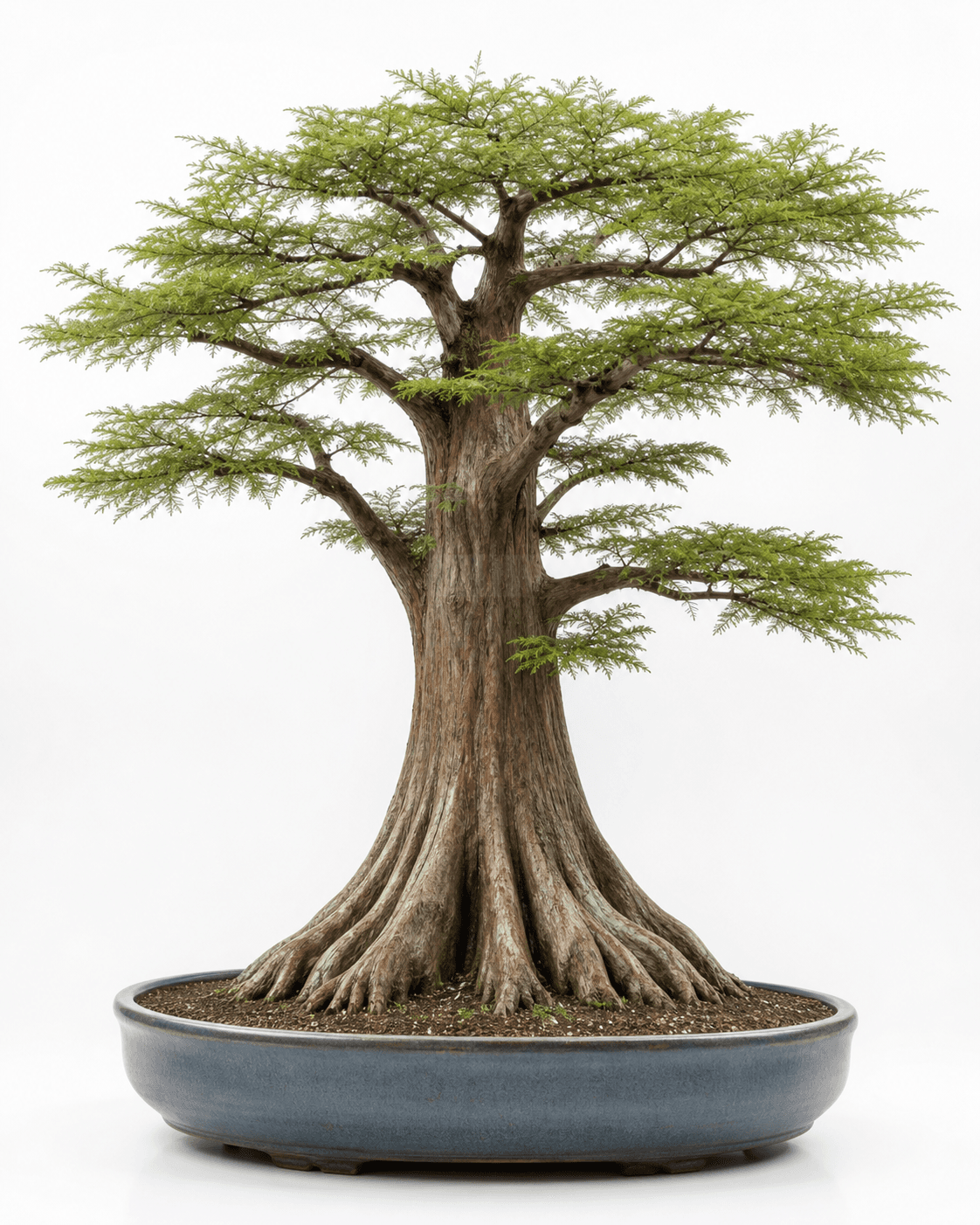
Swamps, floodplains, and buttressed trunks explain the care and the image.
Kew records bald cypress from eastern-central and southeastern North America into Guatemala. NC State and Kentucky Extension describe the familiar U.S. tree of swamps, bayous, rivers, floodplains, and low wet ground. Kew POWONC State ExtensionUniversity of Kentucky Extension
That ecology creates two bonsai truths at once. The tree can use much more water than most container trees, yet refined roots still need oxygen. Mirai Taxodium repotting guidance warns that long-term submersion in a bonsai container can defeat the fine root system needed for ramification. Bonsai Mirai LibraryNC State Extension
The design translation is just as important. Old bald cypress grows as tall vertical trunks with massive bases, reduced lower branches, and broad flat tops. A bonsai that keeps that wetland story reads more honestly than a generic conifer triangle. Bonsai Mirai LibraryNational Bonsai Foundation
Reading the tree
Read buds, shoot color, water movement, and branch hierarchy.
The first signal is spring bud swell. Mirai places spring pruning and major root work before the flush opens, while the buds are visible and the stored energy is still available for roots and new shoots. Bonsai Mirai Library
The second signal is the ruby-red color on new elongating stems. Local Taxodium guidance treats that color as the phloem-hardening cue for post-flush pruning and partial defoliation. Soft green shoots are still building vascular support. Bonsai Mirai Library
The third signal is strength distribution. Vigorous upper or water-conducting shoulder shoots can starve adjacent woody branches. Weak lower branches, green soft shoots, and recovering trunks should keep foliage while stronger areas are reduced. Bonsai Mirai Library
Development and refinement ask for different restraint. A field-grown or nursery tree may need strong extension, sacrifice growth, and a trunk chop plan. A refined tree needs shorter branch-order cuts, energy balancing, and enough foliage to harden a durable second flush. Bonsai Mirai Library
Pruning
Prune twice only when the tree gives the right signals.
The spring pass happens before the flush. Cut to branch hierarchy: longer primary branches, shorter secondaries, compact tertiaries, and enough length to place the next bifurcation where the design needs it. Bonsai Mirai Library
The early-summer pass waits for ruby-red hardened tissue. Mirai partial-defoliation guidance pairs pruning with foliar reduction because intact cypress fronds can keep producing enough sugar to suppress the desired second flush. Bonsai Mirai Library
Use partial defoliation as a strength-balancing tool. Strong apical areas can be reduced more, weak areas should be left alone, and routine full defoliation is a short path to long-term decline outside exceptional circumstances. Bonsai Mirai Library
Do not prune in fall after leaf drop. The local leaf-drop guidance separates fully deciduous broadleaf pruning from deciduous conifers such as Taxodium, larch, and dawn redwood, which can lose fine ramification to winter dieback after late wounds. Bonsai Mirai Library
Roots
Repot in spring and keep continuity in the root mass.
Use the green-bud spring window for aggressive root work. The goal is to enter before full frond demand, reduce thick coarse roots back to live secondary or tertiary roots, and finish cuts cleanly so new roots emerge from the cut surface. Bonsai Mirai Library
Preserve part of the root mass. Mirai forest-repotting guidance says deciduous conifers such as bald cypress, pond cypress, and larch should not be bare-rooted by default because microbial and root continuity matter in recovery. Bonsai Mirai Library
Repot on evidence. Surface roots mounding, poor percolation, thick roots circling the pot, sour pockets, old field soil, or weakening outer trunks in a forest are better signals than a fixed annual habit. Bonsai Mirai Library
Collected trees deserve extra patience. Local Taxodium guidance warns that large severed roots can take 6 to 8 years or more to compartmentalize, so design around existing nebari and avoid shortening major roots casually after collection. Bonsai Mirai Library
Soil and pot
Use moisture retention for refinement and oxygen for durability.
For refined Taxodium, Mirai repeatedly favors pure akadama or akadama-led culture in roughly 2 to 6 mm particles. The point is water and nutrient retention with a particle structure that scales roots finer over time. Bonsai Mirai Library
Developmental and post-collection trees can begin in a transitional medium with more organic content while field or nursery soil is reduced over several repots. Move toward uniform aggregate when roots and watering control are ready. Bonsai Mirai Library
A wide, shallow container fits the species better than a narrow deep pot once the root system is ready. It supports moisture, emphasizes vertical trunks, and gives a buttressed base visual room. Bonsai Mirai LibraryBonsai Mirai / Asymmetry
Surface moss should be managed, not allowed to become a black organic cap. Mirai forest-repotting guidance treats decomposed moss layers as a percolation and oxygen problem in older plantings. Bonsai Mirai Library
Climate
Landscape hardiness and bonsai-pot hardiness are separate numbers.
NC State lists Zones 4a to 9b, and Kentucky Extension says the landscape tree is winter hardy to Zone 4. A bonsai pot exposes roots to sharper cold, wind, and freeze-thaw swings than a floodplain tree experiences in the ground. NC State ExtensionUniversity of Kentucky ExtensionBonsai Mirai Library
In cold regions, keep the tree dormant and outdoor-cold, then protect the container. Mirai method commonly uses protection just above freezing for valuable Taxodium so the tree rests without unpredictable branch loss. Bonsai Mirai Library
In hot regions, water demand and heat stress can outrun the wetland reputation. Shallow containers can scorch around 90 to 100 F with hot wind, and fresh spring foliage is especially vulnerable near 95 F. Bonsai Mirai Library
In the Southeast, the ruby-red refinement window can arrive in late spring and may repeat with enough heat and daylight. In cooler maritime benches, the first window may be later, but missing it is safer than forcing late work that cannot harden. Bonsai Mirai Library
Pests and disease
Most problems follow stress, but Taxodium has real pest names to know.
NC State and Kentucky Extension describe bald cypress as generally durable, while still noting bagworms, spider mites, twig blight, chlorosis, and related site-stress problems. Container stress makes those ordinary issues more consequential. NC State ExtensionUniversity of Kentucky Extension
Cypress twig gall midge and cypress looper are regional Taxodium pests in UF/IFAS references. Gall symptoms, summer defoliation, and branch dieback should be identified locally before treatment. UF/IFAS Cypress twig gall midgeUF/IFAS Cypress looper
During repotting, look for root aphids as bright white cottony pockets. Mirai distinguishes those from duller beneficial fungal networks and treats sour soil odor as a low-oxygen warning sign. Bonsai Mirai Library
Prevention is cultural: strong light, enough water, oxygenated soil, clean root work, protected winter roots, and no repeated weak-tree defoliation. Bonsai Mirai Library
Wiring
Wire for structure, then let pruning build most of the detail.
Mirai Taxodium guidance favors enough wire for one controlled bend. Repeated correction with under-gauged wire causes more tissue damage than a single confident move with the right support. Bonsai Mirai Library
Developmental Taxodium can need heavy copper on primary structure, then smaller gauges for secondary and tertiary work. Use the number as context, not a formula, because branch size, water content, and risk change the choice. Bonsai Mirai Library
Timing matters. Branches are brittle before spring water movement, and newly ruby-red shoots after partial defoliation are still too tender for detail wiring. Mid-season water flow gives more bending margin. Bonsai Mirai Library
Check wire often. Bald cypress thickens quickly, and the right moment is a faint holding impression before permanent bite. Guy wires and padded pulls are useful for trunk spacing and branch angle in forests. Bonsai Mirai Library
Propagation
Seed, cuttings, air layers, and grafts each have a narrow role.
Seed is the broad horticultural route for ordinary bald cypress, and NC State lists seed among propagation methods. Seedlings are useful for forests and for building bases from the beginning. NC State Extension
Cuttings can be used for young material, but bonsai growers usually value air layering when a known trunk section or branch structure is worth preserving. Mirai places Taxodium air layers in late spring or early summer once the tree is energy-positive. Bonsai Mirai LibraryNC State Extension
When air layering, keep foliage above the ring strong because that foliage drives callus and roots. Prune and partially defoliate only below the layer when the layer itself needs maximum sugar production. Bonsai Mirai Library
Grafting is uncommon because bald cypress back-buds freely. Use it mainly for dwarf or cultivar scions, and schedule around spring bud swell when recovery energy is moving. Bonsai Mirai Library
Buying
Buy base, roots, label clarity, and a recoverable future.
Good material usually has a wide base, believable taper, low buds or branch options, strong root flare, and active extensions. For flat-top work, a straight lower trunk with enough height above the buttress is often an asset. Bonsai Mirai LibraryNational Bonsai Foundation
Nursery stock is common, but inspect for buried nebari, coarse circling roots, old field soil, weak interior buds, and grafted or cultivar tags. A wide box can be a better first container than a finished bonsai pot. Bonsai Mirai Library
Collected wetland material requires permission, ethics, and a long recovery plan. Large roots cut at collection shape the design for years, and follow-up root shortening can slow compartmentalization. Bonsai Mirai Library
Confirm the label. Kew recognizes ordinary Taxodium distichum plus accepted varieties for pond cypress and Montezuma cypress. Kentucky Extension notes that pond cypress has long circulated under Taxodium ascendens, so foliage and source should support the tag. Kew POWOUniversity of Kentucky Extension
Troubleshooting
Diagnose by symptom, then correct water, roots, timing, or strength.
Symptom: fronds dry, brown at tips, or collapse in summer. Likely cause: shallow-pot drought, hot wind, salt-heavy water, or fresh foliage above its heat margin. Fix: water deeply, cool the pot, reduce wind, and reassess water quality. Bonsai Mirai Library
Symptom: sour smell, black muck, or weak growth despite wet soil. Likely cause: anaerobic pockets, decomposed organic soil, or stagnant water. Fix: restore percolation, plan spring root work, and stop treating wetness as the whole solution. Bonsai Mirai Library
Symptom: no second flush after pruning. Likely cause: cutting soft green shoots, working too late for daylight, or pruning without enough partial defoliation. Fix: wait for ruby-red hardened tissue next time and leave weak areas untouched. Bonsai Mirai Library
Symptom: lower branch dies after a strong upright shoot appears at its shoulder. Likely cause: the water sprout captured the pathway. Fix: remove shoulder and crotch shoots early in refinement, while preserving growth needed for recovery. Bonsai Mirai Library
Symptom: yellow foliage or poor color in alkaline conditions. Likely cause: chlorosis or site chemistry stress noted by extension sources. Fix: check water, substrate, fertilizer, and local extension guidance before applying pest controls. University of Kentucky ExtensionNC State Extension
Design
Design from the wetland base and the mature flat-top crown.
Start with base, trunk line, defining branch, and apex. Bald cypress power usually lives in the swollen base, vertical trunk, bark, root flare, and crown architecture rather than in dramatic branch deadwood. Bonsai Mirai LibraryBonsai Mirai / Asymmetry
Mature design logic points up and out. Mirai Taxodium guidance keeps useful verticals for flat-top building, removes shoulder shoots that steal strength, and uses upward branch arcs rather than alpine down-swept gestures. Bonsai Mirai Library
The National Bonsai Foundation documents Vaughn Banting moving a museum bald cypress away from an earlier formal upright image toward a flat-top style after studying mature Southern trees. That public history makes flat-top design a sourced bonsai language, not a gimmick. National Bonsai Foundation
Forest designs should vary trunk girth, height, spacing, and planes. Mirai forest guidance also stresses one root system visually: roots should look as if the grove grew together from seed in the same wetland. Bonsai Mirai Library
Treat deadwood with restraint. Domestic Taxodium branch deadwood degrades quickly under bonsai irrigation, while rugged bark, buttress, and crown shape carry the stronger species signal. Bonsai Mirai Library
Forms
Taxodium labels matter more than named cultivars for most bonsai growers.
Kew accepts Taxodium distichum and lists accepted infraspecifics including var. distichum, var. imbricarium, and var. mexicanum. That means ordinary bald cypress, pond cypress, and Montezuma cypress are close enough to compare, while still deserving separate care notes. Kew POWO
Pond cypress labels may appear as Taxodium ascendens, and Montezuma cypress labels may appear as Taxodium mucronatum. Use foliage, habit, source, and range notes before copying a schedule from one Taxodium to another. Kew POWOUniversity of Kentucky Extension
Landscape cultivars include weeping, narrow, feathery, and columnar forms in extension lists. For bonsai, choose by base, branch placement, foliage scale, and health before paying for a cultivar name. NC State ExtensionUniversity of Kentucky Extension
Dwarf forms such as Peve Minaret can be useful, but Mirai notes that Taxodium back-budding and grafting options already give ordinary material plenty of design range. Bonsai Mirai Library
History
The modern bonsai story is North American wetland identity.
Bald cypress is a native North American tree whose strongest bonsai identity comes from its own ecology: swamp habitat, buttressed bases, copper fall color, and old flat-top crowns. NC State ExtensionNational Bonsai Foundation
The National Bonsai Foundation spotlight on the Banting bald cypress documents a tree in training since 1972 and explains how the flat-top image became a serious stylistic direction through Vaughn Banting and later museum stewardship. National Bonsai Foundation
Mirai Taxodium work adds a current technical layer: physiological timing, ruby-red shoot cues, partial defoliation limits, akadama-based root refinement, and forest design grounded in ecosystem character. Bonsai Mirai LibraryBonsai Mirai / Asymmetry
Species questions
Answer the beginner questions before styling.
Is bald cypress a good beginner bonsai?
Yes, for an outdoor grower who can provide full sun, frequent water, and winter pot protection. The tree is vigorous and back-buds well, while refinement takes timing discipline.
Can bald cypress bonsai live indoors?
Treat it as an outdoor deciduous conifer. It needs strong light, seasonal growth, leaf drop, and winter dormancy. Warm indoor storage usually weakens roots and shoots.
Should bald cypress bonsai sit in water?
Use a water tray only as a hot-weather buffer when normal watering cannot keep up. Refined Taxodium roots still need oxygen, and stale permanent submersion can work against fine root ramification.
When should I repot bald cypress bonsai?
Repot in spring as green buds swell and before the fronds open. Repot because percolation, coarse roots, old soil, or design requires it, not because the calendar says another year passed.
When should I prune bald cypress bonsai?
Use two windows: pre-flush spring pruning, then early-summer pruning after the first flush shows ruby-red hardened stems. Avoid fall pruning after leaf drop.
Can I partially defoliate bald cypress?
Yes, on strong trees after the first flush hardens. Use it to balance strength and trigger a second flush. Avoid routine full defoliation, especially on weak trees or late in the season.
Can I wire bald cypress bonsai?
Yes. Use enough wire to set the branch in one controlled bend, then check often because Taxodium thickens quickly. Older dry branches and newly hardened shoots need extra restraint.
Will a bald cypress bonsai grow knees?
It can, especially in wet culture, but knees are not guaranteed. Chasing knees by forcing permanent submersion can compromise the root system and the design.
What style suits bald cypress bonsai?
Formal upright, informal upright, flat-top, and swamp forest styles all work. Older-looking material often suits a flat-top crown with a strong buttressed base and restrained lower branches.
How is bald cypress different from pond cypress?
They are close Taxodium relatives. Pond cypress is often narrower, finer, and sold under Taxodium ascendens or Taxodium distichum var. imbricarium labels. Confirm foliage and source before applying fine distinctions.
What soil is best for bald cypress bonsai?
Refined Taxodium responds well to akadama or akadama-led soil in roughly 2 to 6 mm particles. Developmental or collected trees may need staged transition out of organic field soil first.
Sources
Species advice needs source discipline.
Next decisions
Plan the operation before copying the calendar.
A good care note for Bald cypress records the tree's stage, the work done, and the aftercare used. That record matters more than a month-name rule.
Related species
Compare nearby trees before transferring advice.
European larch
Larix decidua
Japanese larch
Larix kaempferi
American / tamarack larch
Larix laricina
Alpine larch
Larix lyallii
Western larch
Larix occidentalis