
Species guide
Pond Cypress Bonsai Care
Taxodium distichum var. imbricarium
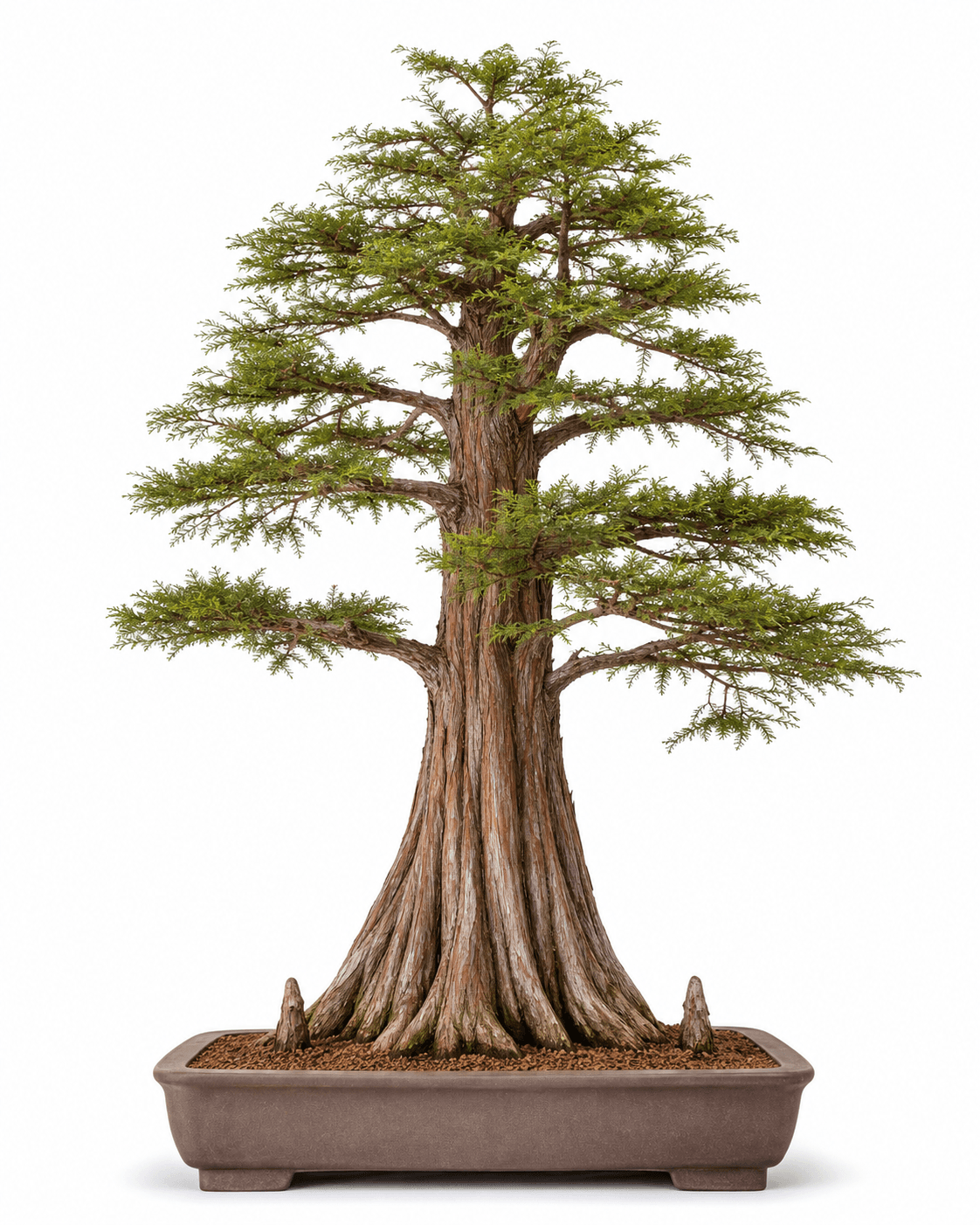
Pond cypress is the narrower, finer-textured Taxodium often sold as Taxodium ascendens, while Kew currently accepts it as Taxodium distichum var. imbricarium. Grow it outdoors in strong light with consistently moist, oxygenated roots, then time bonsai work from spring bud swell, early-summer reddish shoot maturity, and autumn needle drop.
The local Mirai corpus has direct pond cypress coverage through a forest repotting demonstration and Taxodium pruning files. The practical care is close to bald cypress, but the page keeps the pond cypress identity visible: rope-like appressed foliage, a more columnar habit, fewer knees, a southeastern wetland range, and slightly less cold tolerance in several horticultural sources.
Updated June 6, 2026. Written by EntGrove Editorial. Last verified June 6, 2026.
Care fingerprint
Read the species through its shared care pattern.
Use bud swell, needle hardening, and autumn color as signals; root work is seasonal and refinement depends on soft new extension. Use this as the starting point before local conditions and tree strength refine the calendar.
Note: Kew accepts Taxodium distichum var. imbricarium; Taxodium ascendens remains the common trade and UF/IFAS label, with Florida sources also using Taxodium distichum var. nutans.
Do not prune like a pine
Elongating conifers extend from buds and shoots, so candle-cutting assumptions can remove the exact growth the tree needs.
Preserve interior growth
Spruce, fir, hemlock, cedar, redwood, cypress, and larch all become harder to design when interior buds are shaded out.
Keep recovery cool and steady
Many elongating conifers respond best when roots stay evenly moist, oxygenated, and protected from hot dry swings.
Care cadence
The calendar starts with the tree's seasonal state.
Placement
Timing: Grow outdoors in full sun through the growing season, with afternoon protection only when a shallow pot overheats or spring foliage burns in extreme heat.
Watch for: Indoor display, weak shade growth, hot wind above roughly 95 F on fresh foliage, frozen exposed pots, and benches where reflected heat dries the root ball faster than watering can correct.
NC State ExtensionUF/IFAS ExtensionBonsai Mirai LibraryWatering
Timing: Water thoroughly during active growth and keep the root ball evenly moist. Let oxygen return after watering, even when the source tree comes from wetland habitat.
Watch for: Dry pockets, water bypassing an old core, sour anaerobic soil, roots escaping into a tray, or treating pond habitat as permission for permanent submersion.
Bonsai Mirai LibraryUF/IFAS ExtensionRepotting
Timing: Use spring bud swell for major root work. Refined forest plantings may go five or six years when drainage, vigor, and akadama structure remain sound.
Watch for: Surface roots mounding, poor percolation, thick roots circling the edge, weaker outer trunks in forests, sour pockets, and old field soil that needs staged removal.
Bonsai Mirai LibraryPruning
Timing: Prune once before spring flush if buds are swelling but unopened, then prune again in early summer when new stems show the reddish mature-growth signal.
Watch for: Cutting after buds have already spent spring energy, pruning soft green shoots before lignification, late-summer cuts that fail to harden, and uniform cuts that erase branch hierarchy.
Bonsai Mirai LibraryDefoliation and density
Timing: Use partial defoliation only on strong refined trees at the early-summer maturity cue, reducing strong areas to match weak areas.
Watch for: Routine full defoliation, stripping weak trunks in a forest, leaving crotch water sprouts to overpower built branches, and pruning after a repot-plus-exhibition stress year.
Bonsai Mirai LibraryWiring
Timing: Wire structural decisions at spring bud swell or when branches carry enough water to bend. Check often as active growth thickens.
Watch for: Brittle pre-flush twigs, wire bite, under-gauged wire that needs repeated bending, crushed buds, and branch angles that droop like alpine trees instead of rising from low wetland trunks.
Bonsai Mirai LibraryFertilizer
Timing: Feed strongly enough to build prunable extension before summer work, then support the second flush so it matures before leaf drop. Taper heavy nitrogen as late summer shortens.
Watch for: Weak second flushes, coarse growth from overfeeding a refined tree, fertilizer on impaired roots, and microbial inactivity visible as cakes that fail to break down.
Bonsai Mirai LibraryPest and disease checks
Timing: Inspect during active growth, especially after drought, heat, stress, or repeated defoliation in warm southeastern climates.
Watch for: Twig blight on stressed tips, cypress twig gall midge, cypress looper defoliation, caterpillars, leafrollers, root aphids, and stale wet soil that presents as a foliage problem.
UF/IFAS ExtensionUF/IFAS Cypress twig gall midgeUF/IFAS Cypress looperUSDA Forest Service FEISWinter rest
Timing: Let foliage color and drop normally, then keep the dormant tree outside with root-zone protection where the bonsai pot will freeze hard.
Watch for: Warm indoor storage, frozen-dry roots, fall leaf-drop pruning meant for broadleaf deciduous trees, and assuming landscape hardiness equals shallow-pot hardiness.
Bonsai Mirai LibraryNC State ExtensionOregon State Landscape PlantsSpecies guide
Apply the species profile before copying another tree's calendar.
At a glance
Pond cypress is a Taxodium bonsai with a narrow wetland character and confusing labels.
Kew accepts Taxodium distichum var. imbricarium and treats Taxodium ascendens as a synonym. UF/IFAS still publishes its horticultural profile under Taxodium ascendens, and Oregon State lists Taxodium ascendens and Taxodium distichum var. ascendens as synonyms under the accepted variety. Kew POWOUF/IFAS ExtensionOregon State Landscape Plants
For growers, the common name remains useful. Pond cypress usually means the smaller, narrower, more upright Taxodium with appressed awl-like foliage, southeastern wetland habitat, and slightly less cold tolerance than ordinary bald cypress in several horticultural summaries. UF/IFAS ExtensionNC State ExtensionOregon State Landscape Plants
EntGrove places pond cypress in Elongating Species > Deciduous Conifer beside bald cypress, dawn redwood, larch, golden larch, and Montezuma cypress. The working signals are bud swell, shoot extension, reddish stem maturity, autumn color, and spring root recovery. Bonsai Mirai LibraryKew POWO
Wild habitat
Its wild image is still water, low ground, and vertical trunks.
Kew places the variety in the southeastern United States, and USDA FEIS describes pond cypress as generally confined from southeastern Virginia to southern Florida and southeastern Louisiana. UF/IFAS describes it along stream edges and swampy ground where water stands. Kew POWOUSDA Forest Service FEISUF/IFAS Extension
The site context is low and wet. USDA FEIS describes cypress as usually restricted to wet muck, clay, or fine sand where moisture is abundant and fairly permanent, with most natural stands on flat or nearly flat topography below 100 feet above sea level. USDA Forest Service FEIS
UF/IFAS and Purdue both describe useful tolerance beyond wetland edges. Pond cypress can grow on dry or upland sites, and Purdue lists both drought tolerance and wet-soil tolerance, yet the best growth still points back to moist acidic roots. UF/IFAS ExtensionPurdue Arboretum Explorer
For care, translate wetland ecology into consistent water and root oxygen. Mirai forest-repotting guidance warns that bald and pond cypress can be drowned in bonsai containers when water-loving reputation turns into stale saturated culture. Bonsai Mirai Library
For design, translate habitat into vertical trunks, buttressed bases, narrow crowns, wetland groups, and shallow wide containers. The tree should read as a lowland cypress with vertical, swamp-edge character. Bonsai Mirai / AsymmetryUF/IFAS ExtensionUSDA Forest Service FEIS
Reading the tree
Read vigor through extension, root behavior, and which trunks are falling behind.
Mirai Taxodium guidance uses physiology rather than a fixed date. A spring tree is ready for structural pruning while buds are swelling and before the flush opens; after that push, the same work has missed the safest spring window. Bonsai Mirai Library
The early-summer signal is color and firmness in the new stem. When elongating shoots shift from soft green into ruby-red or straw-maturing tissue, phloem and bud formation have advanced enough for pruning and partial defoliation on strong trees. Bonsai Mirai Library
Forest plantings add another diagnostic. Mirai forest repotting lists surface roots mounding, weak percolation, organic buildup, thick roots circling the edge, and weaker outer trees as signs that the whole planting may need root work. Bonsai Mirai Library
Weak trees deserve recovery growth before refinement pressure. The local corpus notes that after repotting plus exhibition stress, bald or pond cypress should be allowed to grow freely so strength returns before another structural push. Bonsai Mirai Library
Pruning
Pond cypress ramification comes from extension, maturity, and precise cuts.
Use two main opportunities on a healthy tree: pre-flush spring pruning and early-summer pruning after the first flush matures. Mirai explicitly applies the same Taxodium strategy to Taxodium ascendens along with bald cypress and likely Montezuma cypress. Bonsai Mirai Library
Avoid soft pinching. Mirai pinching guidance for deciduous conifers says pinching arrests lignification, and soft growth that fails to lignify is shed in autumn. Let shoots extend, harden, and show useful buds before cutting. Bonsai Mirai Library
Cut length controls the next fork. Local Taxodium claims describe very short cuts often yielding one shoot, while moderate cuts more reliably produce two or more adventitious buds. Use longer primary cuts, shorter secondary cuts, and compact tertiary cuts to build taper. Bonsai Mirai Library
Keep useful vertical shoots when they help the flat-top and upper canopy. Mirai Taxodium guidance treats vertical growth as a design asset, while crotch and shoulder water sprouts still need timely removal when they steal strength from built woody branches. Bonsai Mirai Library
Roots
Repot to build fine roots and preserve oxygen.
The strongest pond cypress-specific root claim in the local corpus comes from a six-year-old pond cypress forest. Mirai describes refined Taxodium root systems in akadama as capable of scaling into fine ramification, then eventually reaching a tipping point where coarse roots return and need reduction. Bonsai Mirai Library
Spring bud swell is the safest major root-work signal. For a forest, lift the planting as a single root mass, protect the arrangement, and treat the composition as a unified living unit rather than separate trees to be reset casually. Bonsai Mirai Library
Never bare-root a deciduous conifer in this method. Mirai forest-repotting guidance says to preserve part of the root mass on Taxodium and larch, unlike fully deciduous broadleaf trees that can tolerate more complete soil removal. Bonsai Mirai Library
Root cuts should end at live branching roots. Drop-crotch heavy roots back to secondary or tertiary roots, clean up torn surfaces, and remove sour anaerobic pockets while preserving roots under any weaker tree in a group. Bonsai Mirai Library
Soil and pot
Use moisture-retentive structure and shallow breadth.
Mirai Taxodium guidance favors pure akadama for refined bald and pond cypress because it holds water and nutrients while roots break it into a finer self-scaling environment. Particle guidance in the corpus clusters around roughly 1/16 to 1/4 inch, or about 2 to 6 mm, for refined work. Bonsai Mirai Library
Developmental and post-collection material can need a different transition. The local corpus allows a more organic developmental medium before moving toward refined akadama culture, especially where old field soil or collection roots need staged conversion. Bonsai Mirai Library
Public horticultural sources reinforce the root chemistry. NC State lists acidic soil and frequent standing water through good drainage, while UF/IFAS says pond cypress grows well in many soils except alkaline soils with pH above 7.5. NC State ExtensionUF/IFAS Extension
For pot choice, shallow and laterally wide containers support the visual language of vertical wetland trees and help moisture stay available across a broad root plate. Forests need enough footprint to create varied spacing, depth planes, and visible trunks. Bonsai Mirai LibraryBonsai Mirai / Asymmetry
Climate
Warm wetland genetics still need container protection at both temperature extremes.
Hardiness references measure landscape trees, while bonsai pots expose roots to sharper swings. NC State gives Zones 5a to 9b, UF/IFAS gives 5B to 9B, Purdue gives Zone 4, and Oregon State gives (4)5 while describing pond cypress as somewhat less hardy than bald cypress. NC State ExtensionUF/IFAS ExtensionPurdue Arboretum ExplorerOregon State Landscape Plants
Cold regions should keep the tree dormant outdoors while protecting the container. Mirai Taxodium guidance warns that landscape cold tolerance drops in shallow pots and that freezing can cause unpredictable branch loss. Bonsai Mirai Library
Hot regions should respect shallow-pot heat. The local corpus warns that fresh Taxodium foliage can burn above roughly 95 F and that 90 to 100 F conditions with hot wind can scorch container trees even when in-ground trees tolerate heat. Bonsai Mirai Library
Dry or hard-water regions need root and water-quality records. Summer burn can come from salts, rising pH, dry wind, and hot benches, so shade alone can miss the root-cause pattern. Bonsai Mirai LibraryUF/IFAS Extension
Pests and diseases
Most problems follow stress, but Taxodium has a few real pest names to know.
UF/IFAS says no diseases are serious on pond cypress in landscape use, while naming twig blight as a weak pathogen that appears on dead or dying tissue and can kill tips when trees are stressed. UF/IFAS Extension
Cypress twig gall midge is a Taxodium-specific pest in Florida references. UF/IFAS says it attacks bald cypress and pond cypress by inducing galls from leaf bud tissue, which can distort ornamental growth. UF/IFAS Cypress twig gall midge
Cypress looper is another named defoliator. UF/IFAS lists bald cypress and pond cypress as host plants and notes that severe defoliation can be followed by refoliation with branch dieback. UF/IFAS Cypress looper
USDA FEIS also names forest tent caterpillar and fruit-tree leafroller larvae feeding on cypress needles as buds break. In bonsai, defoliation damage should trigger both pest identification and a review of water, roots, heat, and recent pruning. USDA Forest Service FEIS
Wiring
Wire deliberately, then inspect before vigor leaves a record in the bark.
Mirai Taxodium guidance prefers adequate wire in one confident bend over repeated correction with under-gauged wire. Developmental Taxodium examples use heavy copper for primary structure, then step down through secondary and fine tertiary work. Bonsai Mirai Library
Pre-flush twigs can be brittle before full water flow returns. Larger movement is safer when the branch carries enough water, and active growth also thickens quickly, so the inspection window becomes shorter. Bonsai Mirai Library
Forest work exposes every wire decision. Mirai forest design guidance says structural wire on deciduous conifer forests can remain visible for a long time, so consistent wrap angle, spacing, and clean contact matter. Bonsai Mirai Library
Use guy wires and props for trunk spacing in forests, with rubber pads and independent pad anchors where force is high. Remove temporary stabilizing wires before fast thickening turns them into girdles. Bonsai Mirai Library
Propagation
Seed is documented, and layering is a timed experiment for strong trees.
NC State and UF/IFAS list seed as the recommended or standard propagation method. UF/IFAS also notes the seeds are used by some birds and squirrels, which fits the species wetland wildlife role. NC State ExtensionUF/IFAS Extension
Seedlings are useful for forests because trunk girth, height, spacing, and depth planes can be composed from the beginning. They also let the grower build flat root plates from clean young roots. Bonsai Mirai LibraryBonsai Mirai / Asymmetry
Mirai Taxodium guidance places air layering in late spring or early summer once the tree is energy-positive, using the same reddish elongating growth that marks the second pruning window as a readiness signal. Bonsai Mirai Library
Grafting is rarely central because Taxodium back-buds readily. If a dwarf or cultivar scion is the goal, the local corpus treats spring bud swell as the most plausible grafting timing, with modest confidence. Bonsai Mirai Library
Sourcing
Buy a verified label, visible roots, and a tree that has already recovered.
Confirm the label before applying fine distinctions. Current public sources use Taxodium distichum var. imbricarium, Taxodium ascendens, and Taxodium distichum var. nutans for pond cypress contexts, so the foliage and habit should support the tag. Kew POWOUF/IFAS ExtensionUF/IFAS Cypress overviewOregon State Landscape Plants
Good nursery material has a visible base, firm buds, rope-like appressed foliage when in leaf, no sour root smell, and enough low branches or buds to build the future wetland image. UF/IFAS ExtensionNC State ExtensionBonsai Mirai Library
Forest material should vary trunk girth, height, spacing, and plane. Mirai forest design guidance treats those four variables as the foundation of a believable group planting. Bonsai Mirai Library
Collected wetland material demands ethics, permission, and patience. Preserve major collected roots after the fact; the local corpus warns that severed large Taxodium roots can take six to eight years or more to compartmentalize. Bonsai Mirai Library
Troubleshooting
Start with season, then trace water, roots, heat, and recent work.
Symptom: brown foliage in fall followed by drop. Likely cause: normal deciduous-conifer dormancy. Fix: protect the pot outdoors and wait for spring bud swell. UF/IFAS ExtensionNC State Extension
Symptom: green shoots wilt or scorch in hot weather. Likely cause: dry pockets, hot wind, salts, high pH, or overheated shallow roots. Fix: water through the full mass, cool the pot, protect from wind, and inspect water quality. Bonsai Mirai LibraryUF/IFAS Extension
Symptom: sour smell or black wet pockets at repotting. Likely cause: anaerobic soil. Fix: open the pocket, remove decomposed material, replace with structural substrate, and avoid permanent submersion. Bonsai Mirai Library
Symptom: weak outer trees in a forest. Likely cause: root congestion, poor percolation, strong trunks dominating shared resources, or delayed repotting. Fix: repot as one composition and preserve roots under weak trunks. Bonsai Mirai Library
Symptom: new soft growth dies after pruning. Likely cause: cuts made before the shoot lignified. Fix: wait for reddish mature stem color and visible bud formation before early-summer pruning. Bonsai Mirai Library
Symptom: galls, defoliation, or eaten foliage. Likely cause: twig gall midge, cypress looper, caterpillars, or leafrollers. Fix: identify the pest locally, remove heavily affected tips where appropriate, and restore tree vigor. UF/IFAS Cypress twig gall midgeUF/IFAS Cypress looperUSDA Forest Service FEIS
Design
Style pond cypress as a low wetland tree with vertical authority.
Start from habitat and habit. UF/IFAS describes pond cypress as narrower, smaller, more open, and more upright than bald cypress, with a straight trunk and unusually thick base even on young trees. UF/IFAS Extension
Mirai Taxodium design guidance favors upright trunks, up-and-out branch movement, and mature flat-top logic where age is the story. The central trunk in a forest should read as the strongest, with companions echoing its line. Bonsai Mirai LibraryBonsai Mirai / Asymmetry
A good forest avoids equal spacing. Vary trunk girths, heights, distances, and foreground or background planes, then orient the front so every trunk has a readable role. Bonsai Mirai Library
Deadwood should be restrained. Mirai Taxodium guidance warns that domestic branch deadwood degrades quickly and that rugged bark carries the species character better than stripped jin-style gestures. Bonsai Mirai Library
Knees can be part of the image, but culture still comes first. UF/IFAS says knees form less readily than on bald cypress, and Mirai warns that submerging pots to chase knees can push roots out of the container and compromise refinement. UF/IFAS ExtensionBonsai Mirai Library
Cultivars
Cultivar names matter less than foliage, root quality, and purpose.
NC State lists Nutans and Prairie Sentinel, with Nutans described as a weeping pond cypress and Prairie Sentinel repeated in the cultivar list. UF/IFAS also notes Prairie Sentinel as narrower than the species. NC State ExtensionUF/IFAS Extension
Oregon State compares pond cypress with bald cypress by size, shorter needles, and lower cold hardiness, then names the accepted botanical variety. Those distinctions are more useful for bonsai sourcing than rarity alone. Oregon State Landscape Plants
A narrow form can help columnar or forest design, while a weeping form may fight the natural vertical wetland reading. Inspect grafts, root flare, branch distribution, and whether the inherited form supports the future tree. Bonsai Mirai / AsymmetryNC State Extension
History
The bonsai story is tied to Southern wetlands and modern Taxodium method.
UF/IFAS describes Florida cypress trees as part of forested wetlands, spring runs, streams, ponds, and places with still or slow-moving water, with old-growth Florida cypress exceeding 500 years in some cases. UF/IFAS Cypress overview
The public taxonomy story has shifted. Kew now accepts the pond cypress taxon as Taxodium distichum var. imbricarium, while UF/IFAS and many horticultural tags still preserve the familiar Taxodium ascendens name. Kew POWOUF/IFAS Extension
In modern bonsai, the valuable source material is method more than celebrity names. Mirai has direct pond cypress forest repotting coverage and broader Taxodium pruning coverage that makes the species legible as a refined deciduous conifer with wetland character. Bonsai Mirai Library
Species questions
Answer the beginner questions before styling.
Is Pond cypress the same as bald cypress?
They are very close Taxodium relatives. Kew currently treats pond cypress as Taxodium distichum var. imbricarium, while many trade and UF/IFAS sources still use Taxodium ascendens. Care is broadly similar, with pond cypress usually narrower and finer textured.
Can Pond cypress bonsai live indoors?
Pond cypress is an outdoor deciduous conifer. It needs strong seasonal light, autumn foliage drop, winter dormancy, and spring bud movement.
Should Pond cypress bonsai sit in water?
Keep the root zone consistently moist, especially in active growth, but avoid permanent submersion in a bonsai container. Refined roots need oxygen as well as water.
When should I repot Pond cypress bonsai?
Use spring bud swell for major root work. Refined forest plantings can sometimes run about five to six years between repots when drainage and vigor remain strong.
When should I prune Pond cypress bonsai?
Use a pre-flush spring window while buds are swelling, then an early-summer window when new stems show reddish mature tissue. Avoid pruning soft green shoots before they lignify.
Can I defoliate Pond cypress bonsai?
Use partial defoliation only on strong refined trees at the early-summer maturity cue. Routine full defoliation weakens Taxodium over time and is especially risky outside the native range.
What soil works for Pond cypress bonsai?
Refined Taxodium responds well to akadama-based or pure akadama culture because it keeps water and oxygen available while building fine roots. Developmental trees may need staged conversion from old organic or field soil.
Will Pond cypress bonsai grow knees?
It can grow knees in wet conditions, but UF/IFAS says knees form less readily than on bald cypress, even on wet sites. Chasing knees by keeping a pot submerged can damage refinement.
How do I tell Pond cypress from bald cypress?
Look for appressed, rope-like or scale-like foliage close to the branchlet, a narrower more upright habit, deeper furrowed light-brown bark, and fewer or smaller knees. Labels still need verification because sources use different names.
Sources
Species advice needs source discipline.
Next decisions
Plan the operation before copying the calendar.
A good care note for Pond cypress records the tree's stage, the work done, and the aftercare used. That record matters more than a month-name rule.
Related species
Compare nearby trees before transferring advice.
European larch
Larix decidua
Japanese larch
Larix kaempferi
American / tamarack larch
Larix laricina
Alpine larch
Larix lyallii
Western larch
Larix occidentalis