
Species guide
Montezuma Cypress Bonsai Care
Taxodium distichum var. mexicanum
Montezuma cypress is the warm-climate Taxodium searched under Taxodium mucronatum, ahuehuete, sabino, Mexican cypress, and Montezuma bald cypress. Kew currently accepts it as Taxodium distichum var. mexicanum, so the safest bonsai advice keeps both names visible and treats it as a Taxodium deciduous conifer with warmer, more semi-evergreen behavior.
The local Mirai corpus lacks a dedicated Montezuma-only file. It still has strong Taxodium method and one spring-pruning file that explicitly includes Taxodium mucronatum as part of the same pre-flush and early-summer pruning strategy. Public botanical and extension sources carry the range, hardiness, national-tree, riparian, and dry-adaptation facts.
Updated June 6, 2026. Written by EntGrove Editorial. Last verified June 6, 2026.
Care fingerprint
Read the species through its shared care pattern.
Use bud swell, needle hardening, and autumn color as signals; root work is seasonal and refinement depends on soft new extension. Use this as the starting point before local conditions and tree strength refine the calendar.
Note: Kew accepts Taxodium distichum var. mexicanum and treats Taxodium mucronatum as a synonym; growers, nurseries, and bonsai collections still commonly use Montezuma cypress, ahuehuete, and Taxodium mucronatum.
Do not prune like a pine
Elongating conifers extend from buds and shoots, so candle-cutting assumptions can remove the exact growth the tree needs.
Preserve interior growth
Spruce, fir, hemlock, cedar, redwood, cypress, and larch all become harder to design when interior buds are shaded out.
Keep recovery cool and steady
Many elongating conifers respond best when roots stay evenly moist, oxygenated, and protected from hot dry swings.
Care cadence
The calendar starts with the tree's seasonal state.
Placement
Timing: Grow outdoors in full sun to part shade, giving the strongest light the root system can support. Add afternoon protection when hot wind and shallow-pot heat push foliage toward scorch.
Watch for: Indoor culture, weak shade growth, reflected heat, spring foliage burn above roughly 95 F, and winter exposure beyond what the container can tolerate.
NC State ExtensionCity of Austin Watershed ProtectionBonsai Mirai LibraryWatering
Timing: Water thoroughly through active growth and keep the root ball evenly moist. Let air return to the root zone rather than holding a refined tree in permanent standing water.
Watch for: Dry pockets in old nursery soil, sour anaerobic smell, roots escaping into a tray, alkaline water stress, and drought cycles that collapse soft new extension.
NC State ExtensionUniversity of Arizona Campus ArboretumBonsai Mirai LibraryRepotting
Timing: Schedule major root work at spring bud swell, before the flush opens. Use root density, drainage, surface mounding, and strength after the previous season to choose the interval.
Watch for: Old organic cores, circling roots, weak percolation, black sour pockets, and heavy root reduction on a recently collected or winter-damaged tree.
Bonsai Mirai LibraryPruning
Timing: Use a pre-flush spring window while buds swell, then an early-summer window when new stems firm and show reddish mature tissue.
Watch for: Soft green shoots, missed spring windows, cuts so short they produce only one replacement shoot, and late-season cuts that cannot harden before cold or drought stress.
Bonsai Mirai LibraryDefoliation and density
Timing: Use partial defoliation only on strong refined trees at the stem-maturity cue. Reduce strong areas more than weak areas to balance vigor.
Watch for: Routine full defoliation, stripping weak branches, repeating the technique after repot stress, and using a cool-climate calendar in a warmer semi-evergreen region.
Bonsai Mirai LibraryFertilizer
Timing: Feed enough in spring to create prunable extension, then support the post-pruning flush so it matures. Reduce heavy nitrogen as day length shortens.
Watch for: Coarse rank growth in refined crowns, weak second flushes, fertilizer on impaired roots, and cakes that fail to break down because soil biology is inactive.
Bonsai Mirai LibraryWiring
Timing: Set primary branch decisions when branches carry enough water to bend, then inspect often because Taxodium thickens quickly in warm growth.
Watch for: Brittle pre-flush twigs, under-gauged wire, repeated bending, hidden wire bite, crushed buds, and branch angles that contradict the broad riparian crown.
Bonsai Mirai LibraryPest and disease checks
Timing: Inspect during active growth, especially after heat, drought, root stress, or warm humid spells.
Watch for: Bagworms, mites, caterpillars, root aphids, twig blight, cypress looper where Taxodium hosts occur, and twig gall symptoms on related Taxodium in local regions.
NC State ExtensionUF/IFAS Cypress looperUF/IFAS Cypress twig gall midgeBonsai Mirai LibraryWinter rest
Timing: In mild regions, expect semi-evergreen or delayed leaf drop. In colder regions, keep the tree outdoors and dormant while protecting the container from hard freeze and drying wind.
Watch for: Central Texas northward freeze injury, warm indoor storage, frozen dry roots, and assuming a southern-riparian tree handles shallow-pot cold like bald cypress.
NC State ExtensionCity of Austin Watershed ProtectionBonsai Mirai LibrarySpecies guide
Apply the species profile before copying another tree's calendar.
At a glance
Montezuma cypress is the warm Taxodium with an older name still driving search.
Kew accepts Taxodium distichum var. mexicanum and lists Taxodium mucronatum, Taxodium mexicanum, Taxodium montezumae, and Taxodium distichum var. mucronatum among synonyms. That accepted name matters for source accuracy, while the older Taxodium mucronatum label remains important because growers, museums, and nurseries still use it. Kew POWONC State ExtensionNational Bonsai Foundation
For care, place it beside bald cypress and pond cypress in Elongating Species > Deciduous Conifer. The local Mirai corpus explicitly includes Taxodium mucronatum in the Taxodium spring-pruning family, then treats the practical work through buds, extension, reddish stem maturity, root oxygen, and recovery. Bonsai Mirai Library
The species difference is climate and habit. NC State describes a large aquatic tree from Mexico and Central America that is faster than bald cypress in good conditions and semi-deciduous in winter, while National Bonsai Foundation notes that Montezuma cypress tends toward evergreen behavior in consistently warm climates. NC State ExtensionNational Bonsai Foundation
Wild habitat
Its wild image is river water, broad crowns, and subtropical heat.
Kew gives the native range as southern Texas to Guatemala and says the variety grows primarily in the subtropical biome. NC State gives the practical horticultural range as southern Texas south to Central America. Kew POWONC State Extension
The habitat is riparian rather than permanently submerged bonsai culture. NC State says it is often found in swamps, streams, and river banks, and University of Arizona describes it as usually found in riparian areas while also fairly drought tolerant. NC State ExtensionUniversity of Arizona Campus Arboretum
For care, translate river ecology into reliable water and oxygen. Mirai Taxodium guidance warns that swamp tolerance in nature can mislead a bonsai grower: refined roots need moisture, but stale standing water can undo the fine root system that supports ramification. Bonsai Mirai Library
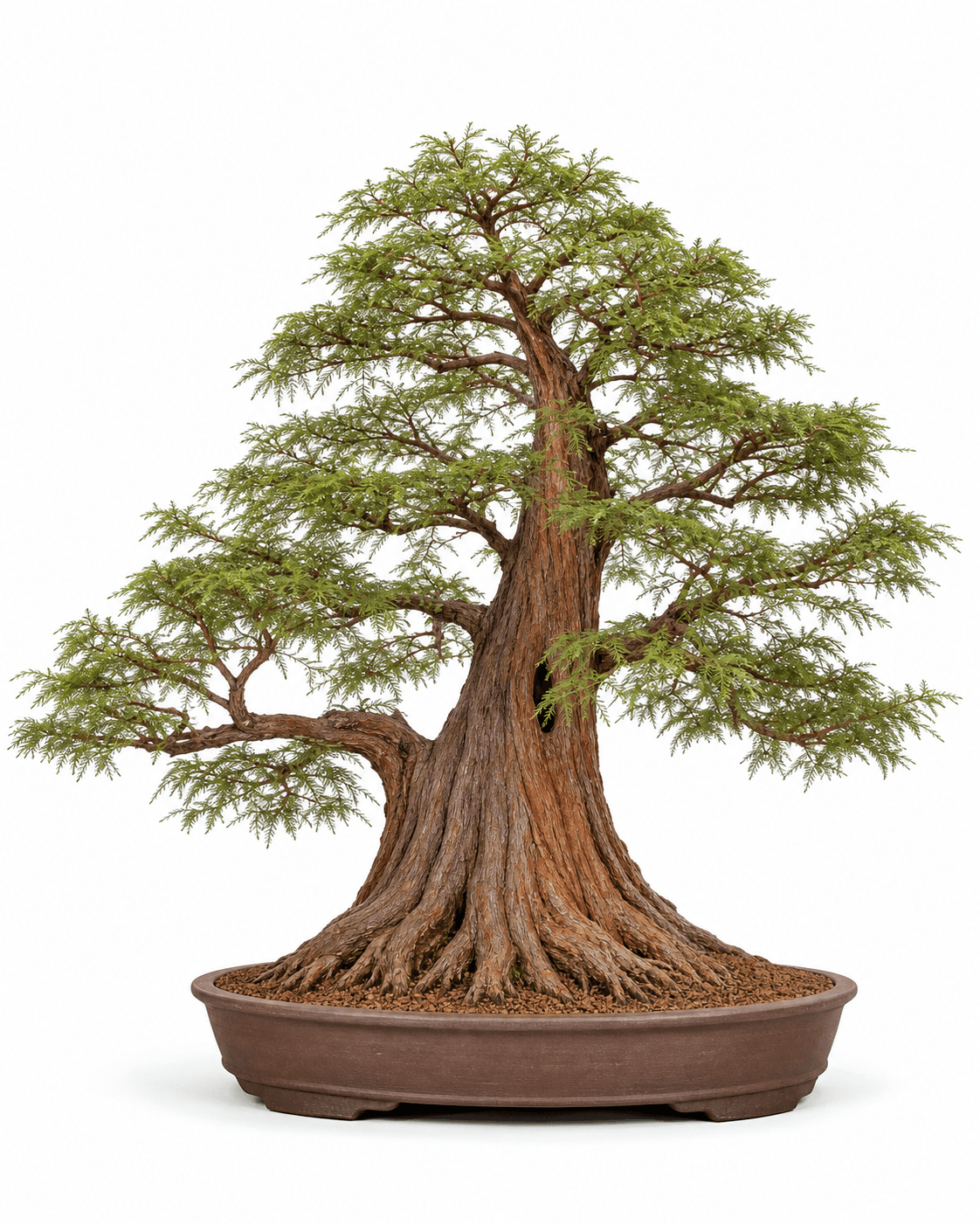
For design, translate ahuehuete habitat into a tall trunk, broad crown, enlarged base, riverbank roots, and upward then spreading branch movement. A mature Montezuma cypress should feel humid, massive, and sun exposed rather than alpine or wind-battered. NC State ExtensionUniversity of Arizona Campus ArboretumBonsai Mirai / Asymmetry
Reading the tree
Read Montezuma cypress by Taxodium signals, then adjust for warmth.
The first signal is spring bud swell. Mirai Taxodium method places structural pruning and major root work before the flush opens, because once buds spend energy into foliage, the safest spring window has passed. Bonsai Mirai Library
The second signal is stem maturity. New Taxodium growth moves from soft green into reddish or straw-colored firm tissue as vascular development catches up. That is the early-summer window for pruning and, on strong refined trees, partial defoliation. Bonsai Mirai Library
Warm climates can shift the rhythm. National Bonsai Foundation says Montezuma cypress tends to be evergreen in consistently warm climates, and NC State calls it semi-deciduous in winter. Use live buds, stem color, and hardening rather than a calendar copied from a cold-winter bald cypress bench. National Bonsai FoundationNC State ExtensionBonsai Mirai Library
Root behavior is the other diagnostic. Surface mounding, slow percolation, sour pockets, circling coarse roots, and reduced vigor all point toward root work. Strong extension with clean color points toward pruning and design work. Bonsai Mirai Library
Pruning
Let extension mature before you ask for ramification.
Use the two main Taxodium pruning windows: pre-flush spring work and early-summer post-flush work. The local spring-pruning file says the same strategy used on bald cypress and pond cypress likely applies to Taxodium mucronatum. Bonsai Mirai Library
Avoid soft pinching. Mirai Taxodium guidance says cutting green, immature extension produces weak response or dieback because the shoot has not built enough vascular support. Wait for the reddish maturity cue and visible buds before shortening. Bonsai Mirai Library
Cut length sets the next fork. Very short cuts often yield a single replacement shoot; moderate cuts more reliably produce two or more shoots. Leave more length on primary structure, less on secondary structure, and compact lengths on tertiary refinement. Bonsai Mirai Library
Vertical growth can help the species. Mirai Taxodium design guidance preserves useful upward shoots for flat-top and broad crown development, while crotch and shoulder water sprouts are removed when they steal strength from woody branches. Bonsai Mirai Library
Roots
Repot for fine roots, oxygen, and staged conversion from nursery soil.
Major root work belongs at spring bud swell. A Montezuma cypress in warm regions may not drop cleanly in winter, so the better evidence is swelling buds, active recovery weather, and a tree that has enough stored strength for both root repair and new extension. Bonsai Mirai LibraryNC State Extension
Never bare-root Taxodium by default. Mirai forest-repotting guidance preserves part of the root mass on deciduous conifers and reduces thick roots back to live secondary or tertiary roots rather than washing everything clean. Bonsai Mirai Library
Collected or old nursery trees often contain organic pockets. Open sour soil, replace it with structural substrate, and remove old field soil over staged repots when the tree has recovered. Strong roots can be reduced hard only when live branching roots remain behind the cut. Bonsai Mirai Library
Forest or group plantings should be handled as compositions. Lift the root mass as one unit when possible, protect weaker trunks, fill hidden voids, and secure the planting so health work and visual placement both survive repotting. Bonsai Mirai LibraryBonsai Mirai / Asymmetry
Soil and pot
The best soil is wet enough for Taxodium and open enough for refinement.
Mirai Taxodium refinement favors akadama because it holds water and nutrients while roots break particles down into a finer, denser system. The local guidance gives roughly 1/16 to 1/4 inch, or about 2 to 6 mm, as a useful particle band. Bonsai Mirai Library
Development can use more organic material temporarily. Mirai nuances describe a transitional mix for developmental or post-collection Taxodium before later shifting toward aggregate and akadama-led refinement soil. Bonsai Mirai Library
Container choice should support the image and water rhythm. Shallow, wide pots visually emphasize vertical trunks and hold a more usable moisture profile than deeper containers of the same footprint. Tie-downs need to be firm because the tree grows fast once warm. Bonsai Mirai Library
Avoid chasing knees by submerging a pot. NC State notes small knees can occur from submerged roots, but Mirai Taxodium method warns that root systems driven out of the container into a water basin compromise bonsai refinement. NC State ExtensionBonsai Mirai Library
Climate
Warm regions get more growth, while cold regions carry more risk.
In southern and subtropical regions, Montezuma cypress may stay partially green, push faster, and allow more frequent pruning cycles when stem maturity repeats. Use the reddish maturity cue and adequate daylight before asking for another flush. National Bonsai FoundationNC State ExtensionBonsai Mirai Library
In Central Texas and colder regions, winter is the limiting factor. Austin notes severe winters can freeze Montezuma cypress, and NC State mentions winter damage from Central Texas northward. A bonsai pot magnifies that exposure. City of Austin Watershed ProtectionNC State ExtensionBonsai Mirai Library
In hot dry regions, the tree can tolerate some drought in the landscape, but bonsai roots are shallow. Protect from hot wind, manage salts and pH, water through the full mass, and use shade only as a heat tool rather than as the default placement. University of Arizona Campus ArboretumCity of Austin Watershed ProtectionBonsai Mirai Library
In cool maritime regions, expect slower hardening and fewer safe pruning windows. Complete early-summer work early enough for the next flush to mature before autumn color or cold storage. Bonsai Mirai Library
Pests
Healthy Taxodium is durable, but stress makes ordinary pests matter.
NC State says well-maintained cypress trees tend to have few insect or disease problems, while listing bagworms as a common insect problem. Use that as a baseline: vigor, light, water, and soil condition prevent more trouble than routine spraying. NC State Extension
Warm, dense, wet containers can still hide problems. Mirai forest-repotting guidance identifies root aphids as bright white cottony pockets, distinct from duller mycorrhizal mesh, and warns that sour anaerobic pockets can masquerade as foliage weakness. Bonsai Mirai Library
Taxodium regional pests include cypress looper and cypress twig gall midge where those insects and hosts overlap. Confirm local identity before treating, because branch dieback, drought, and root rot can look similar from the bench. UF/IFAS Cypress looperUF/IFAS Cypress twig gall midge
Winter damage is a disease lookalike. NC State specifically flags winter damage in colder Texas and northward contexts. Dead tips after a freeze call for protection review before pest assumptions. NC State ExtensionCity of Austin Watershed Protection
Wiring
Wire with enough strength, then remove before fast growth marks the bark.
Mirai Taxodium guidance prefers adequate wire and one confident bend over repeated correction with weak wire. Developmental Taxodium examples use heavy copper for primary structure, then lighter gauges for secondary and tertiary work. Bonsai Mirai Library
Branches are more brittle just before spring push and safer when active foliage has restored water movement. Protect bark, distribute force along the branch, and use raffia or guy wires for major bends when needed. Bonsai Mirai Library
Fast warm growth shortens the inspection interval. Let wire begin to set the branch, then remove before it bites. A faint response may help the branch hold; deep scars on a smooth young section will remain obvious for years. Bonsai Mirai Library
The natural branch direction matters. Low-elevation Taxodium branches begin upward and then spread, so repeated downward conifer styling can erase the riverbank character that makes the species distinct. Bonsai Mirai LibraryBonsai Mirai / Asymmetry
Propagation
Seed is the documented path, with layering reserved for strong trees.
NC State lists seed as the recommended propagation strategy and notes seeds are released when cones ripen. It also says cones open in February and seeds ripen in October after March or April flowering. NC State Extension
Seedlings are useful for forests and riverbank groups because roots, trunk spacing, and height hierarchy can be trained from the beginning. They also avoid mystery field cores that often slow old nursery material. Bonsai Mirai LibraryBonsai Mirai / Asymmetry
Mirai Taxodium guidance places air layering in late spring or early summer once the tree is energy-positive, signaled by the same reddish extension that marks the second pruning window. Bonsai Mirai Library
Grafting is rarely central because Taxodium back-buds readily. Use grafting mainly for a specific form or dwarf scion, and schedule it around spring bud swell when recovery energy is moving. Bonsai Mirai Library
Sourcing
Buy the label carefully and inspect the roots before the trunk seduces you.
Confirm the identity. Kew uses Taxodium distichum var. mexicanum, NC State lists Taxodium mucronatum among previous names, and National Bonsai Foundation still presents museum material under Taxodium mucronatum. A shelf tag alone may lag current taxonomy. Kew POWONC State ExtensionNational Bonsai Foundation
Good nursery material has a visible base, healthy buds, no sour root smell, strong but not coarse extension, and a trunk line that can become broad riparian age. Avoid material with a buried graft, weak winter damage, or a dry compacted root core. NC State ExtensionBonsai Mirai Library
Collected material should be sourced only with permission and recovery time. Mirai Taxodium guidance warns that large severed roots can take six to eight years or more to compartmentalize, so post-collection root decisions shape the design for a long time. Bonsai Mirai Library
For colder regions, buy local-provenance or locally grown material when possible. Austin and NC State both flag winter vulnerability, so a tree raised in a warm nursery may need conservative acclimation before full bench exposure. City of Austin Watershed ProtectionNC State Extension
Troubleshooting
Diagnose by season, water, roots, heat, and recent work.
Symptom: foliage stays green late or drops unevenly. Likely cause: normal warm-climate semi-evergreen behavior. Fix: read buds and stem maturity rather than forcing a bald-cypress dormancy calendar. National Bonsai FoundationNC State Extension
Symptom: spring tips brown after cold. Likely cause: winter damage to a shallow pot or marginal climate. Fix: protect from hard freeze, wait for live buds, and delay major work until vigor returns. NC State ExtensionCity of Austin Watershed Protection
Symptom: green new growth wilts or scorches. Likely cause: hot wind, shallow-pot heat, dry pockets, salts, high pH, or pruning before stem maturity. Fix: water fully, cool the pot, protect from wind, and wait for reddish mature tissue. Bonsai Mirai LibraryCity of Austin Watershed Protection
Symptom: sour soil smell or black wet pockets. Likely cause: anaerobic old substrate. Fix: open the pocket during repotting, replace with structural soil, and stop relying on permanent water trays. Bonsai Mirai Library
Symptom: one shoot replaces every cut. Likely cause: cuts made too short or before adequate stem maturity. Fix: leave a more deliberate section of hardened tissue and prune at the correct early-summer cue. Bonsai Mirai Library
Symptom: white cottony pockets in roots or defoliating insects in summer. Likely cause: root aphids, bagworms, cypress looper, or regional Taxodium pests. Fix: identify the pest locally and restore vigor before repeating refinement work. Bonsai Mirai LibraryNC State ExtensionUF/IFAS Cypress looper
Design
Style it as an old river tree with breadth, heat, and water in the story.
Start with habitat. National Bonsai Foundation describes Montezuma cypress as a riparian tree from the lower Rio Grande Valley to Guatemala, and University of Arizona points to the famous giant at Santa Maria del Tule in Oaxaca. The design vocabulary should feel riverine and massive. National Bonsai FoundationUniversity of Arizona Campus Arboretum
NC State describes a tall straight trunk, broad crown, spreading branches, drooping twigs, and an often enlarged base. For bonsai, that suggests upright or informal upright structure with crown breadth, surface roots, and an old base rather than compact pine-like pads. NC State Extension
Mirai Taxodium design method keeps useful upward growth for the top and uses branch length to create a broad mature canopy. Flat-top logic can work, but Montezuma material can also carry a more spreading subtropical crown than classic Southern bald cypress. Bonsai Mirai LibraryBonsai Mirai / Asymmetry
Deadwood should be restrained. Mirai warns that domestic Taxodium branch deadwood degrades quickly, while bark, buttressing, root flare, and crown architecture carry the better species signal. Bonsai Mirai Library
Forms
Most searches are species labels, with weeping forms as the main note.
NC State lists a weeping form and describes long arching shoots. If a nursery tree is sold as a weeping Montezuma cypress, inspect whether that inherited movement supports the design or fights the upright riparian image. NC State Extension
The larger naming issue is taxonomic rather than cultivar-driven. Kew accepts the variety under Taxodium distichum, while common and bonsai sources often preserve Taxodium mucronatum. Keep both in source notes and search copy. Kew POWONational Bonsai Foundation
Regional nursery stock may be selected for drought tolerance, faster growth, or landscape form. For bonsai, root quality, low buds, winter history, and trunk base matter more than a rarity label. City of Austin Watershed ProtectionNC State ExtensionBonsai Mirai Library
History
Ahuehuete is culturally larger than most bonsai species pages can hold.
NC State calls Mexican swamp cypress the national tree of Mexico and notes trees in Chapultepec Park among the oldest cultivated trees in the New World. University of Arizona highlights the Arbol del Tule in Oaxaca for extraordinary trunk diameter. NC State ExtensionUniversity of Arizona Campus Arboretum
National Bonsai Foundation documents a Montezuma cypress in the National Bonsai and Penjing Museum collection, donated by Mike Naka in honor of John Y. Naka. That makes the species visible in North American bonsai culture, even though direct species-specific technique sources remain thin. National Bonsai Foundation
The taxonomy story is active. Kew accepts the Mexican variety within Taxodium distichum, while older and public-facing references still use Taxodium mucronatum. EntGrove keeps the accepted name and the search name together so readers can reconcile sources without losing the tree they are trying to grow. Kew POWONC State ExtensionNational Bonsai Foundation
Species questions
Answer the beginner questions before styling.
Is Montezuma cypress the same as bald cypress?
It is a close Taxodium relative. Kew currently accepts Montezuma cypress as Taxodium distichum var. mexicanum, while growers often use Taxodium mucronatum. Care overlaps strongly with bald and pond cypress, but Montezuma cypress is warmer, more semi-evergreen, and less cold-safe in bonsai pots.
Can Montezuma cypress bonsai live indoors?
No. It is an outdoor tree that needs strong light, air movement, and seasonal signals. In warm climates it may stay partly green, but indoor light is still too weak for durable bonsai culture.
Should Montezuma cypress bonsai sit in water?
Keep it evenly moist in active growth, but do not rely on permanent submersion for refined bonsai. Mirai Taxodium method treats oxygenated roots as essential for fine ramification.
When should I repot Montezuma cypress bonsai?
Use spring bud swell for major root work. In warm regions, look for live bud movement and recovery weather rather than waiting for a hard cold-climate dormancy cue.
When should I prune Montezuma cypress bonsai?
Use a pre-flush spring window, then prune again when new shoots have firmed and show reddish mature tissue. Soft green shoots should extend before they are shortened.
Does Montezuma cypress need winter protection?
Yes in colder regions. NC State lists Zones 6a to 9b, and Austin warns about severe-winter freeze risk. A bonsai pot is more exposed than an in-ground tree, so protect roots from hard freeze and drying wind.
What soil works for Montezuma cypress bonsai?
Use a moisture-retentive, oxygenated mix. Refined Taxodium can use akadama-led or pure akadama culture, while old nursery or collected trees often need staged conversion out of organic field soil.
Can I defoliate Montezuma cypress bonsai?
Use partial defoliation only on strong refined trees when the new stems have matured. Routine full defoliation and late-season leaf stripping weaken Taxodium over time.
How do I tell Montezuma cypress from pond or bald cypress?
Confirm the label through source, foliage, climate behavior, and range. Montezuma cypress is the southern Taxodium from southern Texas to Guatemala, often semi-evergreen in warmth, with a broad crown and faster warm-climate growth in horticultural sources.
Sources
Species advice needs source discipline.
Next decisions
Plan the operation before copying the calendar.
A good care note for Montezuma cypress records the tree's stage, the work done, and the aftercare used. That record matters more than a month-name rule.
Related species
Compare nearby trees before transferring advice.
European larch
Larix decidua
Japanese larch
Larix kaempferi
American / tamarack larch
Larix laricina
Alpine larch
Larix lyallii
Western larch
Larix occidentalis