
Species guide
Brewer Spruce Bonsai Care
Picea breweriana
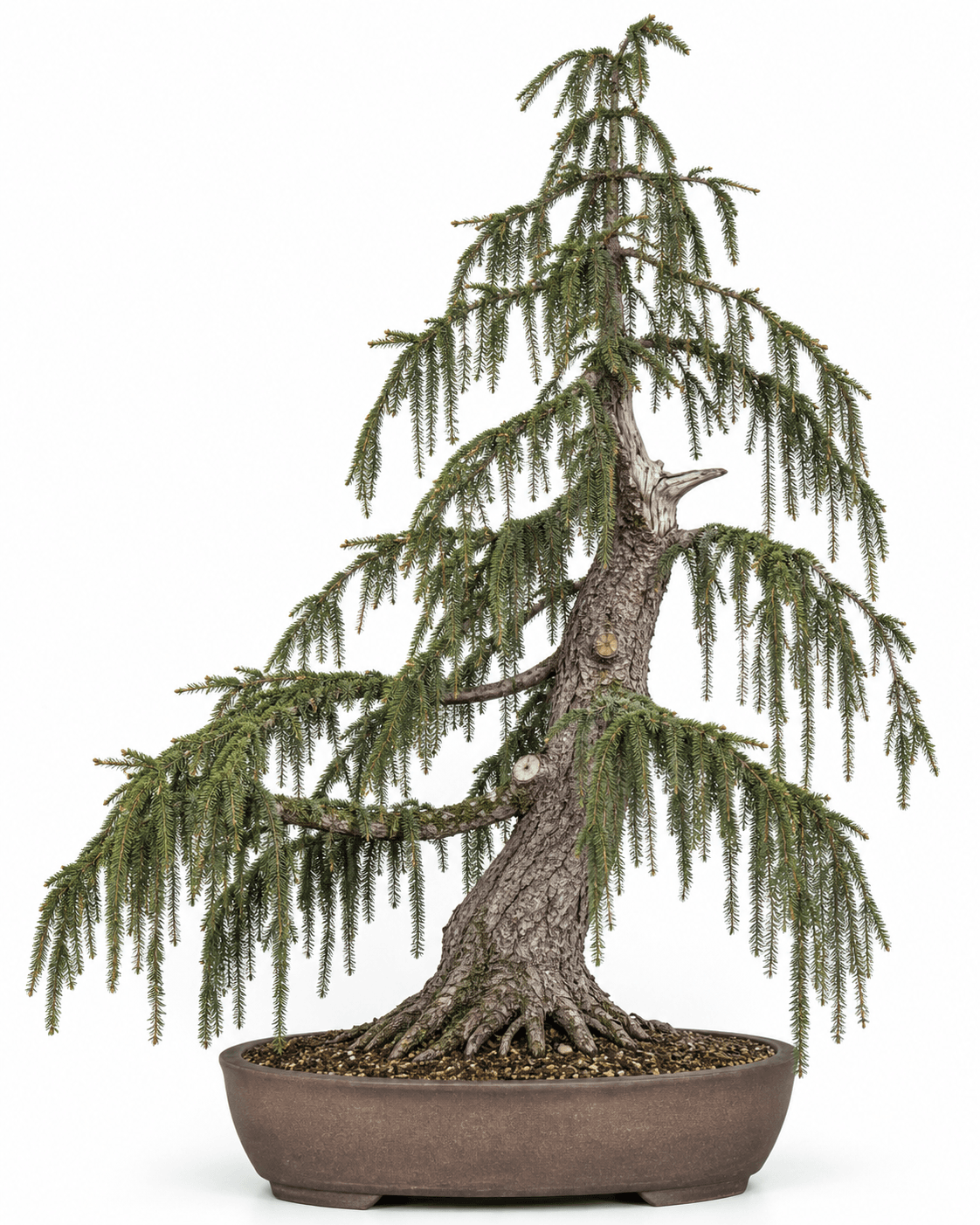
Brewer spruce bonsai is an outdoor, cold-dormant Picea for patient growers who can provide cool roots, strong light without drying wind, and a long development runway. Picea breweriana is a rare Klamath Mountains spruce with curtain-like pendulous branchlets, slow growth, shallow roots, and a narrow native range in northwestern California and southwestern Oregon.
Treat Brewer spruce as a single-flush elongating conifer: build foliage and roots first, pinch only refined soft spring tips, prune after hardening to visible buds, and reserve heavier structural work for spring bud swell or early fall. The practical care pattern is bright outdoor culture, even moisture with oxygen, staged root work, restrained wiring, and design that uses the species natural weeping branchlets rather than forcing compact generic pads.
The local Bonsai Mirai corpus has no dedicated Brewer spruce file. This guide transfers high-confidence Picea and elongating-conifer method from spruce pinching, spruce post-harden pruning, spruce refinement transition, cascading spruce structure, rootbound nursery-stock repotting, watering, soil, wiring, energy, and design files, then grounds Brewer spruce identity, range, hardiness, ecology, propagation, and pest context in USDA Silvics, USDA FEIS, Oregon State, and Kew POWO search workflow sources.
Updated July 4, 2026. Written by EntGrove Editorial. Last verified July 4, 2026.
Care fingerprint
Read the species through its shared care pattern.
Strong light, cool-root management, conservative root work, and post-extension pruning dominate the care calendar. Use this as the starting point before local conditions and tree strength refine the calendar.
Note: USDA Silvics and FEIS use Brewer spruce and weeping spruce for this Klamath-region endemic. Oregon State lists Brewer Spruce, Brewer's Weeping Spruce, Zone 6 hardiness, blunt 2-3 cm needles, 6-15 cm cones, and the Picea brewerana spelling. Keep separate from weeping Norway spruce, weeping white spruce, and weeping blue spruce cultivars.
Do not prune like a pine
Elongating conifers extend from buds and shoots, so candle-cutting assumptions can remove the exact growth the tree needs.
Preserve interior growth
Spruce, fir, hemlock, cedar, redwood, cypress, and larch all become harder to design when interior buds are shaded out.
Keep recovery cool and steady
Many elongating conifers respond best when roots stay evenly moist, oxygenated, and protected from hot dry swings.
Care cadence
The calendar starts with the tree's seasonal state.
Placement
Timing: Grow outdoors year-round. Give bright exposure in cool weather, then cool the pot and protect from high evaporation during hot dry wind, especially after repotting or wiring.
Watch for: Soft spring tips in hot sun, containers sitting on radiant surfaces, dry east-wind conditions, weak interior buds from shade, and warm winter storage.
USDA Forest Service SilvicsBonsai Mirai LibraryWatering
Timing: Water thoroughly as the upper root zone begins to dry. The goal is steady moisture and oxygen return, with special attention to old nursery cores or shallow collected root pads.
Watch for: Water bypassing a dry center, sour organic soil, needles dulling after heat, constant saturation, and dry foliage on windy days after root work.
USDA Forest Service SilvicsBonsai Mirai LibraryFertilizer
Timing: Feed development and recovery trees through active growth and fall. Refined branches can receive lighter spring feeding until the pinching window closes.
Watch for: Coarse extension in a refined silhouette, underfeeding a tree that needs back buds, fertilizer on weak roots, and late nitrogen that delays dormancy.
Bonsai Mirai LibrarySpring pinching
Timing: Pinch only healthy refined shoots while tips are soft and the branch already has a target silhouette. Let development branches elongate first.
Watch for: Removing the whole new shoot, pinching weak trees, pinching after a serious repot, and using pinching before branch placement is decided.
Bonsai Mirai LibraryPost-flush pruning
Timing: After the flush hardens, cut back to visible buds or useful ramification, reduce three-plus-shoot junctions, and open light to interior buds.
Watch for: Cutting mid-internode, exterior shell pruning, removing too much foliage during heat, and thinning weak zones that still need photosynthetic mass.
Bonsai Mirai LibraryStructural work
Timing: Do heavier pruning and wiring in spring before push or early fall after heat. Keep major styling separate from major root work on rare or slow material.
Watch for: Styling a recently repotted tree, under-gauged wire, crushed needles, repeated bends on old branches, and foliage loss on pendant branchlets.
Bonsai Mirai LibraryRepotting
Timing: Repot at spring bud swell while the tree is hydrated. Leave part of the existing root mass intact and tie the tree firmly.
Watch for: Bare-rooting, torn roots, shallow roots rocked by wind, top reduction in the same season, and a pot that dries too quickly for recovery.
Bonsai Mirai LibraryUSDA Forest Service SilvicsNeedle cleaning
Timing: Clean older needles only when they release with light rubbing. Preserve current and second-year needles on weak branches.
Watch for: Stripping live needles, crushing needles under wire, removing foliage before interior buds are actualized, and cleaning for display while the tree is still rebuilding.
Bonsai Mirai LibraryPest and disease inspection
Timing: Inspect during spring soft growth, dry summer weather, and fall needle color changes. FEIS flags Cooley spruce gall adelgid, seed chalcids, dwarf mistletoe, and Heterobasidion root rot in Brewer spruce context.
Watch for: Gall adelgid residue, stippled needles, older-needle drop, resin, branch decline, root sourness, dwarf mistletoe shoots, and dieback after drought or heat.
USDA Forest Service FEISBonsai Mirai LibraryWinter protection
Timing: Keep dormant and cold. Protect container roots from severe freeze-thaw, dry wind, and exposed benches, especially after root work or heavy styling.
Watch for: Indoor storage, dry frozen soil, late wire bite hidden in foliage, unprotected slabs, and winter sun plus frozen roots.
Oregon State Landscape PlantsBonsai Mirai LibrarySpecies guide
Apply the species profile before copying another tree's calendar.
At a glance
Brewer spruce is a rare weeping Picea with slow growth and narrow handling windows.
Picea breweriana is an evergreen spruce of the Klamath region, known for horizontal limbs carrying long rope-like branchlets. Oregon State lists it as Brewer spruce and Brewer's Weeping Spruce, while USDA sources use Brewer spruce and weeping spruce. Oregon State Landscape PlantsUSDA Forest Service SilvicsUSDA Forest Service FEIS
As bonsai, it belongs with alpine elongating conifers. The usable calendar is spring bud swell for root work and structural setup, soft spring tips for refinement, post-flush hardening for pruning, early fall for vascular work, and winter for protected dormancy. Bonsai Mirai Library
The source-depth limit is important. Mirai does not have a dedicated Brewer spruce transcript in the local corpus, so this page applies Picea method conservatively and lets the public forestry sources define what is unique to Brewer spruce. Bonsai Mirai LibraryUSDA Forest Service Silvics
Wild range
Read care from Klamath ridges, winter snow, dry summers, and shallow roots.
USDA Silvics places Brewer spruce only in northwestern California and southwestern Oregon near the Pacific coast, with strong populations on western Siskiyou high ridges and other populations in the Marble, Salmon, and Trinity Mountains. USDA Forest Service Silvics
Its climate is maritime influenced: cool wet winters, warm comparatively dry summers, heavy winter rain or snow, summer fog in western populations, and summer thunderstorms in eastern populations. Annual precipitation can vary from more than 2800 mm on western ridges to less than 1000 mm farther east. USDA Forest Service Silvics
The soil lesson is precise. Brewer spruce grows on sedimentary, granitic, serpentine, and metavolcanic parent materials, often in shallow rocky soils, and USDA Silvics says it is never found in areas where soils are saturated during the growing season. USDA Forest Service Silvics
Design should come from that ecology. The natural image is a high-ridge spruce with horizontal limbs, hanging branch curtains, slow structure, snow-shedding habit, and aged restraint. USDA Forest Service SilvicsBonsai Mirai / Asymmetry
Reading
Judge phase by roots, buds, needle generations, and pendant branch strength.
Development comes first. A young or recently sourced Brewer spruce needs extension, needle mass, root recovery, and interior bud production before refinement pinching has any value. Bonsai Mirai Library
A refined spruce branch is read through visible buds and needle generations. Mirai spruce guidance treats pinching as a refinement technique that works only after a branch has a defined silhouette and enough foliage to respond. Bonsai Mirai Library
Brewer spruce adds a source-specific warning: USDA Silvics describes shallow roots and sensitivity to high evaporation demand. Strong top growth after work should be checked against water uptake, root stability, and late-season bud formation. USDA Forest Service SilvicsBonsai Mirai Library
Pendant branchlets need individual evaluation. A low branch can be visually essential and hormonally vulnerable, so do not remove hanging foliage simply to make the tree look tidy. USDA Forest Service SilvicsBonsai Mirai Library
Spring growth
Pinch refined soft tips, prune after hardening, and keep every cut tied to a bud.
Pinching means removing only the soft tip of new growth while supporting the shoot. Mirai spruce guidance warns that removing the whole new shoot can kill the tip because replacement buds form from retained new-growth tissue. Bonsai Mirai Library
Use pinching only on refined zones. Branches still building length, vascular strength, or back buds should elongate first, then be pruned after hardening to visible buds or useful ramification. Bonsai Mirai Library
After the spring flush hardens, reduce three-or-more shoot junctions, cut flush to the parent branch, and preserve the shoot that supports the design. A weak pendant branch may need more foliage left in place than an upper strong branch. Bonsai Mirai Library
Brewer spruce should not be decandled. Decandling belongs to multiflush pines. Spruce uses soft-tip pinching, post-flush pruning, needle cleaning, and staged structural work. Bonsai Mirai Library
Roots
Repot at bud swell and protect the shallow root system.
Repot in spring as buds swell, while the tree is hydrated and aftercare can exclude freezing, drying wind, and hard sun. Root work should be the major operation for that season on rare or slow material. Bonsai Mirai Library
USDA Silvics describes Brewer spruce as generally shallow-rooted, with some deeper vertical roots only on deeper soils. In a bonsai pot, that shallow habit makes tie-downs, container depth, and wind protection central to recovery. USDA Forest Service Silvics
Do not bare-root Brewer spruce. Mirai rootbound conifer guidance keeps part of the native root mass intact and exchanges old soil over later repots so roots, fungi, and water uptake keep functioning. Bonsai Mirai Library
If the tree comes from nursery stock, find the true root flare before reducing depth. If it comes from legal collected material, preserve every useful root and delay styling until the tree proves recovery. Bonsai Mirai Library
Soil and pot
Build a cool, oxygenated root zone with enough water reserve for summer dryness.
An established Brewer spruce can use a standard open spruce mix such as 3 parts akadama, 1 part pumice, and 1 part lava, adjusted for local heat, wind, and pot depth. The mix should hold water while letting oxygen return after each watering. Bonsai Mirai Library
Treat the native soil signal as adaptation rather than a potting recipe. Silvics records rocky, shallow, and varied geologic soils, while the container target remains water, oxygen, stability, and staged old-core conversion. USDA Forest Service SilvicsBonsai Mirai Library
Use pot shape to support the design and the root system. Weeping upright or literati trees often want quiet unglazed containers with enough depth to buffer summer dry-down. Cascade and semi-cascade compositions need extra tie-down security. Bonsai Mirai / AsymmetryBonsai Mirai Library
Avoid moving into a shallow exhibition container too early. A slow spruce with shallow roots should earn a reduced pot after water uptake, interior buds, and summer heat response are dependable. Bonsai Mirai Library
Climate
Match the Klamath pattern: cool roots, winter rest, and summer evaporation control.
The strongest climates are cool-summer, maritime-influenced, or mountain-adjacent benches where the tree can get bright light without hot dry nights. Fog, winter rain, and snowmelt are part of the species ecological pattern. USDA Forest Service Silvics
Hot inland climates need pot shading, morning sun, afternoon protection, mulch around the container, wind reduction, and conservative summer pruning. USDA Silvics notes that high evaporation demand can close stomata and halt photosynthesis. USDA Forest Service Silvics
Cold climates should preserve dormancy while protecting the pot. Use ground contact, mulch, snow cover, or an unheated cold frame rather than a warm room. Oregon State Landscape PlantsBonsai Mirai Library
Regions without reliable winter chill are poor long-term fits. A grower in those climates should choose a tropical or subtropical broadleaf instead of asking Brewer spruce to survive as an indoor plant. Bonsai Mirai Library
Pests
Watch root stress first, then adelgid, mites, mistletoe, and needle disease.
FEIS records Cooley spruce gall adelgid as common on Brewer spruce, usually with little harm, and seed chalcids in mature seeds. Bonsai growers should still inspect soft growth, galls, residue, and weakened branch tips. USDA Forest Service FEIS
Dwarf mistletoe is part of the wild-species context. FEIS reports Arceuthobium campylopodum parasitism in local populations, so collected material should be inspected before purchase and isolated if suspicious shoots appear. USDA Forest Service FEIS
Root rot deserves more attention than foliar cosmetics. FEIS connects shallow roots with windthrow and Heterobasidion root rot in some areas, and container culture can recreate root stress through stale wet cores. USDA Forest Service FEISBonsai Mirai Library
Use the broader spruce disease filter for mites and needle cast. Gray stippling, webbing, purpling older needles, black fruiting bodies, or needle drop should trigger airflow, water, and local diagnostic checks before treatment. Bonsai Mirai Library
Wiring
Wire the structure, then let pendant branchlets keep the species character.
Spruce wiring needs wood contact on bare branches and loose tubing through needle masses so needles are not crushed. The off hand should support each branch as wire is applied and as bends are set. Bonsai Mirai Library
Brewer spruce has a built-in weeping language. Wire primary and secondary structure to create light, hierarchy, and movement, then leave selected branchlets to hang where they make the tree recognizable. USDA Forest Service SilvicsBonsai Mirai / Asymmetry
Use one decisive bend rather than repeated adjustment. Slow old spruce branches, shallow roots, and pendant foliage all punish casual repositioning. Bonsai Mirai Library
Check wire often in fall. Mirai elongating-conifer guidance treats fall as vascular-growth season, and spruce can bite wire quickly once tissue starts swelling. Bonsai Mirai Library
Propagation
Seed is the realistic route; wild collection needs restraint and proof of legality.
USDA Silvics says Brewer spruce is monoecious, starts seed production around 20 to 30 years, and produces seed crops at roughly 2-year intervals, with some trees producing cones yearly. USDA Forest Service Silvics
Artificial propagation is best from seed. Silvics records that 30 days of cold moist stratification improves germination, and FEIS also frames seed as the practical propagation route. USDA Forest Service SilvicsUSDA Forest Service FEIS
USDA Silvics reports no observed natural layering. Cuttings and air layers should be treated as experimental bonsai propagation rather than a dependable production plan. USDA Forest Service Silvics
Collected material should be rare, legal, and justified by aftercare capacity. The species is localized, slow, and sensitive to root disturbance, so nursery-grown or seed-grown material is the cleaner default. USDA Forest Service SilvicsBonsai Mirai Library
Buying
Buy legal provenance, root health, and a real Brewer identity before silhouette.
Good material has documented identity, legal provenance, visible or discoverable base, living interior buds, flexible design options, and roots that can be converted without bare-rooting. USDA Forest Service SilvicsBonsai Mirai Library
Reject vague weeping-spruce labels unless the botanical identity is clear. Weeping Norway spruce, weeping white spruce, and other Picea cultivars can be visually similar in nursery trade but follow different ecology and hardiness baselines. Oregon State Landscape PlantsUSDA Forest Service Silvics
Ask about repot date, soil history, winter storage, summer heat exposure, pest history, and whether any styling happened recently. A slow spruce should arrive with margin, not with every branch already wired and weak. Bonsai Mirai Library
Red flags include recent wild collection with no recovery record, a dense wet core, dry needle texture, no interior buds, mistletoe signs, severe root rocking, and branches hanging only because they are weak. USDA Forest Service FEISBonsai Mirai Library
Troubleshooting
Most failures trace to stale roots, heat, weak interiors, or premature refinement.
Symptom: dull needles and poor water uptake after repotting. Likely cause: old organic core, torn shallow roots, or a loose tie-down. Fix: stabilize the tree, normalize watering, shade from dry wind, and delay styling. Bonsai Mirai Library
Symptom: soft spring tips brown after a warm spell. Likely cause: exposure rose faster than the cuticle hardened. Fix: use afternoon shade, protect from wind, and avoid feeding as the first response. Bonsai Mirai Library
Symptom: no interior budding after pruning. Likely cause: the tree lacked foliar mass or vascular strength. Fix: let extensions run, preserve needles, feed during active uptake, and prune later to actual buds. Bonsai Mirai Library
Symptom: pendant branchlets dry while upper tips stay green. Likely cause: lower branch energy deficit, shading, or root stress. Fix: restore light paths, reduce upper strength gradually, and keep lower foliage until it recovers. Bonsai Mirai Library
Symptom: older needles purple, banded, or dropping. Likely cause: natural age shed, needle cast, mites, root stress, or summer heat. Fix: confirm needle age, inspect with magnification, improve air and light, and use local diagnosis before treatment. Bonsai Mirai Library
Symptom: branch decline after collection or purchase. Likely cause: shallow roots, hidden root rot, heat, or mistletoe history. Fix: isolate, inspect roots and live tissue, reduce evaporation, and pause all nonessential work. USDA Forest Service FEISUSDA Forest Service Silvics
Design
Use the weeping branchlets as the design signature.
Start with base, trunk line, defining branch, apex, and the direction of environmental pressure. Brewer spruce can read as high-ridge age, snow load, north-slope shade, or an old weeping mountain tree. USDA Forest Service SilvicsBonsai Mirai / Asymmetry
The branchlets are the feature. Rather than flattening them into broad pads, organize primary structure and let selected curtains hang in asymmetric planes with light between them. USDA Forest Service SilvicsBonsai Mirai Library
Cascade and semi-cascade designs can work when the root system is strong and the lower branch remains energy-positive. Keep enough foliage on the cascading branch to justify its survival. Bonsai Mirai Library
Deadwood should be restrained. Brewer spruce has thin bark and fire sensitivity in the wild, so broken stubs, aged scars, and quiet weathered wood usually fit better than large bright carved shari. USDA Forest Service FEISBonsai Mirai / Asymmetry
Forms
Treat Brewer spruce as the species, then verify every weeping label.
FEIS notes no recognized subspecies or varieties for Picea breweriana. That makes the parent species page the correct home for Brewer spruce bonsai guidance. USDA Forest Service FEIS
Oregon State lists Brewer Spruce and Brewer's Weeping Spruce, and records Picea brewerana as a synonym spelling. Older or secondary references can also surface weeping spruce language. Oregon State Landscape Plants
Do not apply this page to every weeping spruce. Picea abies Pendula, weeping white spruce, and weeping blue spruce cultivars should be identified separately because their climate tolerance, vigor, and source behavior differ. Oregon State Landscape PlantsBonsai Mirai Library
A good plant record should store the nursery name, botanical name, origin, repot dates, and photos of needles, cones if present, bark, and branchlet habit so later care decisions do not depend on memory. Bonsai Mirai Library
History
Brewer spruce is a localized Klamath tree with an unusually recognizable silhouette.
USDA Silvics says Brewer spruce was named for its first collector, William Henry Brewer. Oregon State also notes the Brewer name origin. USDA Forest Service SilvicsOregon State Landscape Plants
The species has little commercial timber importance because the distinctive branching creates many knots. Its value for bonsai is visual and ecological: rarity, slow age, weeping branchlets, and high-ridge character. USDA Forest Service Silvics
FEIS and Silvics frame Brewer spruce as locally distributed and tied to specific Klamath forest communities. That argues for restraint in sourcing and for designs that feel rooted in place. USDA Forest Service FEISUSDA Forest Service Silvics
A credible exhibition Brewer spruce should show legal provenance, stable roots, clean needle generations, controlled wire, strong interior buds, and a branch structure that reads immediately as Brewer spruce. Bonsai Mirai / AsymmetryBonsai Mirai Library
Species questions
Answer the beginner questions before styling.
Can Brewer spruce be grown as bonsai?
Yes. Brewer spruce can be grown as bonsai outdoors when it receives cold dormancy, cool roots, strong light, careful water movement, and spruce-specific timing around spring growth and post-flush pruning.
Can Brewer spruce bonsai live indoors?
No. Brewer spruce needs outdoor light, cold dormancy, moving air, and seasonal temperature change. Indoor rooms are too warm, dry, and dim for long-term health.
When should I repot Brewer spruce bonsai?
Repot at spring bud swell, keep part of the existing root mass intact, tie the tree firmly, and protect it from freezing, wind, and harsh sun afterward.
Should I pinch Brewer spruce?
Pinch only healthy refined shoots while the new tips are soft and the branch already has a target silhouette. Development branches should extend and be pruned after hardening.
Can Brewer spruce be decandled?
No. Decandling is for multiflush pines. Brewer spruce is managed through soft-tip pinching, post-flush pruning to visible buds, needle cleaning, and staged wiring.
What soil mix works for Brewer spruce bonsai?
For an established tree, start with an open spruce mix such as 3 parts akadama, 1 part pumice, and 1 part lava. Adjust for local heat, wind, pot depth, and old root-core behavior.
Why is my Brewer spruce turning brown inside?
Common causes include natural older-needle shed, shaded interior buds, mites, needle cast, heat stress, stale wet roots, or too much pruning before the tree rebuilt foliage mass.
Is Brewer spruce rare?
Yes. USDA sources describe Brewer spruce as endemic to the Klamath region of northwestern California and southwestern Oregon, with scattered local populations and best stands on high ridges.
What styles suit Brewer spruce bonsai?
Informal upright, literati, cascade, semi-cascade, forest, and weeping mountain designs suit Brewer spruce when the design preserves horizontal limbs and pendant branchlets.
Is Brewer spruce beginner friendly?
It is a specialist tree. Beginners will usually do better with a more available spruce or juniper before taking on rare, slow, shallow-rooted Brewer spruce material.
Sources
Species advice needs source discipline.
Next decisions
Plan the operation before copying the calendar.
A good care note for Brewer spruce records the tree's stage, the work done, and the aftercare used. That record matters more than a month-name rule.
Related species
Compare nearby trees before transferring advice.
Subalpine fir
Abies lasiocarpa
Balsam fir
Abies balsamea
White fir
Abies concolor
Noble fir
Abies procera
Mountain hemlock
Tsuga mertensiana