
Species guide
Duranta Bonsai Care
Duranta erecta
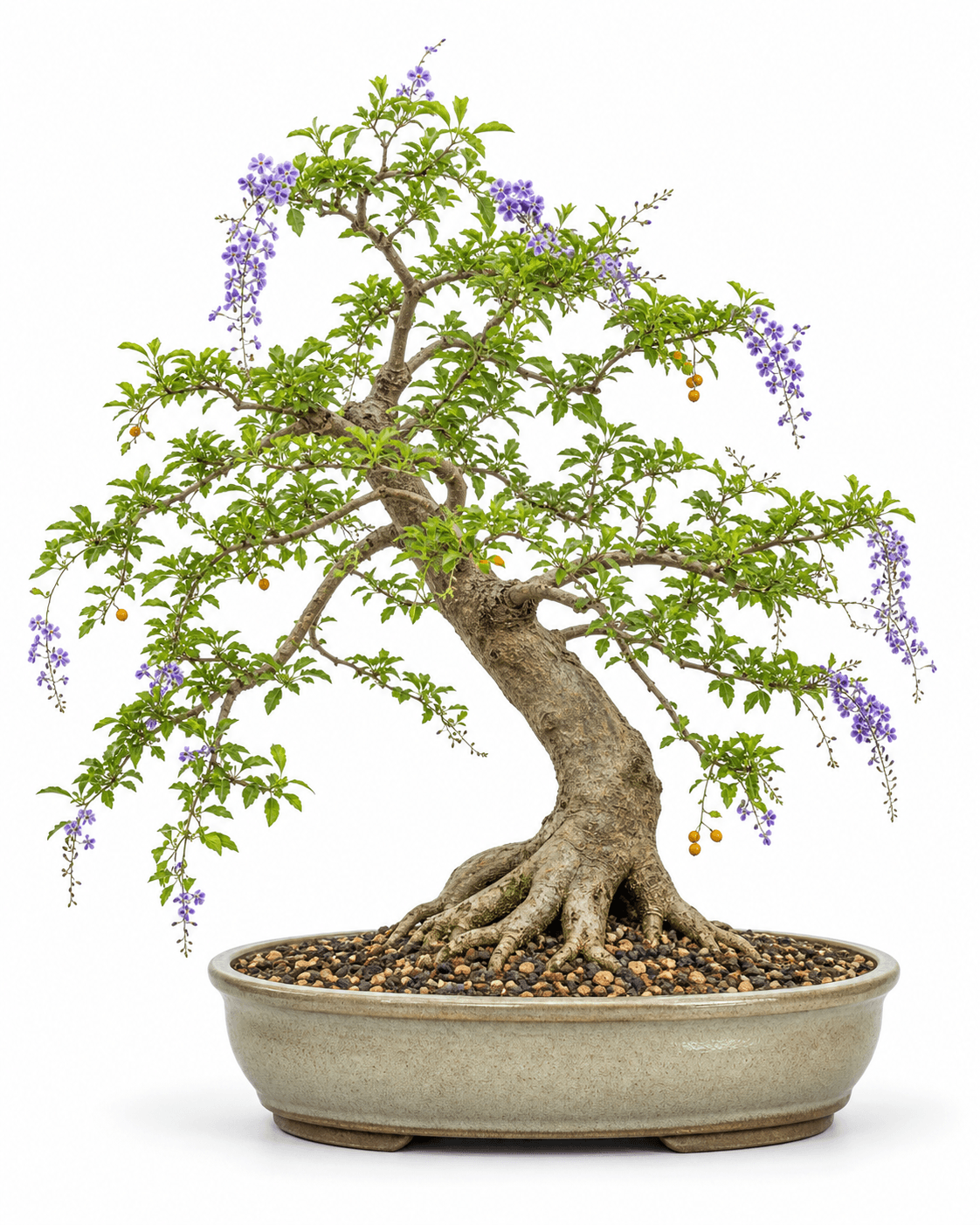
Duranta bonsai should be treated as a fast tropical broadleaf shrub grown for arching shoots, blue to violet flowers, and golden fruit. Give it strong outdoor light in warm weather, keep the root zone moist and oxygenated, prune after flowering or during active growth, and protect the tree before frost.
The accepted botanical target is Duranta erecta. Kew accepts Duranta erecta and lists Duranta repens and Duranta plumieri as synonyms, while bonsai and nursery trade labels still use Duranta repens, golden dewdrop, pigeon berry, and skyflower.
A June 2026 scan of the local Bonsai Mirai corpus found no dedicated Duranta file. The bonsai method here applies Mirai tropical broadleaf timing, root, watering, wiring, propagation, and design principles transparently, then uses Kew, NC State, UF/IFAS, and UNF for species-specific facts.
Updated June 20, 2026. Written by EntGrove Editorial. Last verified June 20, 2026.
Care fingerprint
Read the species through its shared care pattern.
Treat indoor culture as a light-management problem first; prune and repot when the tree is actively growing and warm enough to recover. Use this as the starting point before local conditions and tree strength refine the calendar.
Note: Kew accepts Duranta erecta and treats Duranta repens / D. plumieri as synonym labels still common in bonsai and nursery trade. Fruit and leaves are toxic, and Florida guidance currently treats cultivated golden dewdrop as high invasion risk.
Read the foliage first
Broadleaf stress usually shows in leaf color, leaf size, wilt, scorch, or delayed hardening before it becomes a branch problem.
Match work to dormancy
Deciduous, evergreen, tropical, succulent, and flowering broadleaf trees recover on different calendars.
Protect fine roots
Root work should preserve enough active fine roots for the tree to rehydrate quickly after the operation.
Care cadence
The calendar starts with the tree's seasonal state.
Placement
Timing: Move outdoors after cold risk passes and nights are reliably warm. Use full sun for compact growth and flowering, with afternoon shade only where heat and water demand overwhelm the pot.
Watch for: Long pale internodes, reduced bloom, leaf scorch after abrupt sun exposure, low-40s F discoloration, and cold drafts during winter protection.
NC State ExtensionUF/IFAS Gardening SolutionsBonsai Mirai LibraryWatering
Timing: Water deeply when the upper soil begins to dry during active growth. Reduce frequency in cool protected months while keeping the root ball from becoming bone dry.
Watch for: Wilt in dry heat, sour nursery peat, water that pools after irrigation, leaves yellowing in cold wet soil, and fruiting branches that raise water demand.
Bonsai Mirai LibraryUF/IFAS Gardening SolutionsUniversity of North Florida Botanical GardenFertilizer
Timing: Feed during warm active growth after roots are strong. Increase feeding during development, then moderate feeding when internode length, flower display, and fruit load need control.
Watch for: Coarse hedge shoots from overfeeding in weak light, pale leaves from underfeeding, fertilizer before post-repot recovery, and fruit load on weak trees.
Bonsai Mirai LibraryPruning
Timing: Prune in early spring for structure, then trim warm-season extensions after flowering or after shoots harden. NC State recommends pruning after flowering to keep the plant compact.
Watch for: Removing every flower-bearing shoot, leaving long vine-like stems unchecked, pruning a weak wintered tree too hard, and sealing dense shells that block interior light.
NC State ExtensionBonsai Mirai LibraryBonsai Mirai / AsymmetryFlowering and fruit
Timing: Let vigorous trees flower on new growth. Remove fruit on weak trees, around children or pets, and in invasive-risk regions where seed dispersal matters.
Watch for: Toxic fruit, birds moving seed, heavy clusters bending branch tips, sticky pests near flower racemes, and branch designs that cannot support a display.
NC State ExtensionUF/IFAS Gardening SolutionsUF/IFAS AssessmentRepotting
Timing: Repot in stable warmth when the tree is actively growing and can replace roots. Keep part of the root mass intact and tie the tree securely.
Watch for: Cold aftercare, bare-rooting a leafy tree, buried root crown, compact decomposed organic soil, and pairing heavy root work with heavy branch pruning.
Bonsai Mirai LibraryWiring
Timing: Wire young shoots after they firm enough to hold shape. Use pruning and guy wires for larger corrections because Duranta stems can be fragile.
Watch for: Cracks at branch shoulders, wire bite during rapid growth, wire crossing flower clusters, and bends made soon after repotting.
Bonsai Mirai LibraryBonsai Mirai / AsymmetryPests and disease
Timing: Inspect during soft growth, before winter protection, and after indoor moves. Improve light and airflow before pests compound.
Watch for: Whiteflies, scale, caterpillars, nematodes, aphids, spider mites, mealybugs, powdery mildew, leaf spot, honeydew, and sooty mold.
NC State ExtensionUF/IFAS Gardening SolutionsBonsai Mirai LibraryWinter protection
Timing: Move protected trees before frost and before cold nights make metabolism collapse. Keep the tree bright, airy, and drier than in summer.
Watch for: Leaf discoloration in cool conditions, continuing summer watering after growth slows, weak indoor light, and pest outbreaks in still air.
Bonsai Mirai LibraryUF/IFAS Gardening SolutionsNC State ExtensionSpecies guide
Apply the species profile before copying another tree's calendar.
At a glance
Duranta bonsai is a fast tropical flowering shrub with real safety and seed-risk constraints.
The accepted botanical name is Duranta erecta L. Kew accepts that name and lists Duranta repens, Duranta plumieri, and many older names as synonyms, which explains why bonsai tags and older nursery stock often use Duranta repens. Kew POWOUF/IFAS Assessment
In the EntGrove taxonomy it sits in Broadleaf > Tropical. The calendar follows heat and active growth: major work belongs in warm weather, root disturbance needs warm recovery, and winter is mainly protection and observation. Bonsai Mirai LibraryNC State ExtensionUF/IFAS Gardening Solutions
This guide has a source-depth caveat. A June 2026 local corpus scan found no dedicated Duranta file, so the bonsai technique here uses Mirai tropical principles while Kew and extension sources ground the species facts. Bonsai Mirai LibraryKew POWONC State Extension
Wild habitat
Its best bonsai care comes from warm, bright, seasonally dry tropical logic.
Kew places Duranta erecta in a native range from Mexico to northern South America and southern Florida to the Caribbean, growing primarily in the seasonally dry tropical biome. That range explains its preference for warmth, light, and fast recovery after summer work. Kew POWO
NC State describes golden dewdrop as an evergreen sprawling shrub or rarely a small tree, and UF/IFAS describes irregular drooping branches that carry flowers and fruit at the same time. Bonsai design should use that arching habit as a feature. NC State ExtensionUF/IFAS Gardening Solutions
The care implication is direct: full sun where water can keep pace, a moist but draining root system, and protection from cold before the pot loses metabolic momentum. Bonsai pots narrow the safety margin compared with landscape shrubs. UF/IFAS Gardening SolutionsBonsai Mirai Library
The design implication is equally important. Duranta has a flowering shrub character with racemes and golden fruit, so the tree usually looks better with open structure, a visible trunk line, and room for seasonal display. Bonsai Mirai / AsymmetryUF/IFAS Gardening Solutions
Reading
Read Duranta through shoot length, bloom density, leaf color, fruit load, and root oxygen.
Strong shoots are useful in development because they thicken branches and create future pruning points. Once structure exists, the same rapid extension can make the tree look like a hedge unless shoots are cut back after hardening. NC State ExtensionBonsai Mirai Library
Flower density is a light and timing signal. NC State says flowers are borne on current-season growth, and Mirai tropical method warns that weak light produces larger leaves and stalled compact growth, so placement and pruning timing decide the display. NC State ExtensionBonsai Mirai Library
Leaf color and pest residue matter. Yellowing, sticky leaves, stippled undersides, or black sooty film usually point to root stress, weak indoor light, whiteflies, scale, mites, or honeydew-producing insects before they point to a styling problem. NC State ExtensionUF/IFAS Gardening SolutionsBonsai Mirai Library
Root oxygen decides how hard the tree can be worked. Mirai watering and repotting method prioritizes percolation, oxygen, and warm recovery, which matters for a tropical shrub that likes moisture but declines in stale, cold, wet soil. Bonsai Mirai Library
Pruning
Prune for structure first, then manage flowers and fruit as a seasonal choice.
Start structural pruning on healthy material when warmth can support recovery, removing dead, weak, crossing, or congested branches. NC State recommends pruning after flowering to keep plants compact, which makes the post-display window especially useful. NC State ExtensionBonsai Mirai Library
During active growth, let selected shoots extend when you need thickness, then cut back to interior buds or side shoots after they harden. This clip-and-grow rhythm is safer than trying to miniaturize every flush with constant tip removal. Bonsai Mirai LibraryBonsai Mirai / Asymmetry
Flowers appear on new growth in NC State and UNF descriptions. If a flower display is the goal, preserve enough current-season extension for racemes, then clean the silhouette after flowering. NC State ExtensionUniversity of North Florida Botanical Garden
Fruit management is part of care. The yellow drupes are showy, but NC State and UF/IFAS warn that fruit and leaves are poisonous to people and dogs, and UF/IFAS currently predicts high invasion risk in Florida. NC State ExtensionUF/IFAS Gardening SolutionsUF/IFAS Assessment
Roots
Repot Duranta in warmth, preserve roots, and keep the crown high.
Repot during stable warm active growth, usually after nights are consistently warm enough for tropical recovery. Mirai tropical guidance uses warmth as the operating window because cold roots cannot replace fine roots quickly. Bonsai Mirai Library
Use root condition as the trigger. Repot when percolation fails, decomposed organic soil holds water too long, the root mass fills the container, or a deliberate design and container change justifies the work. Bonsai Mirai Library
Keep part of the root mass intact on leafy tropical material. Mirai repotting method warns against bare-rooting trees that carry foliage, because uninterrupted hydration matters while the tree rebuilds roots. Bonsai Mirai Library
Set the root crown as the high point and avoid burying bark below a wet soil line. This is a transferable tropical-root rule: high water mobility around the crown increases rot risk when bark stays damp. Bonsai Mirai Library
Soil and pot
Use a moist tropical broadleaf mix and a quiet pot that gives the racemes space.
NC State lists good drainage with moist soil, and UNF calls Duranta very adaptable with average water requirements. In a bonsai pot, use water retention plus air space. Heavy garden soil and stale nursery peat hold too much water. NC State ExtensionUniversity of North Florida Botanical Garden
A practical mix can use akadama or a similar water-holding aggregate as the main fraction, then pumice or lava for structure. In wet climates, increase drainage. In hot dry climates, keep enough retention for summer flowering and fruiting. Bonsai Mirai LibraryUF/IFAS Gardening Solutions
Use a pot deep enough to keep a fast tropical shrub watered through hot days. Mirai watering guidance notes that foliar mass, reservoir size, and environment decide water demand, and Duranta often carries a lot of transpiring foliage. Bonsai Mirai Library
Pot choice should support the seasonal display. Muted oval, soft rectangle, or round containers can frame blue-purple flowers and yellow fruit without competing with them. Avoid tiny pots while the tree is still building roots and branch structure. Bonsai Mirai / AsymmetryUF/IFAS Gardening Solutions
Climate
The care calendar changes most around winter protection and invasive-region seed control.
In USDA Zones 9a-11b, landscape Duranta may grow as an evergreen shrub or recover from cold damage, but bonsai pots need earlier protection because roots experience sharper temperature swings. NC State ExtensionUF/IFAS Gardening Solutions
In cool temperate regions, treat Duranta like a warm-protected tropical. Move it inside, under lights, or into a greenhouse before frost, reduce watering as growth slows, and reserve heavy pruning and repotting for warm recovery. Bonsai Mirai LibraryUF/IFAS Gardening Solutions
In hot dry regions, afternoon shade may be useful if leaves scorch or the pot dries too fast, but low light reduces bloom and lengthens internodes. Adjust watering and pot depth before moving the tree into heavy shade. NC State ExtensionUF/IFAS Gardening SolutionsBonsai Mirai Library
In Florida and similar invasive-risk regions, fruit removal is responsible horticulture. UF/IFAS predicts high invasion risk in Florida and does not recommend golden dewdrop there, so bonsai growers should prevent seed escape. UF/IFAS AssessmentUF/IFAS Gardening Solutions
Pests
Most Duranta pest problems are manageable when light, airflow, and root oxygen are stable.
NC State says there are no significant problems but to watch for whiteflies. UF/IFAS Gardening Solutions adds caterpillars, nematodes, and scale as possible offenders. NC State ExtensionUF/IFAS Gardening Solutions
Protected winter culture can make pest problems more likely because airflow drops, light weakens, and inspection is easier to neglect. Treat sticky leaves, sooty film, stippled undersides, and distorted soft growth as early warnings. NC State ExtensionUF/IFAS Gardening SolutionsBonsai Mirai Library
Treat bonsai pests in sequence: isolate, identify, clean leaves, improve airflow, then choose the least disruptive control that fits local extension guidance. Avoid heavy treatments on a newly repotted or heat-stressed tree. Bonsai Mirai LibraryNC State Extension
Nematode or root decline symptoms need root-zone thinking. If leaves yellow while soil stays wet and the pot smells sour, check drainage, organic breakdown, and root health before increasing fertilizer. UF/IFAS Gardening SolutionsBonsai Mirai Library
Wiring
Wire young Duranta shoots lightly and rely on pruning for most structure.
Use wire on young flexible shoots, and use pruning, guy wires, or staged clip-and-grow for stronger changes. Mirai wiring method treats fracture risk as a force-distribution problem, so older stiff Duranta shoots should be tested cautiously before bending. Bonsai Mirai LibraryBonsai Mirai / Asymmetry
Apply structural wire only where it can hold the branch without cracking the shoulder. Mirai wiring guidance favors continuous contact, consistent coil spacing, and bends distributed over a longer span to avoid fracture. Bonsai Mirai Library
Check wire frequently in warm growth. Fast tropical swelling can mark bark quickly, and flower-bearing shoots should be positioned before the racemes become the visual point. Bonsai Mirai LibraryNC State Extension
Avoid making every branch horizontal. Duranta naturally carries arching, drooping branch ends, and the design can use that movement to frame flowers and fruit. UF/IFAS Gardening SolutionsBonsai Mirai / Asymmetry
Propagation
Cuttings are the practical route, with seed and layering as secondary options.
NC State lists seed and stem cutting as propagation strategies. UF/IFAS Gardening Solutions also says seeds or stem cuttings are the best methods for golden dewdrop. NC State ExtensionUF/IFAS Gardening Solutions
For bonsai, stem cuttings are useful because you can select compact internodes, useful low buds, thorn level, foliage color, and flower color from the parent. Root them in warmth and do not judge vigor until new extension is sustained. NC State ExtensionUF/IFAS Gardening SolutionsBonsai Mirai / Asymmetry
Seed can produce variation and may carry regional invasive responsibilities. If seed-grown material is legal and appropriate locally, grow several seedlings and keep the plants with short internodes, flexible shoots, and useful basal movement. UF/IFAS AssessmentNC State Extension
Air layering belongs on vigorous warm-season material only when a branch already has a better trunk line than a cutting would provide. Keep the layer warm, moist, and supported after separation. Bonsai Mirai Library
Buying
Buy for trunk base, compact response, clean leaves, and safe fruit management.
Most Duranta bonsai material starts as nursery shrubs, patio plants, hedges, cuttings, or tropical pre-bonsai. Look for a trunk base that can be exposed, low branches, short internodes, and a plant that has grown in strong light. NC State ExtensionUF/IFAS ExtensionBonsai Mirai / Asymmetry
Compact and variegated forms can be useful, but cultivar vigor matters. NC State lists Alba, Aurea, Cuban Gold, Geisha Girl, Sapphire Showers, and Variegata; UF/IFAS also notes Gold Mound, Sapphire Shower, Alba, and Variegata. NC State ExtensionUF/IFAS Gardening Solutions
Inspect the underside of leaves for whiteflies, scale, mites, and honeydew. Check whether the root ball is a dense organic nursery core that will need staged transition into bonsai substrate. NC State ExtensionUF/IFAS Gardening SolutionsBonsai Mirai Library
Account for toxicity and seed risk before purchase. Avoid fruiting display in homes with children or pets, and remove fruit in places where birds could spread seed into natural areas. NC State ExtensionUF/IFAS Gardening SolutionsUF/IFAS Assessment
Troubleshooting
Most Duranta bonsai problems trace to light, water, cold, pests, or fruit load.
Symptom: few flowers and long pale shoots. Likely cause: too little direct sun or too much feeding in weak light. Fix: increase light gradually, then prune hardened shoots back to useful buds. NC State ExtensionUF/IFAS Gardening SolutionsBonsai Mirai Library
Symptom: yellow leaves in cool protection. Likely cause: cold roots, low light, overwatering, or pest pressure. Fix: inspect undersides, improve light and airflow, and water by current soil moisture. Bonsai Mirai LibraryUF/IFAS Gardening Solutions
Symptom: sticky leaves or black residue. Likely cause: whiteflies, scale, aphids, mites, honeydew, or sooty mold. Fix: isolate the tree, clean foliage, identify the pest, and restore airflow. NC State ExtensionUF/IFAS Gardening Solutions
Symptom: decline after repotting. Likely cause: cold aftercare, excessive root reduction, buried crown, weak roots, or compact organic soil. Fix: warm protected recovery, careful water, no styling, and no fertilizer until growth returns. Bonsai Mirai Library
Symptom: branches snap during styling. Likely cause: forcing older or brittle shoots. Fix: use younger growth, distribute bends over a longer span, or replace the correction with pruning and regrowth. Bonsai Mirai LibraryBonsai Mirai / Asymmetry
Symptom: fruit becomes the main risk. Likely cause: a strong flowering tree setting showy yellow drupes. Fix: remove fruit on weak trees, in homes with children or pets, and in invasive-risk regions. NC State ExtensionUF/IFAS Gardening SolutionsUF/IFAS Assessment
Design
Design Duranta around arching movement, open structure, flowers, and controlled fruit.
Start with base, trunk line, defining branch, and apex. Mirai design method uses those elements to create asymmetry, and Duranta often gives an easy defining branch through its naturally arching growth. Bonsai Mirai / AsymmetryUF/IFAS Gardening Solutions
Keep the canopy open enough for light to reach interior buds. A dense hedge shell can flower, but it hides branch architecture and makes pests harder to see. Bonsai Mirai / AsymmetryNC State Extension
Use the racemes as a seasonal accent. Let flower clusters hang from selected branch ends, then prune after the display to bring the silhouette back to the design. NC State ExtensionUF/IFAS Gardening Solutions
Deadwood should be rare and subordinate. Duranta reads best as a living tropical flowering shrub, with interest coming from trunk movement, soft branching, flower color, and safe fruit management. Bonsai Mirai / Asymmetry
Cultivars
Cultivar choice changes foliage color, flower color, vigor, and bonsai scale.
NC State lists Alba, Aurea, Cuban Gold, Geisha Girl, Sapphire Showers, and Variegata. UF/IFAS Gardening Solutions also names Gold Mound, Sapphire Shower, Alba, and Variegata. NC State ExtensionUF/IFAS Gardening Solutions
Gold Mound and Cuban Gold type plants can be visually useful because compact golden foliage reads at smaller scale, but yellow foliage also makes nutrient and light diagnosis less obvious than on green-leaved forms. NC State ExtensionUF/IFAS Gardening Solutions
Geisha Girl and Sapphire Shower type plants are attractive for flower edging and display. For bonsai, choose them only when the internodes, branch placement, and trunk base are also useful. NC State ExtensionUF/IFAS Gardening SolutionsBonsai Mirai / Asymmetry
Keep old Duranta repens labels with the plant record. They usually point to the same accepted Duranta erecta target, but cultivar identity and regional cold response still need observation. Kew POWOUF/IFAS Assessment
History
Duranta bonsai comes from tropical ornamental shrub culture and warm-climate nursery practice.
Kew and UF/IFAS present Duranta erecta as a widely distributed and widely introduced tropical ornamental shrub or small tree. The bonsai story is therefore tied to nursery stock, patio shrubs, tropical gardens, and warm-climate growers. Kew POWOUF/IFAS ExtensionUF/IFAS Gardening Solutions
No famous Duranta bonsai specimen is treated here as a benchmark. The better standard is horticultural: strong roots, clean foliage, controlled flower and fruit display, and a design that reads as a warm-climate flowering shrub. Bonsai Mirai / AsymmetryNC State Extension
The exhibition standard should be clean and controlled: healthy foliage, no whitefly or scale residue, secure potting, removed or intentional fruit, open branch structure, and flowers that support the design. Bonsai Mirai / AsymmetryNC State ExtensionUF/IFAS Gardening Solutions
Duranta is especially useful as a teaching tree for tropical timing. It shows quickly how warmth, light, water, pruning, and root oxygen interact, and it makes seed and toxicity responsibility visible in a way many bonsai species do not. Bonsai Mirai LibraryUF/IFAS AssessmentNC State Extension
Species questions
Answer the beginner questions before styling.
Can Duranta be grown as bonsai?
Yes. Duranta erecta can be trained as a tropical broadleaf bonsai when it receives strong light, warm protection, moist but draining soil, and pruning that respects flowers on new growth.
Is Duranta repens the same as Duranta erecta?
For most bonsai and nursery labels, yes. Kew accepts Duranta erecta and lists Duranta repens as a synonym, so older tags often use the repens name for the golden dewdrop bonsai subject.
Can Duranta bonsai live indoors?
Duranta can overwinter indoors or in a greenhouse, but it performs best outdoors in warm weather. Indoor protection needs strong light, airflow, lower winter watering, and pest inspection.
How much sun does Duranta bonsai need?
Use full sun for the best flowering and compact growth, with afternoon shade only where heat and water demand are excessive. Move protected trees back into sun gradually.
How often should I water Duranta bonsai?
Water deeply when the upper soil begins to dry in warm active growth, then let the pot drain. In cool winter protection, water less often because metabolism and transpiration slow.
When should I prune Duranta bonsai?
Do structural pruning in early spring on healthy trees, then prune after flowering or after warm-season shoots harden. Flowers form on new growth, so pruning timing affects the display.
Are Duranta berries poisonous?
Yes. NC State and UF/IFAS warn that Duranta fruit and leaves are poisonous to people and dogs. Remove fruit around children, pets, weak trees, and invasive-risk regions.
When should I repot Duranta bonsai?
Repot during stable warm active growth, often after a 2-3 year inspection in warm climates or whenever drainage fails. Keep part of the root mass intact and avoid cold aftercare.
What pests attack Duranta bonsai?
Whiteflies, scale, caterpillars, nematodes, aphids, spider mites, and mealybugs are the main checks. Protected indoor culture can make whiteflies, scale, mites, honeydew, and sooty mold more likely.
Is Duranta invasive?
It can be. UF/IFAS currently predicts Duranta erecta as high invasion risk in Florida and does not recommend it there. Bonsai growers in similar climates should remove fruit and follow local guidance.
Sources
Species advice needs source discipline.
Next decisions
Plan the operation before copying the calendar.
A good care note for Duranta records the tree's stage, the work done, and the aftercare used. That record matters more than a month-name rule.
Related species
Compare nearby trees before transferring advice.
Ficus retusa / Indian laurel
Ficus microcarpa
Tigerbark ficus
Ficus microcarpa 'Tigerbark'
Willow-leaf ficus
Ficus salicaria
Benjamin fig
Ficus benjamina
Ginseng ficus
Ficus microcarpa 'Ginseng'