
Species guide
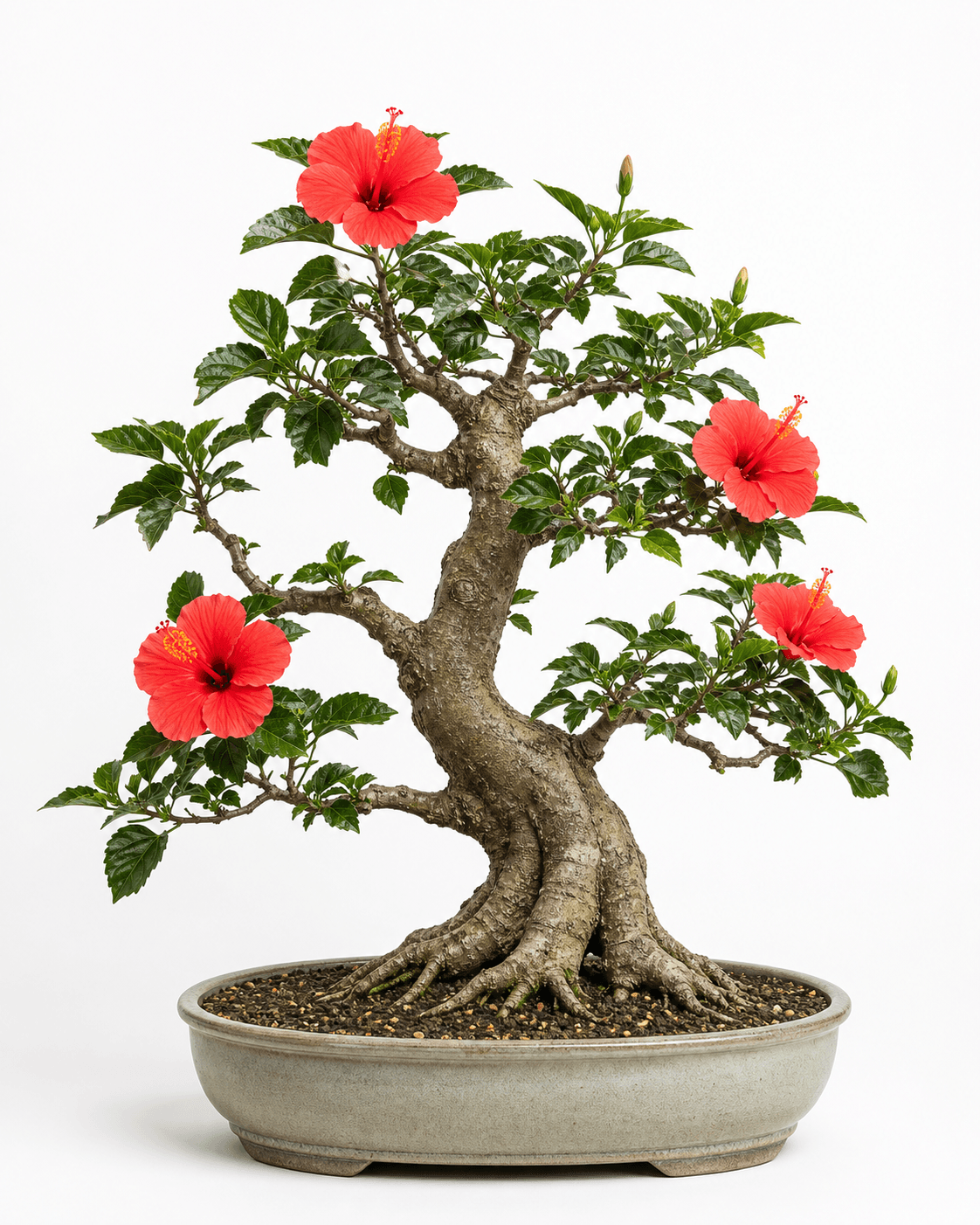
Hibiscus Bonsai Care
Hibiscus rosa-sinensis
Hibiscus bonsai should be treated as a warm-protected tropical broadleaf grown for vigorous new growth and large short-lived flowers. It needs bright outdoor light in warm weather, steady water in active growth, cold protection before frost, and pruning timed around new shoots because the flowers form on new growth.
This page targets Chinese hibiscus, commonly sold as Hibiscus rosa-sinensis. Kew treats the accepted name as Hibiscus x rosa-sinensis, while NC State and many horticultural sources still use Hibiscus rosa-sinensis, so keep the plant tag and avoid mixing this guide with hardy rose of Sharon or perennial swamp hibiscus.
A June 2026 local Bonsai Mirai corpus scan found no dedicated Chinese hibiscus file and only incidental Hibiscus label hits. The bonsai method here uses Mirai tropical timing, root, watering, wiring, propagation, and design principles transparently, then relies on Kew, NC State, Clemson, UF/IFAS, UMN, and Flora of North America for taxonomy, morphology, hardiness, propagation, and pest facts.
Updated June 20, 2026. Written by EntGrove Editorial. Last verified June 20, 2026.
Care fingerprint
Read the species through its shared care pattern.
Treat indoor culture as a light-management problem first; prune and repot when the tree is actively growing and warm enough to recover. Use this as the starting point before local conditions and tree strength refine the calendar.
Note: Use for tropical Chinese hibiscus bonsai. Keep separate from hardy rose of Sharon, cranberry hibiscus, and perennial/swamp hibiscus; Kew treats the accepted plant as Hibiscus x rosa-sinensis while nursery and extension sources commonly use Hibiscus rosa-sinensis.
Read the foliage first
Broadleaf stress usually shows in leaf color, leaf size, wilt, scorch, or delayed hardening before it becomes a branch problem.
Match work to dormancy
Deciduous, evergreen, tropical, succulent, and flowering broadleaf trees recover on different calendars.
Protect fine roots
Root work should preserve enough active fine roots for the tree to rehydrate quickly after the operation.
Care cadence
The calendar starts with the tree's seasonal state.
Placement
Timing: Move outdoors after frost risk passes and nights are consistently warm. Acclimate gradually to brighter light, then use full sun or light afternoon shade.
Watch for: Bud drop after moving, sunburn from sudden exposure, weak indoor light, cold glass, dry forced air, and long internodes from shade.
Clemson ExtensionNC State ExtensionUMN ExtensionWatering
Timing: Water deeply through warm active growth when the upper soil starts to dry, then let the pot drain freely. Reduce frequency in cool protected months.
Watch for: Limp leaves in wet soil, sour organic mix, dry cores inside nursery soil, yellow leaves, and pots that stay saturated after indoor moves.
Clemson ExtensionUMN ExtensionBonsai Mirai LibraryFertilizer
Timing: Feed during warm active growth after roots and light are strong. Use development feeding for trunk and branches, then moderate feeding when flower display and internode control matter.
Watch for: Soft rank shoots in weak light, pale leaves from underfeeding, fertilizer on cold slow roots, and feeding before recovery is visible after repotting.
Bonsai Mirai LibraryClemson ExtensionPruning
Timing: Prune in late winter or early spring for structure, then trim warm-season extensions after shoots harden. Preserve enough new growth when flower display is the goal.
Watch for: Removing all flower-bearing new shoots, cutting back a weak wintered plant too hard, or leaving coarse straight hedge growth to thicken unchecked.
NC State ExtensionClemson ExtensionUMN ExtensionFlowering
Timing: Let vigorous trees bloom on new growth. Remove spent flowers and manage flower load when a small tree is still building roots and branches.
Watch for: One-day flowers, bud drop after relocation, dry roots during bloom, pests hiding near buds, and out-of-scale flowers on tiny material.
UMN ExtensionNC State ExtensionRepotting
Timing: Repot in stable warmth when the tree is actively growing and has recovery time. Keep part of the root mass intact, tie down securely, and avoid heavy top reduction at the same time.
Watch for: Cold aftercare, bare-rooting leafy material, buried root crown, weak post-winter trees, compact nursery peat, and wet soil that no longer percolates.
Bonsai Mirai LibraryWiring
Timing: Wire young shoots after they firm but before they become thick and resistant. Check often during warm growth because swelling can mark bark quickly.
Watch for: Wire over flower buds, brittle older wood, strong bends on recently repotted trees, and wire left through a vigorous summer flush.
Bonsai Mirai / AsymmetryBonsai Mirai LibraryPests and disease
Timing: Inspect while growth is soft, before winter protection, and after any indoor move. Clean leaves and improve airflow before pests build.
Watch for: Scale, aphids, whiteflies, Japanese beetles, leaf spots, southern stem blight, honeydew, sooty mold, and sticky leaves near buds.
NC State ExtensionClemson ExtensionUMN ExtensionWinter protection
Timing: Bring protected trees in before the first frost and keep them bright, warm, and airy. Water less when growth slows.
Watch for: Leaf drop from relocation, dry radiator air, mite and scale pressure, cold drafts, and continued summer watering after light and metabolism fall.
UMN ExtensionBonsai Mirai LibrarySpecies guide
Apply the species profile before copying another tree's calendar.
At a glance
Hibiscus bonsai is a tropical flowering shrub first, then a bonsai subject.
The common bonsai target is Chinese hibiscus, sold as Hibiscus rosa-sinensis. Kew currently accepts Hibiscus x rosa-sinensis and describes it as a cultivated hybrid, while NC State and other extension sources retain the familiar species label for horticultural use. Kew POWONC State ExtensionFlora of North America
The care group is Broadleaf > Tropical. That means the calendar follows warmth, active growth, and root recovery rather than temperate dormancy. Work the tree when it can replace roots and leaves, and protect it before frost. Bonsai Mirai LibraryClemson ExtensionUMN Extension
The page has a source-depth caveat. A June 2026 local corpus scan found no dedicated Chinese hibiscus file, only unrelated or incidental Hibiscus label hits. This guide uses Mirai tropical principles for bonsai technique and extension sources for the species-specific facts. Bonsai Mirai LibraryNC State ExtensionClemson Extension
Wild habitat
Its cultivated origin still points to warm, bright, moisture-aware care.
Hibiscus rosa-sinensis is complicated because it is a long-cultivated tropical ornamental. Kew calls the accepted plant a South Pacific cultigen derived from artificial hybrids, and Flora of North America says it has no known native occurrence under the broad cultivated concept. Kew POWOFlora of North America
NC State describes Chinese hibiscus as a tropical evergreen shrub, and UF/IFAS describes a large upright evergreen with dense foliage and large solitary flowers. In cultivation, that means the bonsai must keep enough leaf mass to power repeated flowering and pruning. NC State ExtensionUF/IFAS Gardening Solutions
Translate the ecology into care: strong light, warm roots, steady water in active growth, well-drained soil, and protection from frost. A dim room can keep leaves alive temporarily; compact bonsai growth usually needs supplemental light. Clemson ExtensionNC State ExtensionUMN Extension
For design, read hibiscus as a flowering tropical shrub. The best image accepts broad leaves and showy flowers, then uses trunk movement, open branch spacing, and a quiet pot to keep the display from becoming visually heavy. Bonsai Mirai / AsymmetryUF/IFAS Gardening Solutions
Reading
Read hibiscus through shoot extension, bud retention, leaf color, and root oxygen.
Strong warm-season shoots are the working currency. They thicken branches, carry flower buds, and reveal whether the plant has enough light. Long pale shoots signal insufficient light or overfeeding in protected conditions. NC State ExtensionClemson ExtensionBonsai Mirai Library
Bud retention is a placement diagnostic. NC State warns that Chinese hibiscus is sensitive to environmental changes and can drop leaves or buds after being moved, so a sudden relocation can look like a disease problem when the root and light balance changed too fast. NC State Extension
Leaf color and leaf surface matter. UMN names yellow leaves, bud drop, and insects as common problems, while Clemson and NC State point to scale, aphids, whiteflies, and Japanese beetles as likely pests. UMN ExtensionClemson ExtensionNC State Extension
Roots decide how hard you can work. Mirai tropical method puts water and oxygen balance first, and that is especially relevant for a leafy flowering shrub that wants generous summer water but declines in stale, cold, wet soil. Bonsai Mirai LibraryClemson Extension
Pruning
Prune for new growth, then decide how many flowers the bonsai can afford.
NC State recommends cutting back by about one-half in early spring to encourage compact growth and notes that flowers bloom on new growth. Clemson gives a related mature-plant rule: prune old wood back by about one-third in spring to keep Chinese hibiscus vigorous. NC State ExtensionClemson Extension
For bonsai, translate those landscape rules into staged work. Use late winter or early spring to reset structure on a healthy tree, then cut warm-season shoots back after they harden so interior buds and finer branch divisions can form. Bonsai Mirai LibraryNC State Extension
Flowers are large and brief. UMN says hibiscus flowers are usually open for only one day, and Clemson lists flowers commonly 4-8 inches wide. On small bonsai, a flower can dominate the whole image, so preserve blooms intentionally. UMN ExtensionClemson Extension
Avoid routine full defoliation. Mirai tropical guidance favors root maturation, tip control, and selective partial leaf work over stripping a tropical broadleaf that still needs energy for roots, buds, and flowers. Bonsai Mirai Library
Repotting
Repot in warmth, keep the root crown clean, and protect recovery.
Use stable warm active growth as the repotting window. Mirai tropical guidance places major root work after temperatures are consistently warm enough for recovery, commonly when nights are above about 60 F / 16 C. Bonsai Mirai Library
Do not bare-root a leafy tropical hibiscus by default. Keep part of the root system intact, remove compacted nursery soil in stages when needed, and avoid pairing root reduction with heavy top pruning or flower forcing. Bonsai Mirai Library
Watch the root crown. Mirai tropical repotting guidance warns against burying the crown because warm wet bark at the soil line can rot. Hibiscus also wants generous water in growth, which makes crown height and drainage more important. Bonsai Mirai LibraryClemson Extension
After repotting, use bright protected light, stable warmth, and careful watering until new growth proves recovery. Delay fertilizer until the tree is pushing strong new shoots and the soil dries at a normal pace. Bonsai Mirai Library
Soil and pot
Use a water-retentive tropical mix that still breathes.
Clemson recommends rich well-drained soil with plenty of organic matter, and UMN says a rich well-drained mixture is ideal. Bonsai culture needs the same moisture support without the compaction risk of ordinary nursery peat. Clemson ExtensionUMN Extension
A practical hibiscus bonsai mix can use akadama or a similar water-holding aggregate with pumice or lava for structure, plus a modest organic fraction where summer heat and flowering demand more moisture. Adjust for climate: wetter regions need more drainage, hotter dry regions need more water retention. Bonsai Mirai LibraryClemson Extension
Container choice should support the flower scale. Development trees usually deserve a deeper training pot or nursery container so roots mature; refined trees can use a quiet glazed pot that gives visual relief from glossy foliage and saturated flowers. Bonsai Mirai / AsymmetryClemson Extension
Leave enough headroom to water thoroughly. A flowering tropical in warm weather can use water quickly, and a shallow pot with no watering margin turns every hot afternoon into a stress test. Bonsai Mirai LibraryClemson Extension
Climate
The care shifts most at the frost line and during indoor winter protection.
In frost-free and near-frost-free regions, hibiscus can grow like a normal outdoor tropical shrub with full sun or afternoon shade, generous water, and frequent pruning. Even there, bonsai pots reduce the cold margin. Clemson ExtensionNC State Extension
In temperate regions, treat the tree as outdoor summer material and protected winter material. UMN says Hibiscus rosa-sinensis must be brought in before first fall frost, and Clemson recommends moving overwintered plants back outside only after frost danger has passed. UMN ExtensionClemson Extension
Acclimation matters both directions. Clemson specifically recommends gradual acclimation to increased light and lower outdoor temperatures after overwintering. The same logic applies before winter: reduce shock by increasing light, airflow, and pest checks before the tree is crowded indoors. Clemson ExtensionNC State Extension
During cold low-light months, water by soil demand and growth rate. Mirai tropical winter guidance reduces watering when metabolism slows; summer watering habits can rot roots in a cool room. Bonsai Mirai Library
Pests
Scale, whiteflies, aphids, and leaf spots are the routine checks.
NC State says Chinese hibiscus has no major problems but to watch for scale insects. Scale is especially easy to miss on bonsai because it hides on stems, petioles, and under leaves near flower buds. NC State Extension
Clemson lists aphids, whiteflies, and Japanese beetles among hibiscus pests. UMN also names insect pests as a common houseplant problem, which fits the winter-protection pattern where airflow drops and pest pressure rises. Clemson ExtensionUMN Extension
Clemson notes fungal leaf spots and southern stem blight. The bonsai translation is sanitation and airflow: remove infected leaves, keep debris off the soil surface, and do not pack mulch or moss tight against stems. Clemson Extension
Most pest treatment should start with identification, leaf cleaning, isolation from other tropicals, and local integrated pest management guidance. Avoid strong chemical treatments on a heat-stressed, newly repotted, or flowering tree unless local guidance supports it. Clemson ExtensionBonsai Mirai Library
Wiring
Wire young growth early, then remove wire before warm-season swelling bites.
Hibiscus is usually shaped by pruning first and wiring second. Use wire to place young flexible shoots, open branch angles, and establish the broad flowering silhouette; avoid fighting thick older shrub wood into hard bends. Bonsai Mirai / AsymmetryNC State Extension
The safest window is after a shoot has firmed enough to hold shape and before it has lignified heavily. In hot growth, inspect weekly because swelling can trap wire faster than expected. Bonsai Mirai Library
Do not wire through the display moment when flower buds are the purpose. Place the structure earlier, then let new growth and flowers finish the image. NC State ExtensionUMN Extension
Use guy wires or clip-and-grow for coarse corrections. A hibiscus bonsai should show broadleaf flowering character, and clean cuts often age better than forced bends on straight nursery shoots. Bonsai Mirai / Asymmetry
Propagation
Stem cuttings are the practical way to build bonsai material.
NC State says Chinese hibiscus is propagated by stem cutting, and Flora of North America says cultivated Hibiscus rosa-sinensis usually fails to set seed and is generally propagated by cuttings. NC State ExtensionFlora of North America
Clemson gives a practical cutting benchmark for hibiscus: pencil-thick, 5-6 inch firm new growth cuttings root fastest in spring, often forming roots in about 4-5 weeks under suitable conditions. Clemson Extension
For bonsai, cuttings let you choose small leaves, shorter internodes, trunk movement, and flower color from the parent plant. Start more than one, then keep the plants with useful low buds and compact response. Clemson ExtensionBonsai Mirai / Asymmetry
Air layering may work on vigorous tropical broadleaf material, but this profile has no Chinese-hibiscus-specific Mirai benchmark. Use layering only when the branch already offers better trunk movement than a cutting can produce. Bonsai Mirai Library
Buying
Buy for roots, internodes, trunk line, and flower scale.
Most source material will be nursery hibiscus, patio shrubs, florist plants, or cuttings from a known cultivar. A pre-made hibiscus bonsai is less common than a hibiscus shrub that can be trained. Clemson ExtensionNC State Extension
Good material has a healthy root flare or a trunk base that can be exposed, useful low shoots, compact internodes, clean leaves, no sticky pest residue, and flowers that suit the intended tree size. UF/IFAS Gardening SolutionsBonsai Mirai / Asymmetry
Reject or isolate plants with scale, whiteflies, yellow leaves, sour soil, weak winter growth, heavy bud drop after purchase, or a trunk made from several braided stems if the braid cannot be turned into a believable design. NC State ExtensionUMN ExtensionClemson Extension
Check the species before applying this tropical guide to rose of Sharon, cranberry hibiscus, or perennial hibiscus. Clemson groups those plants on the same page and gives them different hardiness and habits. Clemson Extension
Troubleshooting
Most hibiscus bonsai problems trace to movement shock, light, water, pests, or cold.
Symptom: buds or leaves drop after moving the tree. Likely cause: rapid environmental change, especially light, temperature, humidity, or watering. Fix: stabilize placement, increase light gradually, and water by soil demand. NC State ExtensionClemson Extension
Symptom: yellow leaves. Likely causes: weak light, cold roots, overwatering in winter, underwatering in summer, nutrient shortage, or pest pressure. Fix: inspect roots and pests before increasing fertilizer. UMN ExtensionBonsai Mirai Library
Symptom: sticky leaves or black residue. Likely causes: scale, aphids, whiteflies, honeydew, and sooty mold. Fix: isolate the tree, clean leaves, identify the pest, and improve airflow. NC State ExtensionClemson Extension
Symptom: long coarse shoots with few buds. Likely causes: shade, too much nitrogen in weak light, or a tree left in development mode. Fix: improve light, let shoots harden, then cut back to useful interior buds. NC State ExtensionBonsai Mirai Library
Symptom: flowers are huge compared with the tree. Likely cause: normal species scale on small material. Fix: grow a larger tree, select smaller-flowered cultivars if available, or treat flowers as a seasonal accent. Clemson ExtensionBonsai Mirai / Asymmetry
Symptom: decline after repotting. Likely causes: cold aftercare, excessive root reduction, buried root crown, wet soil, or top pruning paired with root work. Fix: warm protected recovery, careful water, no fertilizer until strong growth returns, and no further styling. Bonsai Mirai Library
Design
Design hibiscus with open tropical shrub structure and visible flower space.
Start with trunk line, base, flower scale, and the defining branch. The tree should have enough size and negative space that a large flower looks deliberate rather than accidental. Bonsai Mirai / AsymmetryClemson Extension
Open the structure. Dense clipped shells hide interior dieback and make every flower look crowded. A better hibiscus image shows a few well-placed branches, healthy leaves, and a flower display with space around it. Bonsai Mirai / AsymmetryUF/IFAS Gardening Solutions
Use branch extension for thickness while the tree is young. Once the trunk and primaries exist, reduce extensions after hardening and rebuild finer branching closer to the trunk. Bonsai Mirai LibraryNC State Extension
Deadwood is rarely the main feature. Hibiscus is best when it reads as alive, warm, leafy, and flowering. Save dramatic deadwood language for species that carry it naturally. Bonsai Mirai / Asymmetry
Cultivars
Cultivar choice affects flower scale, color, internodes, and winter behavior.
Clemson notes Chinese hibiscus flowers may be single or double and span many colors, including yellow, apricot, and orange tones. UF/IFAS describes solitary flowers with five petals, a bell-shaped calyx, and a conspicuous staminal column. Clemson ExtensionUF/IFAS Gardening Solutions
For bonsai, a smaller flower and shorter internodes are often more useful than the showiest nursery bloom. Dense foliage can be an advantage only if the tree still back buds and interior light reaches the branch structure. Bonsai Mirai / AsymmetryClemson Extension
FNA describes Hibiscus rosa-sinensis broadly as a complex cultivated group that includes many hybrids and selections. That is a useful warning for tags: flower color alone does not prove the exact genetic background or cold tolerance. Flora of North America
Keep hardy hibiscus and rose of Sharon separate. Rose of Sharon is Hibiscus syriacus and can be hardy in much colder zones, while this page is for tropical Chinese hibiscus. Clemson Extension
History
Hibiscus bonsai sits between tropical shrub culture and flower display.
Kew, Flora of North America, and extension sources all present Chinese hibiscus as a heavily cultivated ornamental. Its bonsai history is therefore closer to tropical patio-shrub training than to an old mountain-tree lineage. Kew POWOFlora of North AmericaNC State Extension
It still demands deliberate bonsai work. A good hibiscus bonsai must solve the same design problems as any broadleaf: trunk line, branch hierarchy, root health, light distribution, and a clear reason for every branch. Bonsai Mirai / AsymmetryBonsai Mirai Library
The exhibition standard is clean and seasonal: pest-free leaves, no sticky residue, a stable pot, controlled wire, a flower display that does not exhaust the tree, and a design that accepts tropical character. Clemson ExtensionBonsai Mirai / Asymmetry
Its best role for many growers is educational. Hibiscus teaches how flowering tropicals respond to movement, warmth, light, pruning, and root oxygen, then rewards correct timing with visible new growth and flowers. NC State ExtensionUMN ExtensionBonsai Mirai Library
Species questions
Answer the beginner questions before styling.
Can hibiscus be grown as bonsai?
Yes. Chinese hibiscus can be trained as a tropical broadleaf bonsai when it receives strong light, warm protection, steady water in active growth, and pruning that respects flowers on new growth.
Can hibiscus bonsai live indoors?
It can overwinter indoors or grow under strong protected light, but it performs best outdoors in warm weather. Indoors, use the brightest practical position or grow lights, airflow, and frequent pest checks.
Is hibiscus bonsai the same as rose of Sharon bonsai?
This page covers tropical Chinese hibiscus, usually Hibiscus rosa-sinensis. Rose of Sharon is Hibiscus syriacus and follows a colder outdoor temperate shrub calendar.
How much sun does hibiscus bonsai need?
Use full sun where water and heat can be managed, with light afternoon shade in very hot climates. After winter protection, move it back outdoors gradually to prevent leaf and bud drop.
How often should I water hibiscus bonsai?
Water deeply when the upper soil starts to dry during warm active growth. In cool indoor winter protection, water less often and keep oxygen in the root zone.
When should I prune hibiscus bonsai?
Do structural pruning in late winter or early spring on healthy trees, then cut back hardened warm-season shoots. Flowers form on new growth, so prune with the desired bloom timing in mind.
Why are hibiscus flowers falling off?
Individual flowers often last only one day, and buds can drop after rapid changes in light, temperature, humidity, or watering. Stabilize the environment and avoid moving a budded tree abruptly.
When should I repot hibiscus bonsai?
Repot during stable warm active growth, often on a 2-3 year inspection rhythm. Keep part of the root mass intact and avoid heavy top pruning at the same time.
Can hibiscus bonsai be defoliated?
Routine full defoliation is a poor default. Use root maturation, shoot cutback, and selective leaf work because hibiscus needs leaf mass to recover, bud, and flower.
What pests attack hibiscus bonsai?
Scale, aphids, whiteflies, and Japanese beetles are common checks. Indoor winter protection can make scale, whiteflies, mites, and sticky honeydew problems more likely.
Sources
Species advice needs source discipline.
Next decisions
Plan the operation before copying the calendar.
A good care note for Hibiscus records the tree's stage, the work done, and the aftercare used. That record matters more than a month-name rule.
Related species
Compare nearby trees before transferring advice.
Ficus retusa / Indian laurel
Ficus microcarpa
Tigerbark ficus
Ficus microcarpa 'Tigerbark'
Willow-leaf ficus
Ficus salicaria
Benjamin fig
Ficus benjamina
Ginseng ficus
Ficus microcarpa 'Ginseng'