
Species guide
Citrus Bonsai Care
Citrus limon, Citrus sinensis, and related hybrids
Citrus bonsai are warm-climate broadleaf evergreen fruit trees. They need more sun, air, water movement, and nutrition than most indoor-bonsai buyers expect, and fruit should be treated as an energy cost rather than a guaranteed reward.
Treat citrus as Broadleaf > Tropical in the EntGrove taxonomy. A June 2026 local Bonsai Mirai corpus scan found one citrus-specific thorn-removal claim in tropical-styling plus strong tropical-bonsai methodology, so species facts here are grounded in Clemson, NC State, Kew, Mississippi State, and USDA APHIS.
The practical bonsai lesson is restraint: build roots and branch structure first, remove thorns that interfere with design, protect from cold, and let only strong mature trees carry a small fruit crop.
Updated June 20, 2026. Written by EntGrove Editorial. Last verified June 20, 2026.
Care fingerprint
Read the species through its shared care pattern.
Treat indoor culture as a light-management problem first; prune and repot when the tree is actively growing and warm enough to recover. Use this as the starting point before local conditions and tree strength refine the calendar.
Note: Use as a parent page for lemon, orange, mandarin, lime, kumquat, calamondin, and grafted patio citrus. Verify scion, rootstock, and local citrus-movement rules before applying cold tolerance, fruiting, or disease guidance.
Read the foliage first
Broadleaf stress usually shows in leaf color, leaf size, wilt, scorch, or delayed hardening before it becomes a branch problem.
Match work to dormancy
Deciduous, evergreen, tropical, succulent, and flowering broadleaf trees recover on different calendars.
Protect fine roots
Root work should preserve enough active fine roots for the tree to rehydrate quickly after the operation.
Care cadence
The calendar starts with the tree's seasonal state.
Placement
Timing: Move outside after nights are consistently above about 60 F / 16 C, then give full sun and wind protection while the tree adjusts. Bring protected material in before cold can chill roots or damage tender flushes.
Watch for: Large weak leaves, long internodes, leaf drop after indoor moves, sunburn after sudden exposure, cold glass, dry heated rooms, and weak winter light.
Bonsai Mirai LibraryMississippi State Extension container citrusClemson Extension container citrusWatering
Timing: Water deeply when the top layer starts to dry, often daily in hot weather on small pots. Let water exit the pot freely and avoid standing water.
Watch for: Hydrophobic nursery peat, sour soil, limp leaves in wet soil, dry root cores, salt crust, and water demand spikes when fruit and summer heat coincide.
Clemson Extension container citrusBonsai Mirai LibraryFertilizer
Timing: Feed actively through warm growth. Clemson recommends slow-release citrus or tree fertilizer and 2-3 growing-season applications for container citrus, with acidic soluble feeding if deficiencies appear.
Watch for: Pale new growth, magnesium or calcium shortage, summer flushes that attract leafminer, overfertilized weak-light growth, and fruit loads on underfed trees.
Clemson Extension container citrusClemson Extension citrus insectsPruning
Timing: Prune after a flush hardens and while warmth remains for recovery. Build branch structure first, then refine the outer silhouette after the tree can support fruiting.
Watch for: Removing all leaves from a recently repotted tree, cutting every new shoot before trunk and branch thickness develop, and leaving thorny growth where hands or wire must work.
Bonsai Mirai LibraryClemson Extension container citrusThorn work
Timing: Remove thorns that interfere with wiring, handling, branch placement, or display. Mirai gives citrus the specific instruction to remove thorns systematically because they do not serve the bonsai design.
Watch for: Thorns hidden under leaves, cuts made too close to tender shoots, and wounds left where fruit or hands will rub repeatedly.
Bonsai Mirai LibraryFlowering and fruit
Timing: Let mature vigorous trees bloom, then thin fruit aggressively if the tree is still building roots or branch structure. Clemson notes young grafted oranges, grapefruits, and mandarins may take about 5 years to flower, while lemons can be quicker.
Watch for: A small tree carrying too many fruit, fruit pulling branch tips down, nitrogen pushed at the wrong time, dry roots during bloom, and weak recovery after harvest.
Clemson Extension in-ground citrusClemson Extension container citrusRepotting
Timing: Repot during stable warmth, after the tree is actively growing and before intense summer stress. Keep part of the root mass intact and avoid burying the root flare.
Watch for: Deep planting, cold aftercare, wet organic cores, root flare covered by soil, major top pruning paired with root reduction, and loose tie-downs.
Bonsai Mirai LibraryMississippi State Extension container citrusClemson Extension container citrusWiring
Timing: Wire young flexible shoots after they harden enough to hold a bend. Check frequently because citrus can swell quickly when heat, water, and fertilizer align.
Watch for: Wire bite, thorns under wire, brittle older branches, fruit used as a counterweight, and heavy bends on grafted or weak-root material.
Bonsai Mirai / AsymmetryBonsai Mirai LibraryPests
Timing: Inspect new flushes and leaf undersides through warm growth and again before winter protection. Indoor protection often increases mite, scale, whitefly, and mealybug pressure.
Watch for: Leafminer trails, scales, aphids, whiteflies, spider mites, mealybugs, ants tending honeydew, sooty mold, and distorted new leaves.
Clemson Extension citrus insectsMississippi State Extension container citrusQuarantine and disease
Timing: Check APHIS and state extension rules before buying, shipping, gifting, or moving a citrus bonsai across county or state lines.
Watch for: Huanglongbing, Asian citrus psyllid, citrus canker, citrus black spot, sweet orange scab, quarantine zones, and suspicious symptoms that should go to local plant health officials.
USDA APHIS citrus diseasesClemson Extension in-ground citrusSpecies guide
Apply the species profile before copying another tree's calendar.
At a glance
Citrus bonsai are fruiting tropical broadleaf evergreens with high energy demands.
Citrus belongs to Rutaceae and carries complicated hybrid naming. A bonsai label may point to lemon, sweet orange, mandarin, lime, kumquat, calamondin, or a grafted patio hybrid, so the first care move is to keep the label and learn whether the plant is grafted. Kew POWO CitrusNC State Extension lemonNC State Extension orange
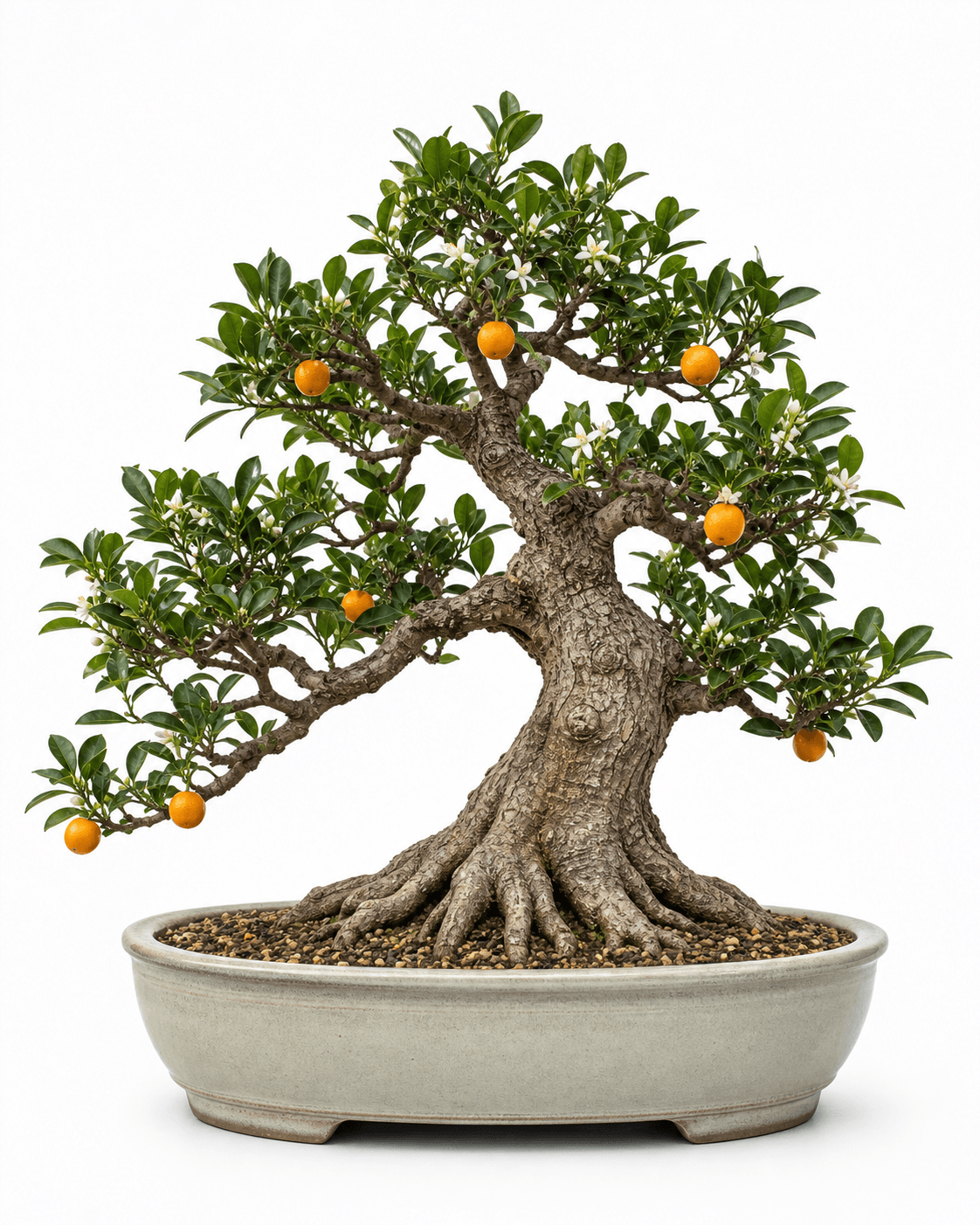
The bonsai target is a compact evergreen fruit tree with fragrant flowers, clean leaves, controlled thorns, and fruit only when the roots and branches can afford it. Treat fruit as a design accent and an energy sink. Clemson Extension container citrusBonsai Mirai / Asymmetry
The source caveat is important. A June 2026 local corpus scan found strong Mirai tropical timing, watering, repotting, structural wiring, energy, and design method, plus one citrus-specific thorn-removal claim in tropical-styling. Species-specific horticulture here comes from Kew, Clemson, NC State, Mississippi State, and USDA APHIS. Bonsai Mirai LibraryKew POWO CitrusClemson Extension container citrusUSDA APHIS citrus diseases
Wild habitat
Its cultivated origin points to heat, sun, drainage, and regional caution.
Kew documents Citrus as a globally distributed cultivated and naturalized genus, while sweet orange naming is treated differently across taxonomic authorities. That complexity fits what growers see on tags: citrus bonsai are often grafted or hybrid plants rather than clean wild species seedlings. Kew POWO CitrusKew POWO Citrus sinensis
Translate the habitat into care rather than romance. Citrus wants high light, warm roots, oxygenated soil, and steady nutrition; it declines when brought into a dim room and watered like a dormant temperate tree. Mississippi State Extension container citrusClemson Extension container citrusBonsai Mirai Library
Citrus also lives inside a serious agricultural disease landscape. USDA APHIS lists huanglongbing, Asian citrus psyllid, citrus canker, citrus black spot, and sweet orange scab as established exotic pests and diseases with national citrus risk. USDA APHIS citrus diseases
For design, cultivated citrus should read as a sun-grown fruit tree: open canopy, fragrant flowers, occasional fruit, visible root flare, and branch spacing that makes fruit look deliberate rather than heavy. Bonsai Mirai / AsymmetryClemson Extension container citrus
Reading
Read citrus through new flushes, leaf color, fruit load, and roots.
New flush tells you whether the tree has enough light and nutrition. Compact green growth in full sun is useful; long pale shoots indoors usually mean the tree is spending stored energy without enough light to replace it. Mississippi State Extension container citrusBonsai Mirai Library
Leaf color and leaf shape help diagnose nutrition and pests. Clemson notes container watering flushes nutrients, and its insect guide warns that leafminer damage is most serious on young vigorous growth. Clemson Extension container citrusClemson Extension citrus insects
Fruit load is a structural and energy diagnostic. A young tree with many fruit is often sacrificing branch thickening and root strength; a mature tree with a few well-placed fruit can make the bonsai image stronger. Clemson Extension in-ground citrusBonsai Mirai / Asymmetry
Roots decide whether every top symptom is fixable. Clemson and Mississippi State both warn against saturated or poorly drained container media; Mirai tropical method keeps root oxygen and warm recovery at the center of the work calendar. Clemson Extension container citrusMississippi State Extension container citrusBonsai Mirai Library
Pruning
Build structure before fruit, and remove thorns that block the design.
Prune citrus after a flush hardens, when the tree is warm and actively growing. Early development should favor trunk, root, and branch strength before asking the tree to hold a showy fruit crop. Bonsai Mirai LibraryClemson Extension in-ground citrus
Mirai gives one citrus-specific bonsai instruction: remove thorns systematically because they add no design value and make handling hazardous. On bonsai, they also complicate wiring and can damage nearby leaves or fruit. Bonsai Mirai Library
Keep some extension where branch thickening is still needed, then cut back to lateral growth once the branch has enough strength. Avoid constant hedge trimming that leaves a green shell with weak interior buds. Bonsai Mirai / AsymmetryClemson Extension container citrus
Thin fruit on small trees. Clemson says many grafted citrus need several years before flowering and fruiting; bonsai pots add another constraint because the root volume is deliberately reduced. Clemson Extension in-ground citrusClemson Extension container citrus
Repotting
Repot citrus warm, shallow, and anchored.
Use stable warmth for repotting. Mirai tropical method places major root work after nights are consistently warm enough for active recovery, which is more useful than a fixed temperate spring date for protected citrus. Bonsai Mirai Library
Mississippi State and Clemson give a container rule that translates directly to bonsai: keep the root flare visible, keep the upper roots at or above soil level, and keep medium or mulch away from the trunk. On grafted trees, also keep the union readable so future cold injury, suckers, or swelling can be diagnosed. Mississippi State Extension container citrusClemson Extension in-ground citrus
Reduce roots in stages if the tree is grafted, weak, fruit-loaded, or trapped in dense nursery soil. Do not combine hard root reduction with heavy top pruning or fruit load unless decline is already forcing emergency correction. Bonsai Mirai LibraryClemson Extension container citrus
After repotting, tie the tree firmly, water thoroughly, place it bright and warm, and remove fruit if the tree needs to rebuild roots. A loose citrus in new soil tears fine roots each time it moves. Bonsai Mirai LibraryClemson Extension container citrus
Soil and pot
Give citrus a fast-draining mix that still holds enough water for heat and fruit.
Clemson gives the container citrus pH target as 5.5 to 6.5 and warns that the root ball should neither dry completely nor stay saturated. That is the bonsai soil brief: water availability with oxygen. Clemson Extension container citrus
A practical bonsai mix is akadama, pumice, and lava with enough moisture retention for your heat, wind, and pot size. In very hot climates or for fruiting trees, increase water-holding capacity without returning to sour peat. Bonsai Mirai LibraryClemson Extension container citrus
Mississippi State recommends bark and sand for larger container citrus, which is useful evidence for drainage and root-flare principles, but bonsai refinement usually needs a more stable aggregate structure. Mississippi State Extension container citrusBonsai Mirai Library
Choose a pot with enough depth to support water demand and fruiting energy. Unglazed warm earth tones suit development; quieter glazed containers can work for refined fruiting display when the fruit color is the visual accent. Bonsai Mirai / AsymmetryClemson Extension container citrus
Climate
Citrus care changes sharply by winter minimums, rootstock, and quarantine region.
In warm citrus regions, bonsai work can follow active growth and pest cycles. In temperate regions, the main design constraint is winter protection with enough light to prevent a slow indoor decline. Bonsai Mirai LibraryMississippi State Extension container citrus
Cold tolerance is a plant identity question, not a generic citrus trait. Mississippi State ranks kumquat, calamondin, and satsuma ahead of sweet orange, grapefruit, lemon, and lime for cold tolerance; Clemson adds that rootstock, scion, age, health, acclimation, and duration of cold all affect survival. Mississippi State Extension container citrusClemson Extension in-ground citrus
A bonsai pot is more exposed than landscape soil, so protect earlier than a regional citrus chart suggests. Cold roots, wet soil, and weak winter light can cause decline before a dramatic freeze injury appears. Bonsai Mirai LibraryClemson Extension container citrus
Follow local citrus movement rules. Clemson documents county-level shipping restrictions tied to citrus greening in South Carolina, and APHIS maintains federal quarantine and response information for citrus diseases. Clemson Extension in-ground citrusUSDA APHIS citrus diseases
Pests
Citrus pests love new flushes, indoor protection, and stressed roots.
Clemson lists scale insects, mites, whiteflies, leafminers, mealybugs, aphids, and fruit flies among sweet orange pests. Its citrus pest guide ties drought and nutrient stress to worse scale and pest problems. NC State Extension orangeClemson Extension citrus insects
Leafminer damage is common on tender new growth. Clemson recommends leaving damaged leaves when useful green tissue remains, because the intact parts still feed the tree. Clemson Extension citrus insects
Mississippi State warns that pests can become a bigger problem when container citrus comes indoors for cold protection. Inspect before moving the tree inside, then continue checking undersides and branch crotches. Mississippi State Extension container citrus
Disease risk is regional and serious. APHIS names huanglongbing, Asian citrus psyllid, citrus canker, citrus black spot, and sweet orange scab as established threats, while Clemson adds root rots, sooty mold, canker, scab, greasy spot, and greening concerns. USDA APHIS citrus diseasesClemson Extension in-ground citrus
Wiring
Wire young shoots and let pruning do the heavier design work.
Wire citrus after shoots lignify enough to hold shape but before wood becomes brittle. Remove thorns first so wire can sit cleanly and hands can work without tearing leaves or fruit. Bonsai Mirai LibraryBonsai Mirai / Asymmetry
Check wire often in warm active growth. Citrus can swell quickly under full sun, water, and fertilizer, and smooth young bark can mark before the grower expects it. Bonsai Mirai / AsymmetryClemson Extension container citrus
Avoid heavy bends on weak roots, graft unions, old brittle branches, or fruit-loaded shoots. If the branch has fruit, remove the fruit or use guying and pruning rather than forcing a bend. Bonsai Mirai LibraryClemson Extension in-ground citrus
Refined citrus often looks better with clip-and-grow structure plus light wiring on young secondary branches. The fruiting image should feel stable, airy, and deliberate. Bonsai Mirai / Asymmetry
Propagation
Grafted nursery stock is the practical source; seed is slow and variable.
NC State lists grafting and seed for lemon, while Clemson notes that commercially available citrus are commonly grafted. In horticulture, grafted citrus is common because rootstock affects vigor, disease resistance, cold tolerance, and container behavior. NC State Extension lemonNC State Extension orangeClemson Extension in-ground citrus
For bonsai, grafted patio citrus is usually the fastest route to flowers and fruit, but the graft union can become an aesthetic liability. Inspect whether the graft can be hidden, accepted, or avoided by choosing seedling or cutting material. Clemson Extension in-ground citrusBonsai Mirai / Asymmetry
Seed can produce interesting trunks and root bases, but fruit quality, thorniness, leaf scale, and juvenile period are unpredictable. Seed-grown citrus is a development project rather than a quick fruiting bonsai. NC State Extension lemonClemson Extension in-ground citrus
Air layering is possible on many tropical broadleaf trees, but this profile has no citrus-specific Mirai benchmark for timing. Use it only when a branch already has better trunk movement than nursery alternatives. Bonsai Mirai LibraryBonsai Mirai / Asymmetry
Buying
Buy citrus bonsai material like a fruit tree and a bonsai tree at the same time.
Read the label first: scion, cultivar, rootstock if listed, graft union, and any quarantine or movement restrictions. A plant sold as lemon bonsai, Meyer lemon, calamondin, kumquat, or orange may need different cold, size, disease, and fruiting expectations. Clemson Extension container citrusClemson Extension in-ground citrusMississippi State Extension container citrusUSDA APHIS citrus diseases
Good material has a visible root flare, clean graft union or no visible graft problem, compact internodes, useful low branches, healthy leaves, no sticky residue, and soil that can be transitioned safely. Mississippi State Extension container citrusClemson Extension citrus insectsBonsai Mirai / Asymmetry
Reject or quarantine plants with scale, whiteflies, mites, leafminer damage across every new shoot, sour soil, covered root flare, heavy fruit on a weak frame, or a graft union that breaks the visual trunk line. Clemson Extension citrus insectsMississippi State Extension container citrusBonsai Mirai / Asymmetry
A larger pre-bonsai or patio citrus may be a better buy than a tiny fruiting novelty. Strong roots and a trunk that can carry fruit matter more than a few impressive lemons on a stressed small tree. Clemson Extension in-ground citrusClemson Extension container citrus
Troubleshooting
Most citrus problems trace to light, water, nutrition, pests, cold, or fruit load.
Symptom: leaves yellow and growth weakens. Likely causes: low nitrogen, magnesium or calcium shortage, poor light, cold roots, waterlogged soil, or salt buildup. Fix: correct light and roots first, then use citrus-appropriate feeding in warm growth. Clemson Extension container citrusMississippi State Extension container citrus
Symptom: twisted young leaves with pale trails. Likely cause: citrus leafminer. Fix: protect future flushes, avoid unnecessary nitrogen during high leafminer periods, and keep useful green tissue when damage is not severe. Clemson Extension citrus insectsMississippi State Extension container citrus
Symptom: sticky leaves, ants, or black coating. Likely causes: scale, aphids, whiteflies, mealybugs, and sooty mold on honeydew. Fix: identify the insect, clean leaves, improve airflow, and use local IPM guidance. Clemson Extension citrus insectsMississippi State Extension container citrus
Symptom: fruit drop or branch exhaustion. Likely causes: immature tree, too many fruit, dry roots, nutrient shortage, heat stress, or recent styling. Fix: remove fruit from development material and rebuild root and leaf strength. Clemson Extension in-ground citrusClemson Extension container citrusBonsai Mirai / Asymmetry
Symptom: decline after coming indoors. Likely causes: weak light, dry air, pest population increase, cold drafts, or watering at outdoor frequency while the tree uses less water. Fix: increase light and airflow, inspect pests, and water by soil demand. Mississippi State Extension container citrusBonsai Mirai Library
Symptom: suspicious blotchy yellowing, deformed fruit, canker-like lesions, or regional quarantine concern. Likely causes include serious regulated citrus diseases. Fix: stop moving the plant and contact local extension or plant health officials. USDA APHIS citrus diseasesClemson Extension in-ground citrus
Design
Design citrus around sun-grown character, fruit restraint, and clean handling.
Begin with root flare, trunk line, graft location, defining branch, and fruit scale. A citrus bonsai needs enough structure to make fruit look intentional rather than like a houseplant forced into a shallow pot. Bonsai Mirai / AsymmetryClemson Extension container citrus
Open branch spacing matters because citrus leaves are glossy and visually dense. Let light reach the interior, preserve some negative space around fruit, and avoid turning the tree into a clipped ball. Bonsai Mirai / Asymmetry
Remove thorns as part of refinement. The tree should be safe to handle, wire, water, and display, and the viewer should notice flowers, fruit, bark, and branch movement before noticing hazards. Bonsai Mirai Library
Pot choice should support heat, water, and fruiting energy first. A refined citrus can use a quiet glazed container, but development material often benefits from a deeper practical pot until roots and branch structure mature. Bonsai Mirai / AsymmetryClemson Extension container citrus
Cultivars
Choose citrus forms for leaf scale, fruit size, cold tolerance, and graft quality.
Clemson lists Eureka and Meyer under lemons, Key and Tahiti under limes, Navel and Valencia under sweet oranges, and mandarins, tangerines, grapefruit, kumquats, and calamondin as common container or regional citrus options. Clemson Extension container citrusClemson Extension in-ground citrus
Meyer lemon is common because it is productive and comparatively manageable for home growers, but fruit still needs scale. Kumquat and calamondin can make more believable small fruiting images because the fruit is smaller. Clemson Extension container citrusClemson Extension in-ground citrus
Cold-hardy labels deserve close reading. Clemson trial data places Meyer lemon warmer than several satsuma, yuzu, mandarin, and kumquat selections, and bonsai pots reduce the margin further. Clemson Extension in-ground citrus
Rootstock can affect vigor, disease resistance, cold hardiness, and container size. Mississippi State notes Flying Dragon can dwarf container citrus and trifoliate orange rootstock can improve cold tolerance; if the graft union is prominent, decide early whether it will be hidden, grown past, air-layered above, or accepted as part of the tree history. Mississippi State Extension container citrusClemson Extension in-ground citrusBonsai Mirai / Asymmetry
History
Citrus bonsai sits between patio fruit culture and bonsai display.
Citrus has a long cultivated history and a global trade footprint, which is why bonsai growers encounter it as patio fruit, greenhouse citrus, mall-bonsai material, and warm-climate nursery stock rather than a single canonical bonsai species. Kew POWO CitrusClemson Extension container citrus
That history matters because many trees are grafted for horticultural performance. Bonsai design must decide whether to feature fruit-tree character, correct a nursery graft problem, or rebuild the plant as a more subtle evergreen image. Clemson Extension in-ground citrusBonsai Mirai / Asymmetry
The exhibition standard is clean and practical: no pests, no honeydew, no leafminer-twisted new growth, stable fruit load, controlled thorns, and a container that keeps roots healthy through the display period. Clemson Extension citrus insectsBonsai Mirai Library
Because citrus diseases can affect regional agriculture, notable stewardship is part of the tree history. A citrus bonsai should be sourced legally, kept clean, and moved only within the rules of the region where it is grown. USDA APHIS citrus diseasesClemson Extension in-ground citrus
Species questions
Answer the beginner questions before styling.
Can citrus be grown as bonsai?
Yes. Citrus can make a good warm-climate or protected bonsai when it receives full sun, strong airflow, warm roots, fast-draining soil, regular feeding, and careful pest control.
Can citrus bonsai live indoors?
Only with strong grow lights or a very bright sunroom, airflow, and pest monitoring. Citrus usually grows better outdoors in warm weather and under bright protected conditions in winter.
Which citrus is best for bonsai?
Meyer lemon, calamondin, kumquat, small mandarin types, and compact patio citrus are practical starts because fruit and leaves can fit smaller trees better than standard oranges or grapefruit.
How much sun does citrus bonsai need?
Use full sun outdoors where heat and water can be managed. Container citrus needs about eight or more hours of direct sun or strong grow lights for compact growth.
How often should I water citrus bonsai?
Water when the upper soil begins to dry, then let the pot drain fully. In hot weather a small citrus bonsai may need water daily, but the root ball should not stay saturated.
When should I repot citrus bonsai?
Repot during stable warm active growth, often on a 2-3 year inspection rhythm for bonsai. Keep the root flare visible and avoid heavy root work on cold, weak, or fruit-loaded trees.
Should I remove thorns from citrus bonsai?
Remove thorns that interfere with wiring, handling, branch placement, or display. They add no useful bonsai design value and can injure leaves, fruit, and hands.
Should citrus bonsai be allowed to fruit?
Only strong mature trees should carry fruit, and even then the crop should be thinned. Fruit consumes energy and can slow root, trunk, and branch development.
Why is my citrus bonsai dropping leaves indoors?
Common causes include weak light, dry heated air, cold drafts, pests, watering too often for winter conditions, and roots that are cold or oxygen-starved.
Can I ship or move a citrus bonsai?
Check local and federal citrus quarantine rules first. Citrus greening, Asian citrus psyllid, canker, black spot, and other regulated problems make citrus movement legally sensitive in many regions.
Sources
Species advice needs source discipline.
Next decisions
Plan the operation before copying the calendar.
A good care note for Citrus records the tree's stage, the work done, and the aftercare used. That record matters more than a month-name rule.
Related species
Compare nearby trees before transferring advice.
Ficus retusa / Indian laurel
Ficus microcarpa
Tigerbark ficus
Ficus microcarpa 'Tigerbark'
Willow-leaf ficus
Ficus salicaria
Benjamin fig
Ficus benjamina
Ginseng ficus
Ficus microcarpa 'Ginseng'