
Species guide
Korean White Pine Bonsai Care
Pinus koraiensis
Korean white pine is an outdoor, cold-dormant, five-needle pine from northeastern Asia. Treat confirmed Pinus koraiensis as Pine > Long-Needle Single-Flush: build needle mass, keep roots oxygenated, prune after sheath drop, and avoid black-pine decandling assumptions.
The local Mirai corpus lacks a dedicated Korean white pine file, so this guide is transparent about transferred method. The bonsai technique comes from Mirai five-needle pine guidance, while Kew, RHS, NC State, Missouri Botanical Garden, Flora of China, the Gymnosperm Database, UMN, and Purdue ground identity, range, hardiness, morphology, pests, and sourcing.
Updated June 7, 2026. Written by EntGrove Editorial. Last verified June 7, 2026.
Care fingerprint
Read the species through its shared care pattern.
Do not default to Japanese black pine decandling; manage vigor through timing, needle balance, light, and conservative pruning. Use this as the starting point before local conditions and tree strength refine the calendar.
Identify flush behavior
Single-flush, multiflush, white pine, and compact pine groups have different pruning windows and different risk levels.
Avoid default decandling
Japanese black pine methods do not transfer safely to every pine, especially slow, weak, collected, or five-needle trees.
Use needles as strength data
Needle length, color, age, and density help show where vigor is strong, weak, or becoming shaded.
Care cadence
The calendar starts with the tree's seasonal state.
Placement
Timing: Grow outdoors in full sun with airflow, cold dormancy, and a cool root zone. Use afternoon shade or pot shielding where summer heat is harsh.
Watch for: Indoor culture, warm winter storage, reflected heat, weak shade growth, hot humid benches, and root-zone temperatures that stay high overnight.
RHSMissouri Botanical GardenUniversity of Minnesota Campus TreesWatering
Timing: Water through the full root mass, then wait for the mix to regain oxygen. Korean white pine wants moisture with drainage and a breathable core.
Watch for: Stale nursery soil, soggy cold pots, hydrophobic dry cores after missed watering, algae on the surface, and yellowing that follows chronic low oxygen.
Missouri Botanical GardenBonsai Mirai LibraryDevelopment feeding
Timing: Feed strongly while building trunk, branches, roots, and interior buds. Developmental five-needle pines need needle mass more than early refinement.
Watch for: Starving a young tree for short needles, pruning every extension, and cutting back before the replacement branch has enough transpiring foliage.
Bonsai Mirai LibraryRefinement feeding
Timing: Withhold or moderate fertilizer during spring elongation on refined trees. After sheath drop and post-flush pruning, use one measured feeding before sustained heat.
Watch for: Spring fertilizer that lengthens needles, heavy feeding during 95 F heat, and refined trees weakening because every strong shoot was removed.
Bonsai Mirai LibrarySheath-drop pruning
Timing: Prune only after the papery sheath drops from the five-needle clusters. The most reliable cutback window is roughly 2 to 3 weeks after sheath drop.
Watch for: Spring candle pinching, Japanese black pine decandling, cutting behind all new needles, and pruning recovery zones that still need foliage.
Bonsai Mirai LibraryNeedle cleanup
Timing: At sheath-drop time, remove dead needles and loose third-year needles. Preserve second-year needles unless a strong branch needs light and separation.
Watch for: Needle plucking as a strength-balancing tool, stripping the underside bare, and tearing clusters backward against the branch.
Bonsai Mirai LibraryRepotting
Timing: Repot in early spring as buds swell, then protect from hard freezes and wind while new roots form. Stage old soil conversion across repots.
Watch for: Bare-rooting older pines, combining root work with heavy top pruning, loose tie-downs, and feeding before the tree shows recovery growth.
Bonsai Mirai LibraryPests and disease
Timing: Inspect during spring shoot growth, humid needle-disease weather, after nursery purchase, and whenever a branch flags yellow or brown out of sequence.
Watch for: Adelgids, conifer aphids, sawfly larvae, pine shoot moth, tip blight, rusts, rots, pine needle scale, moths, borers, and honey fungus.
RHSMissouri Botanical GardenUniversity of Minnesota Campus TreesSpecies guide
Apply the species profile before copying another tree's calendar.
At a glance
Korean white pine is a cold-climate five-needle pine with a bigger scale than Japanese white pine.
Kew accepts Pinus koraiensis Siebold & Zucc. and gives the range as Russian Far East to Korea and Japan. RHS, NC State, Missouri Botanical Garden, UMN, and the Gymnosperm Database all treat it as an evergreen Pinaceae tree commonly called Korean pine. Kew POWORHSNC State ExtensionMissouri Botanical GardenGymnosperm Database
For bonsai, EntGrove classifies Korean white pine with long-needle single-flush pines. The current local Mirai corpus lacks a dedicated Pinus koraiensis file, and its five-needle pine files give the transferable technique: wait for sheath drop, prune conservatively, preserve needles, and avoid decandling. Bonsai Mirai LibraryGymnosperm Database
The working spec is outdoor full sun, real winter, cool roots, oxygen-rich mineral soil, spring root work, post-sheath-drop pruning, and medium-to-large design scale. The tree is usually too coarse for tiny bonsai unless the material is a compact cultivar. RHSNC State ExtensionBonsai Mirai Library
Wild habitat
Its wild ecology is cold Asian mountain forest, large cones, edible seeds, and long-lived white-pine structure.
Flora of China records Pinus koraiensis in mountains at 200 to 1800 m in Heilongjiang and Jilin, with Japan, Korea, and eastern Russia also in range. The Gymnosperm Database gives a subalpine forest context at 1300 to 2500 m in its cited treatment. Flora of ChinaGymnosperm Database
That habitat explains the bonsai priorities. Korean white pine likes cold winters, cool summer roots, moisture that drains, and air around roots. Missouri Botanical Garden notes that it prefers cool summer climates and can struggle in hot humid summer locations. Missouri Botanical GardenBonsai Mirai Library
The large pine-nut cone matters for design and strength. RHS describes cones as appearing in groups up to five, and UMN notes that Korean pine is one of Asia's common pine-nut species. On bonsai, cones can be interesting but often cost too much energy on developing material. RHSUniversity of Minnesota Campus TreesBonsai Mirai Library
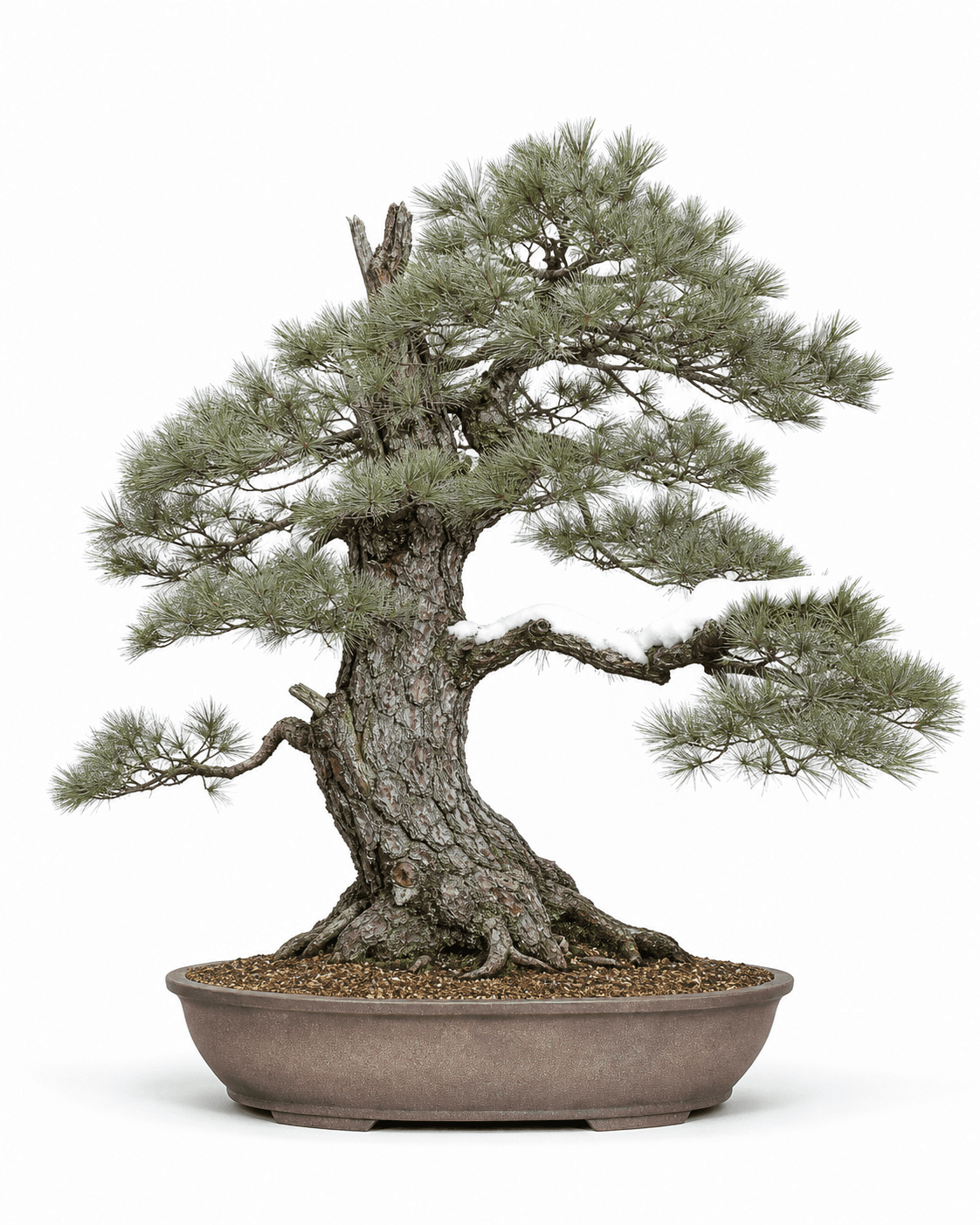
Design should come from a mountain white-pine image: broad conical youth, older horizontal branches, soft blue-green five-needle tufts, and a rounded crown with age. Use a softer rhythm than rigid black-pine silhouettes. Missouri Botanical GardenPurdue Arboretum ExplorerBonsai Mirai / Asymmetry
Reading the tree
Read sheath drop, needle age, cone load, and root oxygen before deciding what the tree can give.
The most important refinement signal is sheath drop. Mirai five-needle pine guidance uses the papery sheath falling from the needle cluster as the sign that the flush has hardened and remaining needles will keep their length. Bonsai Mirai Library
A branch ready for refinement has current needles, older retained needles, and enough interior buds to shorten back to. A branch still in development should look too long for a while because needle mass creates the vascular strength that produces future buds. Bonsai Mirai Library
Cone load is another reading. Korean white pine is valued for edible seeds, but bonsai cones are a strength sink. Remove developing cones when the tree is recovering, building branches, or short on needle mass. RHSUniversity of Minnesota Campus TreesBonsai Mirai Library
Roots decide how much top work is appropriate. If the tree was recently repotted, has moderate spring growth, or sits in old wet nursery soil, prioritize watering stability and root recovery before styling or refinement pruning. Bonsai Mirai LibraryMissouri Botanical Garden
Pruning
Use five-needle sheath-drop pruning and preserve more foliage than instinct suggests.
Mirai five-needle pine method says true five-needle pines respond to refinement after sheath drop. For Korean white pine, that means letting the candle elongate and harden, then pruning only once the papery sheath releases. Bonsai Mirai Library
Shorten strong shoots back to a selected new five-needle cluster within the 2 to 3 week post-sheath window. Keep at least one current-year needle cluster at every cut site so the branch has a bud-forming location. Bonsai Mirai Library
Avoid spring candle pinching on standard Korean white pine. Mirai pinching guidance reserves spring pinching for short-needle single-flush pines because long-needle pines respond by lengthening the remaining needles. Bonsai Mirai Library
Avoid routine decandling. Mirai long-needle single-flush guidance warns that decandling this class aborts many buds and depletes the tree over multiple seasons rather than producing the annual second flush expected from Japanese black pine. Bonsai Mirai Library
Clean with restraint. Dead needles and loose third-year needles can come off at sheath-drop time. Second-year needles still feed the tree, so preserve them unless the branch is strong and needs light or space. Bonsai Mirai Library
Roots
Repot in early spring, tie the tree firmly, and convert old soil by stages.
Use early spring as buds swell and before active elongation for root work. Mirai repotting fundamentals decide by percolation, root density, soil breakdown, and design need rather than by a rigid anniversary. Bonsai Mirai Library
Korean white pine needs protection from poorly drained wet soil. Missouri Botanical Garden recommends moist, well-drained loams and warns against wet soils, which matches Mirai's oxygen-forward five-needle pine root strategy. Missouri Botanical GardenBonsai Mirai Library
When old nursery soil remains, remove it in planned sections. A wet organic core inside dry mineral soil is a common reason pines decline after purchase, especially when the grower waters by the outer mix alone. Bonsai Mirai Library
Tie-downs matter. Mirai container-preparation guidance treats movement after repotting as a root-growth failure, because new roots hesitate or tear in shifting substrate. Anchor the root mass before filling and chopstick thoroughly. Bonsai Mirai Library
Soil and pot
Use mineral soil with extra air and pots that respect the tree's broad, cold-forest character.
A dependable default is 1:1:1 akadama:pumice:lava. Mirai soil guidance uses akadama for nutrient and water exchange, pumice for water availability and structure, and lava for oxygen movement. Bonsai Mirai Library
For white pines and similar oxygen-loving long-needle pines, Mirai pot-preparation guidance removes the smallest 1/16 inch fraction and uses roughly 1/8 to 1/4 inch interior particles to increase air space. Bonsai Mirai Library
In cooler, windy, or newly repotted situations, a little more akadama or careful top dressing can stabilize moisture. In hot humid regions, protect roots from heat while keeping the mix open enough to breathe overnight. Bonsai Mirai LibraryMissouri Botanical Garden
Pot choice should make the tree feel rooted in a cold mountain forest. Unglazed brown, gray, muted ochre, or quiet reddish clay suits old bark and blue-green needles. Very shallow pots are best reserved for refined, proven root systems. Bonsai Mirai / Asymmetry
Climate
Cold is an asset for this species, while hot humid summers require root-zone management.
NC State lists Zones 4a to 7b, UMN lists Zones 3 to 7, and RHS rates it H7. In a bonsai pot, use those landscape numbers as a starting point, then protect roots from severe freeze-thaw cycles. NC State ExtensionUniversity of Minnesota Campus TreesRHS
In cold regions, give winter dormancy outdoors with wind protection and an insulated root zone. Avoid warm garages or indoor windows that interrupt dormancy while light remains weak. Bonsai Mirai LibraryUniversity of Minnesota Campus Trees
In hot-summer regions, prioritize morning sun, airflow, a shaded pot, and water timing that leaves oxygen available overnight. Missouri notes that Korean pine generally dislikes hot humid summer locations such as St. Louis. Missouri Botanical GardenBonsai Mirai Library
In alkaline-water regions, watch for broad chlorosis and declining root function. Mirai five-needle pine guidance flags alkaline conditions as a common white-pine decline driver, so use water and substrate choices that keep roots functional. Bonsai Mirai Library
Pests and disease
Most Korean white pine problems are ordinary pine pests amplified by weak roots or the wrong climate.
RHS lists possible adelgids, conifer aphid, sawfly larvae, pine shoot moth, honey fungus, and needle cast diseases. UMN adds tip blight, rusts, rots, pine needle scale, sawflies, moths, and borers. RHSUniversity of Minnesota Campus Trees
Missouri Botanical Garden notes that healthy, well-maintained trees in native habitat usually have few major problems, then warns that soil and climate make the species harder in hot humid St. Louis conditions. Missouri Botanical Garden
Prevention in bonsai is simple and strict: full sun, clean airflow, open soil, correct watering, no stacked root work and top work, and rapid quarantine when a newly purchased pine shows scale, mites, boring dust, or branch flagging. Bonsai Mirai LibraryMissouri Botanical Garden
Because Pinus koraiensis is a white pine, inspect any rust-like branch flagging, cankers, or orange spore structures seriously. Confirm locally before pruning diseased material or moving plants across regions. Missouri Botanical GardenUniversity of Minnesota Campus Trees
Wiring
Wire after recovery and preserve the soft white-pine arc.
Mirai five-needle pine method allows refined wiring from sheath drop onward, when the needle-to-shoot connection has strengthened. Heavier structural work is usually better in early fall on a strong tree. Bonsai Mirai Library
Use normal structural wiring fundamentals: 55 to 60 degree coils, equal spacing, continuous contact, and branch pairs anchored with a full trunk revolution. Check often because smooth pine bark can hold scars for years. Bonsai Mirai Library
The design line should be softer than black pine. Mirai pine design language describes white pine branch movement as smooth and subtle, with tips lifted gently toward light rather than snapped into rigid shelves. Bonsai Mirai / Asymmetry
Protect branch crotches and avoid severe bends after repotting, during spring push, or when the tree has a heavy cone load. If a branch needs a major bend, prepare mechanically and accept that Korean white pine responds slowly. Bonsai Mirai Library
Propagation
Seed is the cleanest path, while grafting and cultivar material need label discipline.
RHS lists seed, semi-ripe cuttings, hardwood cuttings, and grafting as propagation options. NC State recommends seed as the propagation strategy for the species. RHSNC State Extension
Seed-grown material gives the cleanest root and trunk relationship, but it is slow. RHS gives a 20 to 50 year range to ultimate landscape height, and NC State lists slow growth. RHSNC State Extension
Grafted material can be useful when a compact or blue form is desired, but inspect the union. A distracting base graft, mismatched bark, or swelling at the union can dominate the eventual bonsai. Bonsai Mirai LibraryNC State Extension
Air-layering is a high-risk strategy for pines and should be treated as experimental. For bonsai, better outcomes usually come from seedlings, field-grown stock, grafted compact cultivars, or already established pre-bonsai. Bonsai Mirai Library
Buying
Buy the Latin name, the roots, and the needle mass before buying the idea of a white pine.
Start with identity. Confirm Pinus koraiensis, five-needle bundles, Korean pine or Korean white pine labeling, and a source that separates it from Pinus densiflora, Swiss stone pine, Japanese white pine, and generic pine-nut seedlings. Kew POWOGymnosperm DatabaseMissouri Botanical Garden
Good material has live older needles, clear buds, no active scale or boring evidence, no branch flagging, and a root system that can be moved into bonsai soil in stages. Bonsai Mirai LibraryMissouri Botanical GardenUniversity of Minnesota Campus Trees
NC State lists Compact Glauca, Silveray, and Winton. Compact or blue forms may help scale and color, but cultivar names do not compensate for weak roots, a poor graft union, or a trunk with no usable movement. NC State Extension
Avoid newly imported, freshly dug, or recently root-pruned material with little needle mass. Long-needle five-needle pines can look unchanged for months after root stress, then decline after stored reserves run out. Bonsai Mirai Library
Troubleshooting
Use symptom, cause, and fix thinking before adding more technique.
Symptom: new needles become too long after spring work. Likely cause: candles were pinched or shortened before sheath drop. Fix: grow the tree for strength and return to post-sheath pruning next year. Bonsai Mirai Library
Symptom: tips die after cutback. Likely cause: pruning behind all current-year needle clusters. Fix: leave at least one new five-needle cluster at every cut site. Bonsai Mirai Library
Symptom: broad yellowing with wet soil. Likely cause: poor oxygen, old organic core, root rot, alkaline water, or root damage from recent work. Fix: stabilize water, improve drainage at the next safe repot, and defer pruning. Bonsai Mirai LibraryMissouri Botanical Garden
Symptom: a single branch flags brown or yellow. Likely cause: borer, rust, canker, root failure feeding that branch, or mechanical damage. Fix: isolate the tree, inspect bark and roots, and confirm disease before cutting or moving material. Missouri Botanical GardenUniversity of Minnesota Campus Trees
Symptom: weak buds and no interior growth. Likely cause: too little needle mass, too much shade, repeated early pruning, or a weak root system. Fix: feed and grow developmentally until the tree has real replacement shoots. Bonsai Mirai Library
Symptom: sudden decline after styling. Likely cause: stacked stress from repotting, wiring, cone load, and pruning in the same season. Fix: reduce workload, remove cones, protect roots, and rebuild strength before refinement. Bonsai Mirai Library
Design
Style Korean white pine as an old Asian mountain pine with softer branch rhythm.
Missouri Botanical Garden describes a narrow pyramidal young tree that relaxes with age into a loose pyramidal form with a rounded crown and nearly horizontal branching. Purdue notes tight pyramidal branching in youth that loosens as the tree matures. Missouri Botanical GardenPurdue Arboretum Explorer
That gives a clear bonsai image: broad base, patient taper, open horizontal branch rhythm, blue-green five-needle tufts, a rounded or weather-affected apex, and enough negative space for large needles to breathe. Bonsai Mirai / Asymmetry
Choose medium or large scale unless the tree is a compact cultivar. RHS describes needles around 13 cm, and NC State gives 3.5 to 4.5 inch needles, so tiny bonsai will fight the species unless the material is exceptional. RHSNC State Extension
The defining branch should explain the environment: a snow-loaded shoulder, a broad mountain-forest side branch, a broken upper trunk, or a quiet literati line. Keep deadwood restrained and pine-specific. Bonsai Mirai / AsymmetryBonsai Mirai Library
Forms
Compact Glauca, Silveray, Winton, and dragon-eye labels need verification before design decisions.
NC State lists Compact Glauca, Silveray, and Winton. Compact Glauca is described with long soft blue needles, Silveray as fastigiate and columnar with bluish needles, and Winton as a low spreading form that grows wider than tall. NC State Extension
Cultivar traffic around Korean pine can include blue, compact, weeping, columnar, and dragon-eye style labels. Treat cultivar labels as identity clues, then verify growth habit, graft quality, and needle scale on the actual plant. NC State ExtensionPurdue Arboretum Explorer
Kew records synonyms including Pinus mandschurica, Strobus koraiensis, and Pinus prokoraiensis. Older labels may appear in botanical or nursery material, so publish and tag the accepted name first. Kew POWOGymnosperm Database
Separate Korean white pine from Korean red pine. Korean red pine is Pinus densiflora, a two-needle multiflush pine with very different pruning and decandling rules. Kew POWOGymnosperm Database
History
Korean white pine carries food, timber, and forest history, while the bonsai record remains thinner than Japanese white pine.
Flora of China records edible, medicinal, and oil uses for the seeds, plus construction, furniture, pulp, turpentine, and tannin uses from the timber and bark. Missouri also notes furniture, bridge, construction, and commercial pine-nut value. Flora of ChinaMissouri Botanical Garden
UMN notes that most pine nuts imported by the United States come from Korean pines, and that Korean pine is the most commonly used pine-nut tree in Asia among the species it compares. University of Minnesota Campus Trees
The Gymnosperm Database records a 330 year known living specimen from a South Korean tree-ring chronology and a 42 m specimen from the Ussuri Natural Reserve context. Gymnosperm Database
As bonsai, Korean white pine has less public technique coverage than Japanese white pine, Japanese black pine, Scots pine, or Ponderosa pine. That is why the page names the transferred method and stays precise about the lack of a complete Pinus koraiensis Mirai species file. Bonsai Mirai LibraryBonsai Mirai / Asymmetry
Species questions
Answer the beginner questions before styling.
Can Korean white pine be grown as bonsai?
Yes. Korean white pine can be grown as outdoor bonsai when it has full sun, winter dormancy, cool roots, oxygen-rich soil, and conservative five-needle pine timing.
Can Korean white pine bonsai live indoors?
Keep Korean white pine outdoors. It needs strong light, airflow, seasonal temperature change, and winter dormancy, with indoor display limited to brief viewing periods.
Is Korean white pine an outlier pine?
EntGrove places Korean white pine in Long-Needle Single-Flush Pines. The available evidence supports five-needle sheath-drop pruning and lacks a Korean-specific outlier decandling basis.
Should I decandle Korean white pine?
Avoid routine decandling. Use sheath-drop pruning after the spring flush hardens, and preserve enough needle mass to build roots and future buds.
When should Korean white pine be pruned?
Prune in the 2 to 3 week window after papery sheaths drop from the five-needle clusters. Defer heavy structural work to early fall on strong trees.
Can I pinch Korean white pine candles?
Avoid pinching elongating candles on standard Korean white pine. Long-needle single-flush pines respond to spring pinching with excessive needle length.
What soil works for Korean white pine bonsai?
Use an oxygen-rich mineral pine mix such as akadama, pumice, and lava. Reduce very fine particles so the roots can breathe after watering.
How cold hardy is Korean white pine bonsai?
Landscape sources commonly place Korean pine around USDA Zones 3 or 4 to 7. Bonsai roots still need protection from severe freeze-thaw exposure in pots.
Why is my Korean white pine turning yellow?
Likely causes include wet roots, poor oxygen, old nursery soil, alkaline water, recent overwork, needle disease, scale, borers, rust, or normal old-needle aging.
How is Korean white pine different from Korean red pine?
Korean white pine is Pinus koraiensis, a five-needle white pine. Korean red pine is Pinus densiflora, a two-needle multiflush pine with different pruning rules.
Sources
Species advice needs source discipline.
Next decisions
Plan the operation before copying the calendar.
A good care note for Korean white pine records the tree's stage, the work done, and the aftercare used. That record matters more than a month-name rule.
Related species
Compare nearby trees before transferring advice.
Ponderosa pine
Pinus ponderosa
Jeffrey pine
Pinus jeffreyi
Bishop pine
Pinus muricata
Sugar pine
Pinus lambertiana
Eastern white pine
Pinus strobus