
Species guide
Natal Plum Bonsai Care
Carissa macrocarpa
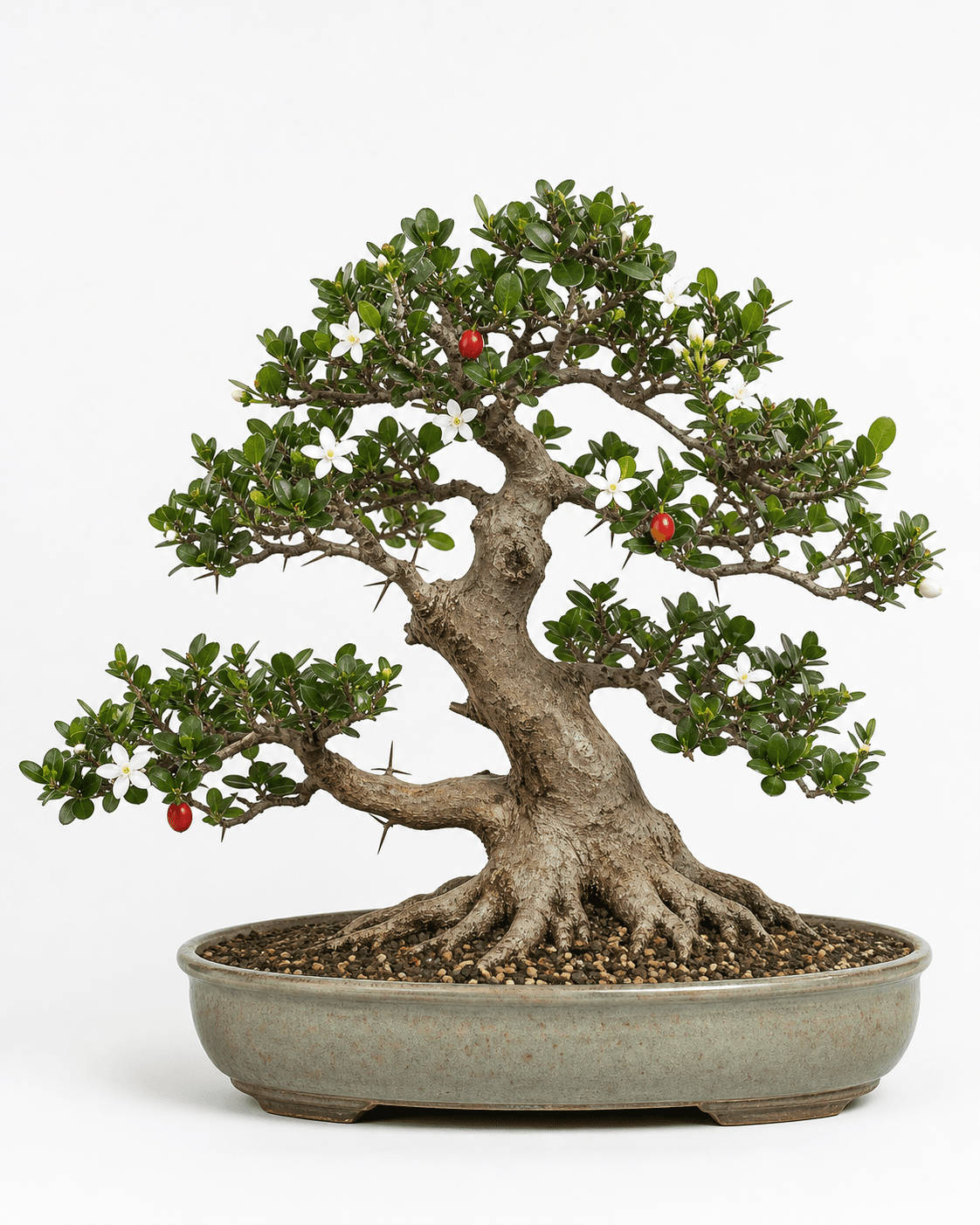
Natal plum bonsai, Carissa macrocarpa, is a warm-climate Apocynaceae shrub grown for glossy evergreen leaves, white star-shaped flowers, red edible fruit, paired thorns, and salt-tolerant coastal toughness. Treat it as protected tropical broadleaf material: high light, warm roots, fast drainage, deliberate cutback, careful thorn handling, and no freeze.
The local Bonsai Mirai corpus has no dedicated Natal plum or Carissa file. This guide transfers only broad tropical, broadleaf-evergreen, fruiting-bonsai, watering, soil, repotting, wiring, propagation, energy, and design method from Mirai, then uses Kew, NC State Extension, SANBI PlantZAfrica, and Useful Tropical Plants for identity, range, habitat, hardiness, toxicity, and propagation facts.
Natal plum is most promising for growers who can provide strong outdoor light and bright winter protection. The main risks are low-light indoor decline, cold wet roots, thorny branch handling, latex irritation, fruit load on weak trees, and shearing the plant into a dense shell with no interior structure.
Updated July 4, 2026. Written by EntGrove Editorial. Last verified July 4, 2026.
Care fingerprint
Read the species through its shared care pattern.
Treat indoor culture as a light-management problem first; prune and repot when the tree is actively growing and warm enough to recover. Use this as the starting point before local conditions and tree strength refine the calendar.
Read the foliage first
Broadleaf stress usually shows in leaf color, leaf size, wilt, scorch, or delayed hardening before it becomes a branch problem.
Match work to dormancy
Deciduous, evergreen, tropical, succulent, and flowering broadleaf trees recover on different calendars.
Protect fine roots
Root work should preserve enough active fine roots for the tree to rehydrate quickly after the operation.
Care cadence
The calendar starts with the tree's seasonal state.
Placement
Timing: Grow outside in full sun during warm weather after acclimation. Move into bright protection before cold nights threaten tropical root function.
Watch for: Long weak indoor shoots, large shaded leaves, scorch after sudden exposure, cold drafts, and fruiting branches that shade the interior.
NC State ExtensionBonsai Mirai LibraryWatering
Timing: Water the whole root mass when the upper soil is approaching dryness, then let drainage and air return before the next full watering.
Watch for: Hydrophobic nursery cores, wet lower soil during winter protection, dry edges in hot wind, salt accumulation, and wilting after a recent watering.
Bonsai Mirai LibraryPlantZAfrica: Carissa macrocarpaFertilizer
Timing: Feed during active warm growth. Use stronger feeding for development and moderate feeding when flowers, short internodes, or refinement matter.
Watch for: Coarse thorny shoots from heavy feeding in low light, fruit load on weak trees, and fertilizer applied while roots are cold or recently disturbed.
Bonsai Mirai LibraryPruning
Timing: Let selected shoots extend enough to feed the branch, then cut back to useful interior growth while warmth remains for recovery.
Watch for: Repeated hedge shearing, removing all flower-bearing tips, bars from paired branching, latex flow from heavy cuts, and shaded inner growth.
Bonsai Mirai LibraryPlantZAfrica: Carissa macrocarpaFlower and fruit management
Timing: Allow flowers and fruit only on strong trees that are past the recovery stage. Remove excess fruit from trees still building roots or primary structure.
Watch for: Fruit set exhausting weak branches, pruning just before display, birds or pests on ripe fruit, and confusing edible ripe fruit with irritating sap.
NC State ExtensionBonsai Mirai LibraryWiring
Timing: Wire young flexible shoots during active growth, then inspect often because warm growth can swell under wire and thorns complicate access.
Watch for: Wire bite on glossy bark, thorn punctures, bending brittle old wood, wiring after root work, and branch cracks with latex flow.
Bonsai Mirai LibraryRepotting
Timing: Repot in warm active growth, generally after nights are near 60 F / 16 C or warmer and several warm weeks remain.
Watch for: Bare-rooting a leafy tree, burying the crown, cutting roots and canopy hard together, weak tie-downs, and cold wet aftercare.
Bonsai Mirai LibraryPropagation
Timing: Use seed, cuttings, or layers in warmth. Cuttings need humidity and oxygen, while seed may vary from the parent plant.
Watch for: Cold saturated media, too much foliage on cuttings, unripe fruit collection, thorny handling, and layers separated before enough roots form.
Useful Tropical Plants: Carissa macrocarpaBonsai Mirai LibraryPests and safety
Timing: Inspect dense warm foliage and protected winter plants regularly, and wear protection when pruning thorny or latex-bearing branches.
Watch for: Scale, mites, mealybugs, sooty residue, root rot, thorn injuries, pets or children around fruit and sap, and poor airflow inside clipped canopies.
NC State ExtensionBonsai Mirai LibrarySpecies guide
Apply the species profile before copying another tree's calendar.
At a glance
Natal plum is a coastal tropical shrub with bonsai promise and sharp edges.
Carissa macrocarpa brings several traits bonsai growers like: glossy evergreen leaves, fragrant white flowers, red fruit, tight twigging potential, and rugged coastal tolerance. It also brings paired thorns and milky sap, so handling and pruning need more care than a soft tropical broadleaf. Kew POWONC State ExtensionPlantZAfrica: Carissa macrocarpa
The local Mirai corpus does not contain a dedicated Natal plum file. This page applies source-depth-aware tropical method from Mirai files such as tropical-primer, tropical-bonsai-repot, tropical-winter-preparation, broadleaf-evergreen, fruiting-bonsai-design, beginner-series-watering, beginner-series-soil, beginner-series-repotting, beginner-series-structural-wiring, fertilizer-101, energy-distribution, propagation-primer, and design-fundamentals. Bonsai Mirai LibraryBonsai Mirai / Asymmetry
That limitation matters. The safest care calendar is evidence-based and conservative: bright warmth, active extension, an oxygenated root zone, and recovery time before major pruning, wiring, repotting, or fruiting expectations. Bonsai Mirai Library
Wild habitat
Its native signal is coastal sun, drainage, wind, and salt tolerance.
PlantZAfrica describes Carissa macrocarpa as a South African coastal shrub or small tree associated with dune vegetation, forest margins, and thickets. Kew places it in southern Africa and records the accepted name in Apocynaceae. PlantZAfrica: Carissa macrocarpaKew POWO
Useful Tropical Plants and PlantZAfrica both point to a plant comfortable in sandy or well-drained coastal settings, with tolerance for salt-laden wind once established. In bonsai, that translates into strong light, air movement, and soil that drains quickly after each full watering. PlantZAfrica: Carissa macrocarpaUseful Tropical Plants: Carissa macrocarpa
For care, avoid turning coastal toughness into neglect. A landscape shrub can chase moisture through a large root system, while a bonsai pot has limited reservoir, more heat swing, and less margin after root work. Bonsai Mirai Library
For design, the wild story supports compact coastal shrub images, informal upright trees with wind-shaped structure, exposed-root or clump forms, and open flowering branch tips. Dense hedge balls hide the best parts of the species. Bonsai Mirai / AsymmetryPlantZAfrica: Carissa macrocarpa
Reading the tree
Read Natal plum through light, thorny extension, flower rhythm, and root oxygen.
Strong Natal plum growth is compact, glossy, and firm, with new shoots that can be shortened back to useful interior growth. Weak growth is long, pale, oversized, or clustered only at the tips after repeated shearing. Bonsai Mirai Library
Thorns mark the plant as a protective coastal shrub and affect styling access. Remove or shorten thorns only when they interfere with wiring, safety, or the design; keep in mind that thorn removal can create small wounds and latex flow. PlantZAfrica: Carissa macrocarpaBonsai Mirai / Asymmetry
Flowers and fruit are a strength signal. A tree that is recently repotted, low on light, or still building primary branches should spend energy on roots and structure before carrying a heavy crop. NC State ExtensionBonsai Mirai Library
Root oxygen is the everyday diagnostic. Yellow leaves, sour soil, and stalled shoots usually point first to cold wet roots, old nursery soil, poor drainage, or a watering rhythm that never lets air return. Bonsai Mirai Library
Pruning
Prune for interior structure before asking the tree to flower heavily.
Use extension and cutback. Let selected shoots lengthen enough to feed a branch or thicken a section, then cut back to a lateral shoot, interior bud, or branch line that supports the future silhouette. Bonsai Mirai Library
Avoid constant hedge clipping. NC State describes Natal plum as dense and mounding, which is useful for nursery production, but bonsai refinement needs light to reach inner buds and branch junctions that can be read. NC State ExtensionBonsai Mirai / Asymmetry
Flower timing changes the pruning choice. If a strong refined tree is being prepared for display, leave selected flower-bearing tips and shorten after the display. If the tree is in development, remove flowers or young fruit that interfere with branch building. NC State ExtensionBonsai Mirai Library
Handle thorns and latex deliberately. Use gloves and eye protection when cutting thorny branches, and clean tools after sap contact. Keep pets and children away from pruning waste and unverified fruit use. NC State ExtensionPlantZAfrica: Carissa macrocarpa
Roots
Repot warm, preserve function, and keep the crown high.
Mirai tropical method places major root work after warm nights stabilize near 60 F / 16 C or warmer. Natal plum should be worked in that same active-growth window so cuts can callus and roots can replace lost function. Bonsai Mirai Library
Do not bare-root a leafed tropical shrub. Leave part of the root mass functioning, remove the worst soil or circling roots first, and stage nursery-core correction across more than one repot when the tree is weak. Bonsai Mirai Library
Keep the root crown exposed and stable. Mirai tropical repotting guidance warns that burying crowns deeper can invite rot where bark stays wet. Set the root flare as the high point and tie the tree firmly. Bonsai Mirai Library
After repotting, water through, confirm drainage, protect from harsh wind or afternoon sun, and wait for new extension before pruning hard or allowing fruit to mature. Bonsai Mirai Library
Soil and pot
Use a coastal-tropical root system: water available, air returning fast.
A practical starting mix is equal parts akadama, pumice, and lava. Add more pumice or durable aggregate in rainy, humid, or indoor-protected conditions where akadama and organic fines stay wet too long. Bonsai Mirai Library
Useful Tropical Plants describes Natal plum as tolerating a range of soils when drainage and sun are strong. Bonsai culture should translate that into particle size, tie-down stability, and enough pot depth to buffer hot coastal or patio exposure. Useful Tropical Plants: Carissa macrocarpaBonsai Mirai Library
During development, use a deeper training container so roots and branch structure can build. Move to a shallower display pot after the root pad, branch rhythm, and watering schedule can tolerate less reservoir. Bonsai Mirai LibraryBonsai Mirai / Asymmetry
Pot choice should support white flowers, red fruit, glossy foliage, and coastal shrub character. Quiet unglazed or softly glazed ovals and rectangles usually serve the species better than a loud container. Bonsai Mirai / AsymmetryNC State Extension
Climate
The care calendar changes most around winter protection and summer heat.
In frost-free coastal or subtropical regions, Natal plum can live outdoors year-round if the pot drains well and summer watering keeps pace. Salt and wind tolerance help, but a small pot still dries faster than a landscape root system. PlantZAfrica: Carissa macrocarpaUseful Tropical Plants: Carissa macrocarpaBonsai Mirai Library
In cold-winter regions, use bright protected tropical culture. Move the tree before freezing weather, reduce watering as metabolism slows, and avoid pruning, wiring, or repotting while nights are cold. NC State ExtensionBonsai Mirai Library
In hot inland regions, full sun may still be correct after acclimation, but recently repotted trees, nursery stock from shade, and trees in shallow pots need afternoon protection during recovery. Bonsai Mirai Library
In humid regions, airflow matters. Dense clipped foliage, flowers, and fruit can trap moisture and pests, so open the structure gradually and keep dead stubs and fallen fruit out of the canopy and pot. Bonsai Mirai LibraryNC State Extension
Pests
Most problems trace to dense foliage, weak winter culture, or wet roots.
NC State lists relatively few serious pest and disease problems for landscape Natal plum, but bonsai conditions are different. Containers, winter protection, and dense pruning can make scale, mealybugs, mites, and sooty residue more likely. NC State ExtensionBonsai Mirai Library
Inspect branch crotches, thorn bases, underside leaf surfaces, and the inner canopy. Pests hide where shearing has created dense foliage and poor light. Bonsai Mirai Library
Root disease risk is mainly cultural. Cold wet soil, buried crown tissue, decomposed nursery peat, and poor tie-down stability reduce root oxygen and make decline look like a mysterious species problem. Bonsai Mirai Library
Safety belongs in pest management too. NC State notes low severity poison characteristics from sap and lists the ripe fruit as edible. Treat sap, unripe fruit, pruning waste, and unknown seedlings conservatively. NC State Extension
Wiring
Wire young growth, protect glossy bark, and respect the thorns.
Young shoots are the best wiring targets. Wire while the tree is actively growing, support the branch with your fingers, and bend gradually rather than forcing old thorny wood. Bonsai Mirai Library
Thorns change hand position and tool access. Remove only the thorns that make the work unsafe or visually distracting, then clean up the small wound and monitor latex flow. PlantZAfrica: Carissa macrocarpaBonsai Mirai Library
Check wire often in warm weather. A well-fed tropical broadleaf can swell quickly, and smooth bark records wire marks long after the branch has set. Bonsai Mirai Library
Use pruning for much of the final branch architecture. Directional cutback, branch replacement, and light access are usually safer than heavy bends on older thorny branches. Bonsai Mirai / AsymmetryBonsai Mirai Library
Propagation
Seed, cuttings, and layers are possible when warmth and oxygen are steady.
Useful Tropical Plants lists seed, cuttings, and layering as propagation paths. For bonsai, cuttings and layers preserve known leaf size, internode length, flower rhythm, and thorn character better than seed. Useful Tropical Plants: Carissa macrocarpa
Mirai propagation method puts softwood and semi-hardwood cutting work into sustained warm nights, with perlite or similarly airy media, reduced foliage, humidity, and no fertilizer until roots exist. Bonsai Mirai Library
Air layers can rescue the useful top of hedge stock with poor roots or a buried base. Layer in active growth and separate only after roots can support the evergreen canopy. Bonsai Mirai Library
Seedlings are useful for root work and clump experiments, but they may vary in fruit, thorn density, compactness, and vigor. Record the parent plant and germination date. Useful Tropical Plants: Carissa macrocarpaBonsai Mirai / Asymmetry
Buying
Buy for base, interior branches, and manageable thorns before fruit.
Good material has a visible root flare, active low branches, short internodes, compact glossy leaves, healthy tips, and a trunk that can be read after thinning. Fruit on a weak plant is a lower priority. Bonsai Mirai / AsymmetryNC State Extension
Hedge and nursery stock can work if the trunk line has movement below the clipped shell. Open the canopy gradually and do not combine first styling, hard root work, and fruit display in the same season. Bonsai Mirai Library
Red flags include sour organic soil, a buried crown, no interior growth, large shaded leaves, scale or mealybug residue, cracked thorny branches, poor graft or layer history, and labels that do not separate Natal plum from unrelated plum species. NC State ExtensionUseful Tropical Plants: Carissa macrocarpa
For cold regions, ask how the tree was wintered and when it last had root work. A warm-grown coastal shrub needs staged acclimation into indoor protection, supplemental light, and a slower watering rhythm. Bonsai Mirai Library
Troubleshooting
Start diagnosis with light, warmth, roots, recent cuts, and fruit load.
Symptom: long shoots, large leaves, and few flowers. Likely causes: low light, excessive nitrogen, or constant clipping. Fix: increase light gradually, moderate feeding, and use extension-and-cutback cycles. Bonsai Mirai Library
Symptom: yellowing leaves with wet soil. Likely causes: cold roots, decomposed nursery soil, poor drainage, or a buried crown. Fix: warm the tree, reduce watering frequency, and plan staged root correction in active growth. Bonsai Mirai Library
Symptom: no interior buds after shearing. Likely causes: a dense exterior shell and poor light penetration. Fix: open windows for light, preserve weak inner shoots, and rebuild from selected cutback points. Bonsai Mirai / AsymmetryBonsai Mirai Library
Symptom: branch cracks and milky sap after bending. Likely causes: wiring old wood, moving too far at one point, or working while the branch is dry. Fix: stop bending, support the branch, and build future movement with younger shoots. Bonsai Mirai LibraryNC State Extension
Symptom: flowers appear but fruit drops or weakens the branch. Likely causes: water swings, weak roots, poor light, or too much crop load. Fix: stabilize care and remove excess fruit until the tree is stronger. NC State ExtensionBonsai Mirai Library
Symptom: sticky leaves or black film. Likely causes: scale, mealybugs, aphids, or sooty mold from honeydew. Fix: isolate, identify the pest, improve airflow, and clean the canopy before escalating treatment. Bonsai Mirai Library
Design
Style Natal plum as a coastal flowering shrub with visible structure.
Start with the base, trunk line, defining branch, and apex. Natal plum often reads best when the design shows a tough coastal shrub character rather than a smooth indoor houseplant silhouette. Bonsai Mirai / AsymmetryPlantZAfrica: Carissa macrocarpa
Use thorns as part of the species character when they are scaled and safe, then remove distracting or dangerous thorns that break the line. A few visible thorns can communicate the plant better than a completely sanitized canopy. PlantZAfrica: Carissa macrocarpaBonsai Mirai / Asymmetry
Open branch architecture is essential. White flowers and red fruit need light and visibility, and dense shell pruning hides the seasonal display that makes the species worth growing. NC State ExtensionBonsai Mirai / Asymmetry
Deadwood is usually a supporting feature at most. The stronger design language is live coastal movement, glossy leaves, flowers, fruit, exposed roots, and thorny age marks. Bonsai Mirai / Asymmetry
Forms
Most bonsai labels point to one species, but cultivar traits still matter.
Kew accepts Carissa macrocarpa as the botanical anchor. PlantZAfrica and Useful Tropical Plants record common names such as Natal plum, large num-num, big num-num, amatungulu, and related South African names. Kew POWOPlantZAfrica: Carissa macrocarpaUseful Tropical Plants: Carissa macrocarpa
Nursery forms may be selected for compactness, fruit, hedge behavior, or lower thorn density. For bonsai, choose by internode length, leaf size, trunk base, branch options, root health, and how safely the plant can be worked. NC State ExtensionBonsai Mirai / Asymmetry
Do not transfer this page to unrelated plum labels in Prunus. Natal plum is an evergreen Apocynaceae shrub, while true plums are temperate Rosaceae trees with very different dormancy and pruning windows. Kew POWONC State Extension
History
Its bonsai story is nursery, hedge, and coastal-shrub material rather than a famous old lineage.
PlantZAfrica frames Natal plum as a valued indigenous South African shrub for hedging, coastal planting, wildlife, flowers, and fruit. That practical landscape history explains why bonsai candidates often start as hedge or nursery stock. PlantZAfrica: Carissa macrocarpa
Compared with Japanese black pine, Shimpaku, Satsuki azalea, and Japanese maple, Natal plum has a thinner public record of named exhibition trees. That makes transparent methodology more important than inherited legend. Bonsai Mirai LibraryBonsai Mirai / Asymmetry
For EntGrove records, track source label, winter lows, repot dates, fruit load, pruning cycles, thorn removal, sap reactions, pest checks, and whether the tree was grown from seed, cutting, layer, or nursery stock. Bonsai Mirai Library
Species questions
Answer the beginner questions before styling.
Is Natal plum good for bonsai?
Yes, for growers who can provide strong light, warm roots, careful watering, and safe thorn handling. It has glossy evergreen leaves, fragrant white flowers, red fruit, and compact shrub character.
Can Natal plum bonsai grow indoors?
It can be winter-protected indoors under strong light, warmth, airflow, and careful watering. Ordinary low-light windowsill culture usually causes weak growth and poor flowering.
How cold can Natal plum bonsai tolerate?
NC State lists Carissa macrocarpa for USDA Zones 9-11, but bonsai pots need earlier protection. Avoid freezing the root ball and save major work for warm active growth.
When should I repot Natal plum bonsai?
Repot in warm active growth, usually after nights are near 60 F / 16 C or warmer. Repot for drainage, root density, old soil, anchoring, or design need rather than a fixed calendar.
What soil is best for Natal plum bonsai?
Use a fast-draining tropical broadleaf mix. Equal parts akadama, pumice, and lava are a useful starting point, adjusted for local heat, rain, indoor protection, and pot depth.
How do I prune Natal plum bonsai?
Let selected shoots extend enough to feed the branch, then cut back to useful interior growth. Avoid constant hedge shearing because it shades the interior and weakens branch structure.
Can Natal plum bonsai fruit?
Yes. Strong trees can flower and carry red ripe fruit, but fruit load costs energy. Remove excess fruit on trees that are recovering, recently repotted, or still building primary structure.
Is Natal plum poisonous?
NC State lists ripe fruit as edible and gives the sap low severity poison caution. Handle latex, thorns, pruning waste, unripe fruit, pets, and children conservatively.
Can Natal plum be propagated from cuttings?
Yes. Useful Tropical Plants lists cuttings and layering along with seed. Use warmth, humidity, and an airy medium, and reduce foliage so transpiration does not outrun new roots.
Is Natal plum the same as a true plum?
Natal plum is Carissa macrocarpa in Apocynaceae. True plums are Prunus in Rosaceae, so dormancy, pruning, pests, and repot timing differ substantially.
Sources
Species advice needs source discipline.
Next decisions
Plan the operation before copying the calendar.
A good care note for Natal plum records the tree's stage, the work done, and the aftercare used. That record matters more than a month-name rule.
Related species
Compare nearby trees before transferring advice.
Ficus retusa / Indian laurel
Ficus microcarpa
Tigerbark ficus
Ficus microcarpa 'Tigerbark'
Willow-leaf ficus
Ficus salicaria
Benjamin fig
Ficus benjamina
Ginseng ficus
Ficus microcarpa 'Ginseng'