
Species guide
Orange Jasmine Bonsai Care
Murraya paniculata
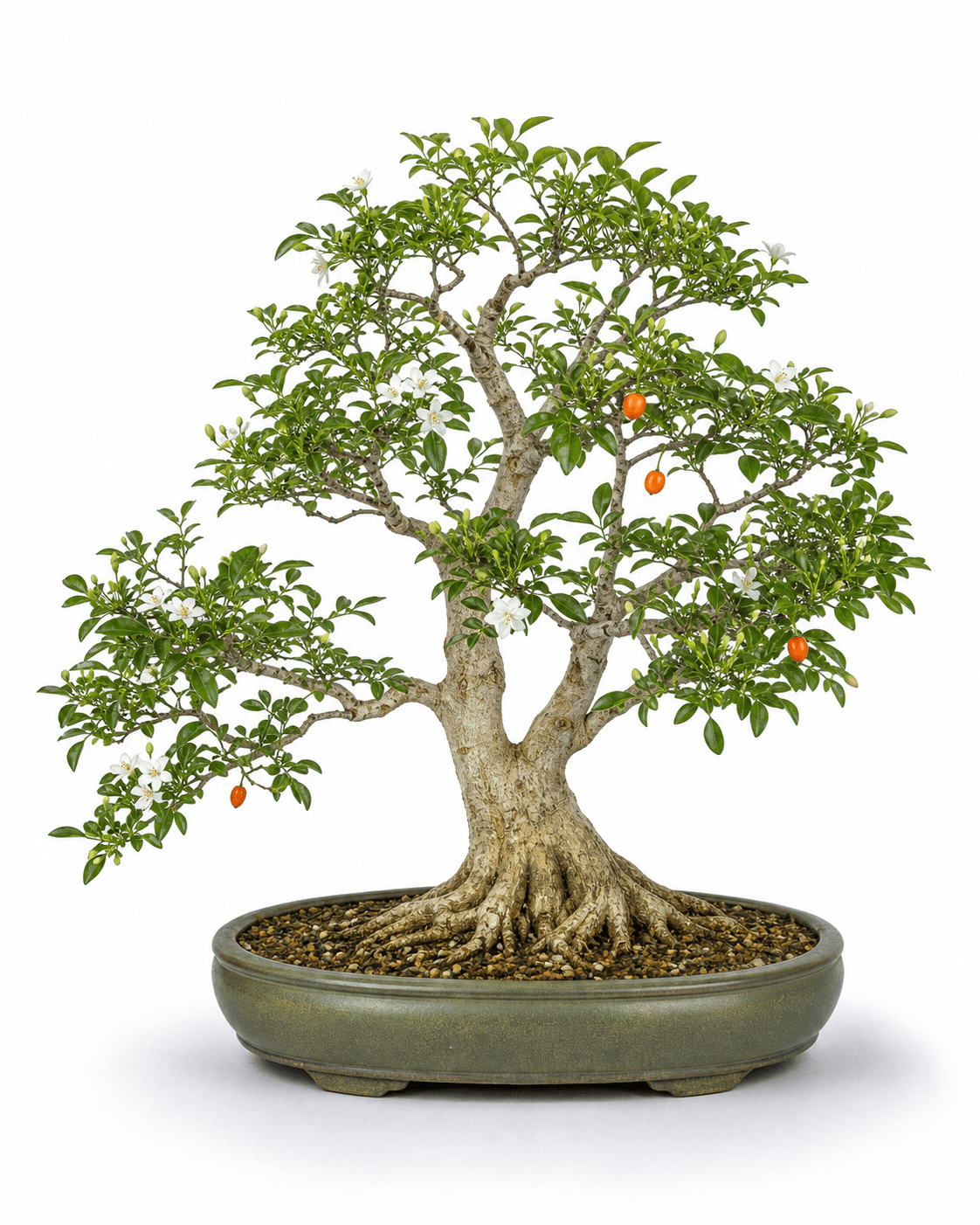
Orange jasmine bonsai, Murraya paniculata, is a warm-climate Rutaceae shrub or small tree grown for glossy compound foliage, fragrant white flowers, red-orange fruit, and hedge-stock responsiveness. Treat it as a protected tropical broadleaf bonsai: strong light, warm roots, oxygenated soil, repeated cutback, and no frost.
The local Bonsai Mirai corpus has no dedicated orange jasmine file. This guide transfers only broad tropical and broadleaf-evergreen method from Mirai, then anchors identity, range, habitat, and cultivation limits in Kew, Flora of China, Useful Tropical Plants, and UC IPM citrus-relative pest guidance.
Orange jasmine can be useful bonsai material for growers who can provide bright outdoor warmth or serious winter protection. The main risks are low-light indoor decline, cold wet roots, hedge-shearing into a dense shell, root disturbance, and citrus-region quarantine or psyllid concerns.
Updated July 4, 2026. Written by EntGrove Editorial. Last verified July 4, 2026.
Care fingerprint
Read the species through its shared care pattern.
Treat indoor culture as a light-management problem first; prune and repot when the tree is actively growing and warm enough to recover. Use this as the starting point before local conditions and tree strength refine the calendar.
Read the foliage first
Broadleaf stress usually shows in leaf color, leaf size, wilt, scorch, or delayed hardening before it becomes a branch problem.
Match work to dormancy
Deciduous, evergreen, tropical, succulent, and flowering broadleaf trees recover on different calendars.
Protect fine roots
Root work should preserve enough active fine roots for the tree to rehydrate quickly after the operation.
Care cadence
The calendar starts with the tree's seasonal state.
Placement
Timing: Grow outside in bright warmth whenever nights stay reliably above about 60 F / 16 C. Protect before nights approach 45 F / 7 C.
Watch for: Leaf drop after moves, long soft indoor shoots, cold wet benches, scorched recently sheltered foliage, and weak flowering in shade.
Bonsai Mirai LibraryUseful Tropical Plants: Murraya paniculataWatering
Timing: Water the whole root mass when the upper soil is approaching dryness, then let the pot drain and breathe before the next full pass.
Watch for: Hydrophobic old nursery cores, sour wet soil, winter overwatering, tip wilt in hot wind, and watering only the surface of a dense root ball.
Bonsai Mirai LibraryFertilizer
Timing: Feed in active growth after light, water, and roots are stable. Use moderate feeding during development and lighter feeding when short internodes and flowers matter.
Watch for: Coarse hedge-like shoots, weak pale growth, fertilizer on cold roots, and heavy nitrogen that favors leaves over flower display.
Bonsai Mirai LibraryPruning
Timing: Let shoots extend enough to feed the branch, then cut back to useful interior buds while warmth remains for recovery.
Watch for: Repeated shearing, shaded interiors, removing every flowering tip, cutting into weak branches, and pruning immediately after repotting.
Bonsai Mirai LibraryFlowering
Timing: Flowering is strongest on a healthy tree with bright light, warm roots, and some extension. Shorten after a display rather than constantly pinching every tip.
Watch for: Bud drop after cold moves, no flowers in weak indoor light, fruit load on an undeveloped tree, and pruning all new tips before bloom.
Useful Tropical Plants: Murraya paniculataBonsai Mirai LibraryWiring
Timing: Wire young flexible shoots during active growth, then inspect often because warm growth can swell quickly under wire.
Watch for: Bark marks, brittle older branches, unsupported bends, wire left through a growth flush, and bending right after root work.
Bonsai Mirai LibraryRepotting
Timing: Repot only in warm active growth, usually when nights are near 60 F / 16 C or warmer and several warm weeks remain.
Watch for: Bare-rooting, tearing fine roots, burying the crown, cold aftercare, severe top pruning in the same window, and loose tie-downs.
Bonsai Mirai LibraryUseful Tropical Plants: Murraya paniculataPests and regulation
Timing: Inspect new flushes during warm growth and before moving plants across citrus-region boundaries.
Watch for: Scale, whitefly, mites, sooty mold, nematode-weakened roots, ants, Asian citrus psyllid concern in citrus areas, and local quarantine rules.
Useful Tropical Plants: Murraya paniculataUC IPM: Asian Citrus Psyllid and HuanglongbingSpecies guide
Apply the species profile before copying another tree's calendar.
At a glance
Orange jasmine is a citrus-family tropical bonsai for bright warmth and repeated cutback.
Murraya paniculata gives bonsai growers small glossy leaflets, fragrant white flowers, red-orange fruit, smooth pale bark, and hedge-stock availability. The trade names are broad, so verify the plant before copying care from generic jasmine, mock orange, or citrus pages. Kew POWO search: Murraya paniculataFlora of China via eFlorasUseful Tropical Plants: Murraya paniculata
The local Mirai corpus does not contain a dedicated orange jasmine transcript. The defensible bonsai method is transferred from tropical-primer, tropical-bonsai-repot, tropical-winter-preparation, tropical-styling, broadleaf-evergreen-refinement, watering, soil, repotting, wiring, energy, and design files. Bonsai Mirai LibraryBonsai Mirai / Asymmetry
That means the care calendar is conservative. Work the tree only when warmth, light, root oxygen, and active growth are present. Let plant-specific sources handle identity, habitat, and pest cautions, then apply tropical bonsai technique with restraint. Bonsai Mirai LibraryUseful Tropical Plants: Murraya paniculata
Wild habitat
Its native pattern points to warm thickets, forest edges, and filtered tropical light.
Flora of China describes Murraya paniculata in thickets and montane forests from near sea level to about 1,300 m, with a range through southern China and adjacent Asian regions. Useful Tropical Plants extends the practical range description through the Indian subcontinent, Myanmar, Southeast Asia, and Australia. Flora of China via eFlorasUseful Tropical Plants: Murraya paniculata
For care, this means warmth and moisture without stagnant roots. A bonsai pot should receive thorough water and then recover oxygen quickly, especially in winter protection when tropical metabolism slows. Bonsai Mirai Library
For design, the wild signal is a fine-textured evergreen shrub or small tree, not a pine, juniper, or temperate flowering tree. Orange jasmine designs read best when the canopy has air, scent, small flowers, and restrained tropical movement. Useful Tropical Plants: Murraya paniculataBonsai Mirai / Asymmetry
In hot inland climates, give strong morning sun and afternoon protection after repotting or relocation. In humid warm climates, maintain airflow so dense hedge foliage does not become a pest and fungal shelter. Bonsai Mirai LibraryUseful Tropical Plants: Murraya paniculata
Reading the tree
Read growth by light, root activity, and whether pruning is creating interior buds.
A developing orange jasmine should extend, harden, and be cut back in cycles. Each extension feeds the branch; each cutback should leave useful buds closer to the trunk. Constant shearing creates a green shell and weak interior structure. Bonsai Mirai Library
A refined tree shows shorter internodes, compact leaves, visible branch lines, fragrant flowers on healthy tips, and enough open space for light to reach the next generation of buds. Bonsai Mirai / AsymmetryBonsai Mirai Library
Weak trees usually tell the story in the tips first: pale leaves, stalled extension, dropped buds, soft waterlogged soil, or long indoor growth. Correct light, warmth, water, and roots before styling. Bonsai Mirai Library
Because orange jasmine is in Rutaceae, tender flushes also deserve pest attention. In citrus-growing areas, new flushes should be inspected before moving the tree or placing it near citrus. Kew POWO search: Murraya paniculataUC IPM: Asian Citrus Psyllid and Huanglongbing
Pruning
Use extension and cutback rather than hedge shearing.
Prune after a shoot has made enough leaves to feed the branch. Cut to a lateral bud or interior fork that supports the future silhouette. On young hedge stock, grow first for trunk and low branches before chasing tiny outline control. Bonsai Mirai Library
Flowering changes the choice. If a refined tree is strong, leave selected tips to bloom, then prune after the display. If the tree is still in development or just repotted, remove excess flower and fruit load so energy returns to leaves, roots, and branch structure. Useful Tropical Plants: Murraya paniculataBonsai Mirai Library
Avoid routine full defoliation. Selective leaf removal can open a strong tree for light or wiring, but stripping every leaf removes the energy source that tropical broadleaf trees need for warm recovery. Bonsai Mirai Library
When rebuilding nursery material, choose the trunk line and defining branch first. Then remove only what blocks that image or shades necessary inner growth. A slower first year often produces a better second year. Bonsai Mirai / Asymmetry
Roots
Repot warm and keep enough root function to support evergreen leaves.
Mirai tropical method places major root work in warm active growth, after nights are reliably near 60 F / 16 C or warmer. That threshold is especially useful for orange jasmine in temperate climates because cold wet roots recover slowly. Bonsai Mirai Library
Repot for evidence: poor drainage, decomposed soil, circling roots, a buried crown, bad anchoring, or a container stage that no longer matches the design. Avoid bare-rooting a weak tree just to make old nursery soil disappear in one session. Bonsai Mirai Library
Useful Tropical Plants notes sensitivity to root disturbance in general cultivation. In bonsai, that argues for staged root correction, firm tie-downs, warm aftercare, and leaving enough foliage to rehydrate the tree. Useful Tropical Plants: Murraya paniculataBonsai Mirai Library
After repotting, water through, confirm drainage, protect from harsh wind or afternoon sun, and wait for new extension before pruning hard. Do not ask roots and canopy to rebuild from maximum reduction at the same time. Bonsai Mirai Library
Soil and pot
Build a warm root zone that holds water briefly and then breathes.
Useful Tropical Plants describes preference for rich, moist, well-drained loam and full sun to part shade, sheltered from strong winds. A bonsai mix should translate that into water availability plus fast oxygen return. Useful Tropical Plants: Murraya paniculata
A practical training mix is equal parts akadama, pumice, and lava. In wet or indoor-protected conditions, increase pumice or lava. In dry warm wind, retain enough akadama or similar water-holding mineral to keep fine roots active between waterings. Bonsai Mirai Library
Pot selection should stay quiet because the flowers and fruit are already the seasonal accent. Unglazed clay, muted green, warm gray, and small oval or rectangle forms usually support the species better than loud glaze. Bonsai Mirai / Asymmetry
Use deeper training containers while building trunks and primary branches. Move to a shallower pot only after the root pad, watering rhythm, and branch structure can tolerate the reduced reservoir. Bonsai Mirai Library
Climate
The calendar changes most in winter and in hot inland summer.
In frost-free tropical and subtropical regions, orange jasmine can grow as an outdoor bonsai through multiple warm flushes. Use bright light, wind protection after work, and careful pruning so flowers and inner buds are not removed by habit. Useful Tropical Plants: Murraya paniculataBonsai Mirai Library
In cold-winter regions, treat it as protected tropical material. Bring it into bright warmth before nights approach 45 F / 7 C, reduce water demand with temperature, and avoid major pruning or repotting until warm active growth returns. Bonsai Mirai Library
In hot dry regions, the issue is afternoon exposure and pot reservoir. A strong established tree can handle sun better than a freshly repotted or newly purchased one. Acclimate in steps. Bonsai Mirai LibraryUseful Tropical Plants: Murraya paniculata
In citrus-growing regions, local regulation matters. UC IPM explains that citrus trees and close relatives can be subject to quarantine restrictions where Asian citrus psyllid and HLB are managed. Check local movement rules before transporting orange jasmine. UC IPM: Asian Citrus Psyllid and HuanglongbingKew POWO search: Murraya paniculata
Pests
Most pest problems start with dense flushes, weak indoor culture, or citrus-relative exposure.
Useful Tropical Plants lists weed potential and notes common cultivation use in tropical and subtropical regions. In a bonsai pot, dense hedge-like foliage can shelter scale, whitefly, mites, and sooty residue when airflow is poor. Useful Tropical Plants: Murraya paniculata
Inspect new flushes first. UC IPM explains that Asian citrus psyllid monitoring focuses on young developing leaves on citrus flushes, with twisted leaves, waxy deposits, honeydew, sooty mold, eggs, nymphs, and adults as warning signs. UC IPM: Asian Citrus Psyllid and Huanglongbing
Root pests and root decline are easy to confuse. If leaves dull, tips stall, or buds drop, check drainage, old soil, cold exposure, and wet lower layers before assuming a rare disease. Bonsai Mirai Library
Avoid broad pesticide habits on a flowering plant. Identify the pest, remove flowers if a treatment could affect pollinators, and follow local guidance where citrus pest programs are active. UC IPM: Asian Citrus Psyllid and Huanglongbing
Wiring
Wire flexible shoots and build the rest with cutback.
Young orange jasmine shoots can be wired during active growth when they are still flexible. Use smooth coils, support the branch while bending, and distribute movement rather than forcing one sharp bend. Bonsai Mirai Library
Older hedge branches often respond better to pruning, replacement shoots, and guy-wire adjustments. If a branch resists, grow a younger branch in the right direction rather than tearing the cambium. Bonsai Mirai / Asymmetry
Inspect wire frequently in warm weather. A tree that is extending and being fed can mark quickly, and scars on smooth pale bark remain visible longer than the grower expects. Bonsai Mirai Library
Do not wire immediately after repotting or during weak indoor winter protection. Wait until new extension confirms that roots and foliage are working together. Bonsai Mirai Library
Propagation
Cuttings, seed, and air layers all fit, but timing decides success.
Useful Tropical Plants describes orange jasmine as cultivated, ornamental, and capable of repeated flowering and fruiting in suitable climates. Seed can be used when fruit is available, though seedling variation should be expected. Useful Tropical Plants: Murraya paniculata
Stem cuttings are practical for preserving compact leaves, flower habit, or an unusually good hedge selection. Root them in warmth, humidity, and an airy medium rather than cold wet potting soil. Bonsai Mirai Library
Air layers are useful when a hedge or nursery plant has a better upper trunk than root base. Layer only during active growth and separate when enough roots exist to support the evergreen canopy. Bonsai Mirai Library
Grafting is rarely the first path for ordinary bonsai culture, but Rutaceae identity means citrus-family compatibility questions can appear in horticulture. For bonsai, own-root cuttings or layers are easier to interpret. Kew POWO search: Murraya paniculataBonsai Mirai / Asymmetry
Buying
Buy for roots, branch options, and legal local movement.
Good starter material has a visible base, active low branches, short internodes, healthy glossy foliage, and soil that can be transitioned in stages. A flowering top on a weak root system is not enough. Bonsai Mirai / AsymmetryBonsai Mirai Library
Hedge material can be excellent if the trunk has movement and taper below the clipped shell. Open the canopy gradually, preserve interior growth, and avoid styling and repotting during the first stabilization window. Bonsai Mirai Library
Red flags include sour organic soil, a buried crown, no interior buds, scale or whitefly residue, long weak indoor shoots, recent severe pruning plus recent repotting, and labels that cannot separate Murraya from true jasmine or mock orange. Useful Tropical Plants: Murraya paniculataBonsai Mirai Library
In citrus regions, ask whether the seller can move the plant legally. UC IPM quarantine guidance for citrus and close relatives is a practical reason to buy locally and avoid casual interstate plant movement. UC IPM: Asian Citrus Psyllid and HuanglongbingKew POWO search: Murraya paniculata
Troubleshooting
Diagnose by light, warmth, roots, and recent work before styling harder.
Symptom: long soft shoots and no flowers. Likely causes: low light, too much nitrogen, or constant pinching before tips mature. Fix: increase light, moderate feeding, and let selected shoots extend before cutback. Bonsai Mirai Library
Symptom: leaves yellow and drop in winter. Likely causes: cold roots, low light, wet soil, or a sudden indoor move. Fix: warm the root zone, increase light, reduce watering frequency, and delay pruning. Bonsai Mirai Library
Symptom: flower buds drop. Likely causes: relocation stress, dry root swings, cold nights, or pruning too late in the display cycle. Fix: stabilize placement and water, then prune after the next healthy display. Useful Tropical Plants: Murraya paniculataBonsai Mirai Library
Symptom: runoff bypasses a dry center. Likely causes: old hydrophobic nursery core or root congestion. Fix: soak thoroughly, monitor weight, and plan a staged warm repot when the tree is strong. Bonsai Mirai Library
Symptom: sticky leaves, black film, or distorted new growth. Likely causes: scale, whitefly, aphids, or citrus psyllid concern. Fix: inspect new flushes, isolate the plant, identify the pest, and follow local citrus guidance where relevant. UC IPM: Asian Citrus Psyllid and Huanglongbing
Symptom: inner branches die after repeated clipping. Likely causes: hedge shearing, shaded interiors, and no structural cutback plan. Fix: open windows for light and rebuild from selected interior shoots. Bonsai Mirai / AsymmetryBonsai Mirai Library
Design
Style orange jasmine as a fragrant tropical shrub with visible structure.
Start with the base, trunk line, defining branch, and apex. The best orange jasmine designs avoid the clipped-ball look and reveal how branch choices support flowers, fruit, and small glossy leaves. Bonsai Mirai / Asymmetry
Informal upright and clump designs suit nursery material with low branching. Broom-like images can work when branch distribution is radial and the canopy is refined by cutback rather than shearing. Bonsai Mirai / Asymmetry
Use flowers as a seasonal accent, not as the whole design. A tree with a weak trunk, congested branches, and fragrant flowers still needs structural work before it becomes a serious bonsai. Bonsai Mirai / AsymmetryUseful Tropical Plants: Murraya paniculata
Smooth pale bark and small leaves favor restrained pots and clean line. Deadwood is usually less convincing than live branch architecture, flowers, and old hedge texture. Bonsai Mirai / AsymmetryUseful Tropical Plants: Murraya paniculata
Forms
Treat most labels as orange jasmine until a true cultivar difference is proven.
Murraya paniculata, Murraya exotica, orange jasmine, orange jessamine, Chinese box, China box, and satinwood commonly point to this care subject in horticultural and trade contexts. Kew POWO search: Murraya paniculataUseful Tropical Plants: Murraya paniculata
The name mock orange can also refer to unrelated Philadelphus shrubs, and jasmine can refer to true Jasminum species or unrelated fragrant plants. Verify leaf structure, Rutaceae identity, flowers, and fruit before applying this page. Flora of China via eFlorasKew POWO search: Murraya paniculata
Select forms by internode length, leaf size, flower habit, trunk base, branch options, and root health rather than by fragrance alone. Compact growth matters more than a romantic trade name. Bonsai Mirai / Asymmetry
History
Its bonsai value comes from tropical hedge culture and fragrance more than exhibition standardization.
Useful Tropical Plants describes orange jasmine as widely planted in the tropics and subtropics as an ornamental, hedge, and scented-flower plant. That horticultural availability is why many bonsai candidates begin as nursery or landscape material. Useful Tropical Plants: Murraya paniculata
Compared with pines, junipers, maples, and azaleas, orange jasmine has a thinner public record of named masterpiece bonsai. That makes source transparency important: technique should come from transferable tropical method and direct observation rather than copied legend. Bonsai Mirai LibraryBonsai Mirai / Asymmetry
For EntGrove records, track source label, winter lows, repot dates, pruning cycles, flower and fruit load, pest inspections, and any movement through citrus-regulated regions. Those notes decide whether the tree is ready for refinement or still in stabilization. Bonsai Mirai LibraryUC IPM: Asian Citrus Psyllid and Huanglongbing
Species questions
Answer the beginner questions before styling.
Is orange jasmine good for bonsai?
Yes, if you can provide bright warmth and winter protection. Murraya paniculata has small glossy leaves, fragrant flowers, red-orange fruit, and good cutback potential, but it is less forgiving in low indoor light or cold wet soil.
Can orange jasmine bonsai grow indoors?
It can be winter-protected indoors under strong light, warmth, airflow, and careful watering. Long-term ordinary windowsill culture usually weakens growth and flowering.
How cold can orange jasmine bonsai tolerate?
Use a conservative tropical bonsai threshold. Protect before nights approach 45 F / 7 C, and save repotting, hard pruning, and wiring for warm active growth near 60 F / 16 C nights or warmer.
How often should I water orange jasmine bonsai?
Water thoroughly when the root zone is approaching dryness, then let drainage restore oxygen. In winter protection, water less often because the tree uses less water under cooler lower-light conditions.
When should I repot orange jasmine bonsai?
Repot in warm active growth, typically after nights are near 60 F / 16 C or warmer. Repot for drainage, soil condition, roots, anchoring, or design, not because a calendar interval says so.
What soil is best for orange jasmine bonsai?
Use a fast-draining tropical broadleaf mix. Equal parts akadama, pumice, and lava are a useful starting point, adjusted for local heat, rain, indoor winter protection, and pot depth.
Why is my orange jasmine not flowering?
Common causes include low light, cold roots, constant pinching, too much nitrogen, recent repotting, or weak roots. Let healthy shoots extend, give bright warmth, and prune after selected displays.
Can I defoliate orange jasmine bonsai?
Use selective leaf removal rather than routine full defoliation. Leaves are the energy source for tropical recovery, and full stripping belongs only on strong trees for a specific refinement reason.
Is orange jasmine related to citrus?
Yes. Murraya paniculata is in Rutaceae, the citrus family. In citrus-growing regions, inspect tender growth and follow local rules for movement of citrus relatives and possible psyllid host plants.
Is orange jasmine the same as jasmine?
No. Orange jasmine is Murraya paniculata in Rutaceae. True jasmine species are Jasminum in Oleaceae, and mock orange can refer to Philadelphus, so labels should be verified before care assumptions transfer.
Sources
Species advice needs source discipline.
Next decisions
Plan the operation before copying the calendar.
A good care note for Orange jasmine records the tree's stage, the work done, and the aftercare used. That record matters more than a month-name rule.
Related species
Compare nearby trees before transferring advice.
Ficus retusa / Indian laurel
Ficus microcarpa
Tigerbark ficus
Ficus microcarpa 'Tigerbark'
Willow-leaf ficus
Ficus salicaria
Benjamin fig
Ficus benjamina
Ginseng ficus
Ficus microcarpa 'Ginseng'