
Species guide
Phillyrea Bonsai Care
Phillyrea angustifolia, Phillyrea latifolia
Phillyrea bonsai is a Mediterranean broadleaf evergreen in the olive family, usually built from Phillyrea angustifolia or Phillyrea latifolia. It is most useful as small-leaved hedge or shrub material with olive-like leaves, clipped-hedge tolerance, small axillary flowers, and dark drupe fruit.
Treat Phillyrea as Broadleaf > Evergreen: strong outdoor light, well-drained mineral soil, careful watering with oxygen return, spring root work, post-harden pruning, and winter protection for shallow roots. The tree can tolerate drought in the ground, but a bonsai container needs steadier water management.
The source-depth caveat matters. The local Mirai corpus has no dedicated Phillyrea file, so this guide transfers broadleaf-evergreen and Mediterranean-source method transparently, then grounds identity, size, leaf scale, flowers, fruit, clipping response, and Mediterranean range in Kew and Trees and Shrubs Online sources.
Updated June 12, 2026. Written by EntGrove Editorial. Last verified June 12, 2026.
Care fingerprint
Read the species through its shared care pattern.
Protect from hard freezes when species demands it, prune with active foliage in mind, and repot when roots can recover without dormancy cues. Use this as the starting point before local conditions and tree strength refine the calendar.
Note: Mediterranean olive-family broadleaf evergreen hedge or shrub material. Verify Phillyrea angustifolia versus P. latifolia before applying leaf-scale, size, or form notes, and separate from olive, privet, myrtle, mastic, Osmanthus, and boxwood labels.
Read the foliage first
Broadleaf stress usually shows in leaf color, leaf size, wilt, scorch, or delayed hardening before it becomes a branch problem.
Match work to dormancy
Deciduous, evergreen, tropical, succulent, and flowering broadleaf trees recover on different calendars.
Protect fine roots
Root work should preserve enough active fine roots for the tree to rehydrate quickly after the operation.
Care cadence
The calendar starts with the tree's seasonal state.
Placement
Timing: Grow outdoors in full sun to light partial shade. Increase sun gradually after purchase or repotting, especially when moving greenhouse or shade-grown hedge stock.
Watch for: Long weak shoots in shade, dull leaves after root stress, sudden scorch after exposure changes, and winter wind on small pots.
Trees and Shrubs Online: PhillyreaBonsai Mirai LibraryWatering
Timing: Water to runoff, then wait for the upper root zone to regain oxygen. In summer heat, check daily because small evergreen leaves still draw steadily from a shallow pot.
Watch for: Dry-looking foliage on wet soil, compact nursery cores, water bypass around roots, and the mistake of keeping Mediterranean material constantly wet.
Bonsai Mirai LibraryFeeding
Timing: Feed moderately after active growth confirms root function. In refinement, reduce nitrogen after the first flush hardens so internodes and leaves stay smaller.
Watch for: Coarse extension, oversized leaves on P. latifolia, weak pale interior leaves, and fertilizer immediately after root work.
Bonsai Mirai LibraryTrees and Shrubs Online: Phillyrea latifoliaPruning
Timing: Let shoots extend and harden, then cut back to visible interior leaves or buds. Use repeated light cuts to build density instead of shearing the whole outline flat.
Watch for: Hedge-shell pruning, removing all interior leaves, cutting before recovery after repotting, and fruiting shoots that are needed for branch structure.
Bonsai Mirai LibraryTrees and Shrubs Online: PhillyreaLeaf work
Timing: Use selective exterior leaf reduction on vigorous refined trees after hardening. Thin only enough to admit light and preserve interior productivity.
Watch for: Routine full defoliation, cutting every leaf for size, shaded interiors, and weakening small branches that have few leaves.
Bonsai Mirai LibraryRepotting
Timing: Repot in spring as buds begin to move, or in a mild Mediterranean setup during the early protected root window only when local conditions support recovery.
Watch for: Full bare-rooting old hedge material, unanchored trunks, dense organic cores, root work before cold nights, and styling in the same session as heavy root reduction.
Bonsai Mirai LibraryWiring
Timing: Wire lignified young shoots after growth hardens. Older wood should be moved with support, small bends, guy wires, or clip-and-grow.
Watch for: Wire hidden by evergreen leaves, bark scuffs, cracked old branches, and bends that turn leaf pads away from light.
Bonsai Mirai LibraryBonsai Mirai / AsymmetryWinter protection
Timing: Protect roots before hard freezes. In mild regions, shelter from cold wind and prolonged wet soil; in colder regions, use bright cold protection rather than warm indoor storage.
Watch for: Frozen pots, wet cold organic soil, late-winter repotting followed by frost, and dry warm rooms that trigger weak growth.
Trees and Shrubs Online: Phillyrea angustifoliaBonsai Mirai LibraryPests and disease
Timing: Inspect before buying, before wiring, and through dense summer growth. Keep the crown open enough for light, airflow, and pest checks.
Watch for: Scale, mites, aphids, sooty residue, root rot from stale soil, and weak interior foliage hidden under clipped exteriors.
Bonsai Mirai LibrarySpecies guide
Apply the species profile before copying another tree's calendar.
At a glance
Phillyrea is olive-family Mediterranean evergreen material for small-leaf, clipped-shrub bonsai.
Phillyrea is a small genus of Mediterranean evergreen shrubs or small trees in Oleaceae. Trees and Shrubs Online lists Phillyrea angustifolia and Phillyrea latifolia as the species in the genus. Trees and Shrubs Online: PhillyreaKew POWO search: Phillyrea
For bonsai, the useful signals are evergreen opposite leaves, tolerance of clipping, small axillary flowers, dark one-seeded drupes, and a growth habit close enough to olive, privet, and Osmanthus to be familiar without becoming interchangeable. Trees and Shrubs Online: PhillyreaBonsai Mirai Library
P. angustifolia is the narrow-leaved choice. Trees and Shrubs Online describes a dense shrub up to about 10 feet high with linear or linear-lanceolate leaves 1 to 2 1/2 inches long and blue-black fruit about 1/4 inch long. Trees and Shrubs Online: Phillyrea angustifolia
P. latifolia is the broader and more variable choice. Trees and Shrubs Online describes an evergreen shrub or small tree up to 15 or even 30 feet high, with leaves from 1/2 to 2 1/2 inches long and blue-black fruit 1/4 to 3/8 inch long. Trees and Shrubs Online: Phillyrea latifolia
Habitat
Mediterranean range explains the leaves, drought response, and need for root oxygen.
Trees and Shrubs Online describes the genus as native to the Mediterranean region. P. angustifolia ranges through Portugal, North Africa, and the Mediterranean region toward Dalmatia, while P. latifolia spans southern Europe, North Africa, and Asia Minor. Trees and Shrubs Online: PhillyreaTrees and Shrubs Online: Phillyrea angustifoliaTrees and Shrubs Online: Phillyrea latifolia
The wild image is evergreen shrubland and small-tree material: leathery leaves, compact branching, and fruit that resembles tiny dark olives. In a pot, that ecology becomes a demand for oxygen, full watering, and reliable dry-back. Trees and Shrubs Online: PhillyreaBonsai Mirai Library
Mirai broadleaf-evergreen method describes waxy or drought-adapted evergreen foliage as part of the arid and Mediterranean survival package. Phillyrea fits that care frame even though the corpus has no dedicated Phillyrea class. Bonsai Mirai LibraryTrees and Shrubs Online: Phillyrea
For design, let the tree read as Mediterranean evergreen shrub material. Show age through base, bark, trunk movement, and layered leaf masses instead of forcing a maple-like branch silhouette. Bonsai Mirai / AsymmetryTrees and Shrubs Online: Phillyrea
Reading the tree
Read the exact species, old hedge roots, and stage before choosing a pruning rhythm.
Start with identity. Phillyrea angustifolia, P. latifolia, olive, privet, myrtle, mastic, Osmanthus, and boxwood can all appear as small evergreen hedge stock, but leaf arrangement, fruit, flowers, and label history matter. Trees and Shrubs Online: PhillyreaTrees and Shrubs Online: Phillyrea angustifoliaTrees and Shrubs Online: Phillyrea latifolia
Read roots before branches. Old nursery or hedge plants often carry a compact organic core under a clipped green exterior. Water movement through the pot tells you more than the outline does. Bonsai Mirai Library
Read development stage by base quality, branch exits, interior leaves, and root recovery. Development trees need extension, selection, and root conversion. Refined trees need shorter cycles, restrained feeding, and selected leaf reduction. Bonsai Mirai LibraryBonsai Mirai / Asymmetry
Read fruit as a strength and identity clue. A few dark drupes can help verify Phillyrea, but fruit should be reduced on weak, recently repotted, or structure-building branches. Trees and Shrubs Online: PhillyreaBonsai Mirai Library
Pruning
Prune after hardening and build layers instead of a clipped hedge shell.
Trees and Shrubs Online says Phillyrea bears clipping well, and cuttings of current-season wood root readily. For bonsai, clipping tolerance is useful only when the pruning exposes structure and keeps interior growth alive. Trees and Shrubs Online: PhillyreaBonsai Mirai Library
Let new shoots harden before ordinary refinement pruning. Cut back to viable interior leaves or buds, leaving enough foliage on each branch to keep sap flow and recovery moving. Bonsai Mirai Library
Use P. angustifolia for finer leaf scale when available. P. latifolia can still work, but its broader and more variable leaves usually ask for a larger bonsai or a stronger old-shrub image. Trees and Shrubs Online: Phillyrea angustifoliaTrees and Shrubs Online: Phillyrea latifoliaBonsai Mirai / Asymmetry
Selective leaf reduction should be modest: remove or reduce large exterior leaves to admit light, then leave interior leaves intact. Full defoliation belongs only in advanced testing on vigorous refined trees. Bonsai Mirai Library
Roots
Convert old hedge roots in stages and keep the first repot conservative.
Use spring bud movement as the default repotting cue. A mild Mediterranean grow space may permit earlier protected work, but most growers should prioritize warmth, shelter, and visible recovery. Bonsai Mirai Library
Remove old nursery soil in stages. A retained-foliage shrub needs functioning roots and foliage after the repot, so keep a working portion of the root system while correcting water entry and drainage. Bonsai Mirai Library
Tie the tree firmly. Phillyrea can be bought as clipped hedge stock, and old root balls often wobble after soil reduction unless the trunk is anchored tightly. Bonsai Mirai LibraryTrees and Shrubs Online: Phillyrea
After root work, shelter the tree bright, avoid hot wind and cold nights, water thoroughly, and wait for extension before fertilizing hard, wiring, or reducing more foliage. Bonsai Mirai Library
Soil and pot
Use mineral drainage first, then refine with akadama only after roots are dependable.
For development and old nursery stock, use a well-drained mineral baseline such as 1:1:1 akadama:pumice:lava, or shift pumice higher when old soil, cold rain, or root weakness makes oxygen the priority. Bonsai Mirai Library
For refined and established trees, akadama-heavy soil can support finer roots, smaller leaves, and steadier water distribution. Move there only after the tree has proven it can drain, root, and recover. Bonsai Mirai Library
Pot choice should match the species image. Unglazed or quiet warm-toned containers suit old Mediterranean shrub and olive-adjacent designs, while restrained glazes can work for small flowering or fruiting display. Bonsai Mirai / Asymmetry
Use pot depth to protect roots during conversion. A shallow final pot is easier after the interior root mass has been opened and the tree has rebuilt fine roots close to the trunk. Bonsai Mirai Library
Climate
Mediterranean tolerance helps in mild climates, while cold wet pots need protection.
In Mediterranean and dry-summer climates, Phillyrea can be a practical outdoor evergreen bonsai if the pot is watered deeply and allowed to breathe. Do not copy in-ground drought schedules into a shallow container. Trees and Shrubs Online: PhillyreaBonsai Mirai Library
In cool maritime climates, protect against long wet cold periods. Tilt pots or shelter from excess rain when old organic soil remains in the root ball. Bonsai Mirai Library
In continental or colder climates, overwinter bright and cold, with root protection before hard freezes. Avoid warm rooms that break dormancy while light stays weak. Trees and Shrubs Online: Phillyrea angustifoliaBonsai Mirai Library
In humid heat, prioritize airflow, open structure, clean sourcing, and fast drainage. Dense evergreen canopies hide pest and fungal problems until branches are already weak. Bonsai Mirai Library
Pests
Prevent trouble with clean sourcing, open foliage, and root oxygen.
The most likely bonsai issues are general evergreen hedge problems: scale, mites, aphids, sooty residue, stale wet roots, and weak interior foliage under dense clipping. Bonsai Mirai Library
Inspect leaf undersides, twig crotches, and shaded interior growth before buying or wiring. Dense small leaves can hide pests well enough that damage appears before the insects are obvious. Bonsai Mirai LibraryTrees and Shrubs Online: Phillyrea
Root rot risk rises when Mediterranean evergreen roots sit in cold, wet, organic soil. The prevention plan is drainage, full watering to runoff, oxygen return, and cautious winter shelter. Bonsai Mirai Library
Treat after identification rather than on a calendar. Clean the canopy, improve airflow, correct watering, then use the least disruptive control that addresses the actual pest or disease. Bonsai Mirai Library
Wiring
Wire young shoots carefully and use pruning to carry most of the refinement.
Wire after shoots lignify and the tree is growing well. Small evergreen leaves hide wire bite, so check often and remove wire before it cuts into bark. Bonsai Mirai Library
Older branches should be moved slowly. Use two hands, raffia only when truly useful, guy wires, and clip-and-grow rather than forcing large bends into brittle old hedge wood. Bonsai Mirai / AsymmetryBonsai Mirai Library
Maintain broadleaf movement. Branches should emerge from the trunk, move out, and return toward light with natural lift instead of making conifer pad shelves. Bonsai Mirai / Asymmetry
After wiring, make sure every branch still sees light. A successful bend that buries a leafy branch in shade can cause slower decline on retained-foliage material. Bonsai Mirai Library
Propagation
Cuttings are the practical route when a plant has good leaves and tight growth.
Trees and Shrubs Online says current-season wood cuttings made in July root readily. That makes cuttings a practical way to preserve narrow leaves, compact habit, and known identity. Trees and Shrubs Online: Phillyrea
Seed can produce useful material, but seedlings vary in leaf width, vigor, fruiting, and cold response. Keep records if selecting for bonsai traits. Trees and Shrubs Online: Phillyrea angustifoliaTrees and Shrubs Online: Phillyrea latifolia
Air-layering is worth testing on vigorous material with good trunk line, especially if old hedge roots are poor. Start with a nonessential branch before risking the main trunk. Bonsai Mirai Library
Grafting is uncommon for ordinary Phillyrea bonsai. Reserve it for root correction, cultivar preservation, or advanced repair after the tree is strong and the design need is clear. Bonsai Mirai / Asymmetry
Buying
Buy verified labels, small leaves, visible base, and roots that can be converted.
Good candidates are nursery shrubs, clipped hedge plants, old container stock, and legally collected landscape removals with clear Phillyrea labels. Trees and Shrubs Online: PhillyreaBonsai Mirai / Asymmetry
Inspect the base, trunk movement, branch exits, interior leaves, root flare, water entry, and pot weight after watering. A clipped ball without a trunk is only topiary stock. Bonsai Mirai / AsymmetryBonsai Mirai Library
Prefer P. angustifolia for finer leaves and P. latifolia for larger or more powerful small-tree images. Keep any rosmarinifolia, media, buxifolia, or spinosa label with the plant until identity is settled. Trees and Shrubs Online: Phillyrea angustifoliaTrees and Shrubs Online: Phillyrea latifolia
Red flags include a vague olive or privet tag, scale in the interior, dead shaded branches, sour old soil, water bypass, no visible trunk, and fruiting heavily on weak branch tips. Bonsai Mirai LibraryTrees and Shrubs Online: Phillyrea
Troubleshooting
Most Phillyrea problems trace to roots, dense clipping, cold wet soil, or mistaken identity.
Yellow leaves with wet soil: suspect stale organic roots, poor oxygen, cold wet conditions, or water bypass around a compact core. Improve airflow and watering now, then repot in the right window. Bonsai Mirai Library
Interior dieback: the canopy has probably been clipped into a shell. Open windows, cut back to living interior leaves, and rebuild layers over multiple flushes. Bonsai Mirai LibraryTrees and Shrubs Online: Phillyrea
Oversized leaves: check species, light, fertilizer, and stage. P. latifolia naturally has broader variable leaves, while shade and heavy feeding exaggerate size. Trees and Shrubs Online: Phillyrea latifoliaBonsai Mirai Library
Sticky foliage or black residue: inspect for scale or aphids. Clean the plant, improve airflow, and treat the actual pest before wiring or pruning hard. Bonsai Mirai Library
Advice conflict: verify whether the plant is Phillyrea, olive, privet, myrtle, mastic, boxwood, or Osmanthus. Common hedge labels can blur plants with different roots and timing. Trees and Shrubs Online: PhillyreaKew POWO search: Phillyrea
Design
Design Phillyrea from olive-family shrub character, not from generic topiary.
Start with base, trunk line, defining branch, and apex. The species can carry quiet Mediterranean age, but only if the clipped outline is opened enough to reveal structure. Bonsai Mirai / AsymmetryTrees and Shrubs Online: Phillyrea
Use leaf mass as a soft broadleaf volume rather than a conifer pad. Branches can lift, turn, and layer around the trunk while keeping enough foliage to feed the evergreen structure. Bonsai Mirai / AsymmetryBonsai Mirai Library
P. angustifolia suits finer, more restrained images because of the narrow leaves. P. latifolia suits stronger trunks, larger sizes, and old shrub or small-tree images. Trees and Shrubs Online: Phillyrea angustifoliaTrees and Shrubs Online: Phillyrea latifolia
Deadwood should be minimal and believable. Phillyrea is better sold by trunk age, small evergreen leaves, fruit, and Mediterranean habit than by pale carved features. Bonsai Mirai / AsymmetryTrees and Shrubs Online: Phillyrea
Forms
Track angustifolia, latifolia, rosmarinifolia, media, and spinosa labels carefully.
Trees and Shrubs Online lists P. angustifolia f. rosmarinifolia as a narrower, smaller-leaved form with a greyer or glaucous shade. That can be useful for bonsai scale if the plant is correctly labeled. Trees and Shrubs Online: Phillyrea angustifolia
For P. latifolia, Trees and Shrubs Online lists Phillyrea media as a synonym and explains that some plants once named P. media represent adult-stage P. latifolia. Trees and Shrubs Online: Phillyrea latifolia
The same source lists f. spinosa under P. latifolia, with strongly toothed leaves. Keep that label because leaf margin can affect visual scale and identity. Trees and Shrubs Online: Phillyrea latifolia
Buy by traits as much as by name: small leaves, short internodes, visible base, interior buds, clean roots, and a trunk line worth converting. Bonsai Mirai / AsymmetryBonsai Mirai Library
History
Phillyrea is old Mediterranean garden material with bonsai potential through hedge-stock conversion.
Trees and Shrubs Online says P. angustifolia was cultivated in England before 1597, and P. latifolia has been cultivated in Britain since the 16th century. Trees and Shrubs Online: Phillyrea angustifoliaTrees and Shrubs Online: Phillyrea latifolia
The genus belongs near olive-family garden material rather than classic Japanese bonsai canon. That makes honest source-depth important and rewards growers who test locally. Trees and Shrubs Online: PhillyreaBonsai Mirai / Asymmetry
Its likely bonsai pathway is ordinary and useful: nursery shrub, clipped hedge, compact form, old container plant, or cutting-grown selected material converted slowly into a small evergreen tree. Trees and Shrubs Online: PhillyreaBonsai Mirai Library
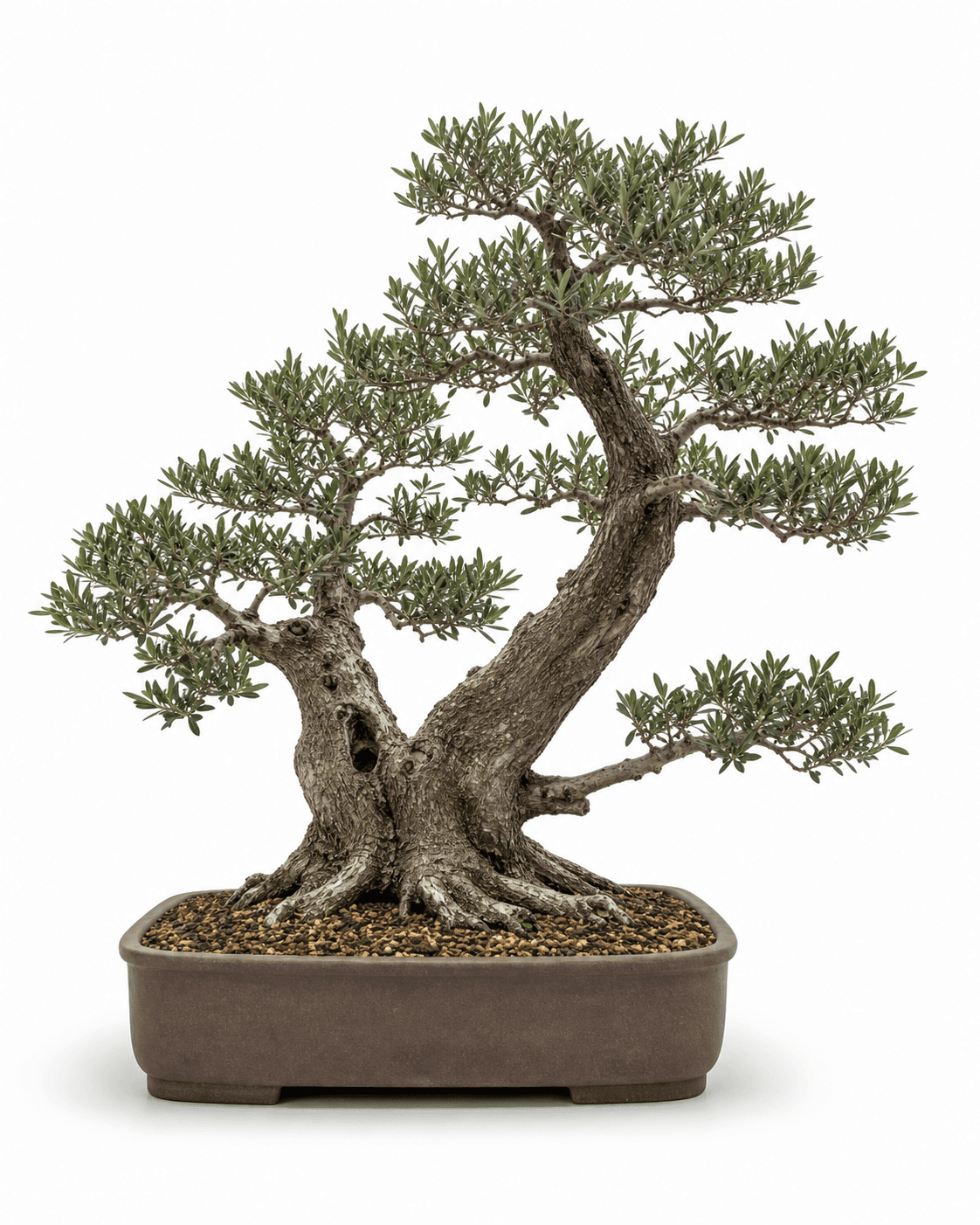
A mature Phillyrea bonsai should show the base, trunk line, layered evergreen branches, narrow or well-scaled leaves, and a quiet Mediterranean character that separates it from privet, olive, myrtle, and boxwood. Bonsai Mirai / AsymmetryTrees and Shrubs Online: Phillyrea
Species questions
Answer the beginner questions before styling.
Can Phillyrea be grown as bonsai?
Yes. Phillyrea can work as an outdoor broadleaf evergreen bonsai when selected for small leaves, usable trunk, healthy roots, strong light, mineral drainage, conservative spring root work, and post-harden pruning.
Which Phillyrea species is best for bonsai?
Phillyrea angustifolia is usually more promising for smaller bonsai because its leaves are narrower. Phillyrea latifolia can work better for larger, older shrub or small-tree images.
Is Phillyrea an indoor bonsai?
Use outdoor culture as the baseline. Indoor placement is limited to short display or bright cool winter shelter because Phillyrea needs sun, airflow, and seasonal rhythm.
When should I repot Phillyrea bonsai?
Repot in spring as buds begin to move. Work old nursery roots in stages, keep useful foliage, anchor firmly, and shelter the tree bright until new growth confirms recovery.
What soil is best for Phillyrea bonsai?
Use well-drained mineral soil. A 1:1:1 akadama:pumice:lava mix is a practical development baseline, with akadama-heavy refinement only after the root system is dependable.
How should I prune Phillyrea bonsai?
Let shoots extend and harden, then cut back to visible interior leaves or buds. Avoid flat hedge shearing; build layered branch structure and preserve interior foliage.
Can I defoliate Phillyrea bonsai?
Use selective exterior leaf reduction only on vigorous refined trees. Routine full defoliation is too risky for retained-foliage broadleaf evergreen material with thin species-specific evidence.
Is Phillyrea the same as olive or privet?
They are separate care subjects in the same broad olive-family neighborhood. Phillyrea has its own leaf, fruit, and growth traits, so verify the label before applying olive or privet assumptions.
Why is my Phillyrea dropping interior leaves?
Common causes are dense hedge-shell pruning, low light inside the crown, stale wet roots, pest pressure, or a compact old nursery core. Open the canopy and diagnose roots before pruning harder.
Does Phillyrea need winter protection?
Yes, in a bonsai pot. Even quite hardy landscape or garden shrubs need shallow-root protection before hard freezes, plus shelter from cold wind and prolonged wet cold soil.
Sources
Species advice needs source discipline.
Next decisions
Plan the operation before copying the calendar.
A good care note for Phillyrea records the tree's stage, the work done, and the aftercare used. That record matters more than a month-name rule.
Related species
Compare nearby trees before transferring advice.
English boxwood
Buxus sempervirens
Japanese boxwood
Buxus microphylla
Korean boxwood
Buxus sinica var. insularis
English holly
Ilex aquifolium
Japanese holly
Ilex crenata