
Species guide
Pomegranate Bonsai Care
Punica granatum
Pomegranate bonsai works best as a seasonal outdoor tree: full sun and heat in the growing season, strong air movement, careful water through flower and fruit, and protected cold storage before the pot freezes hard. The species is generous in warm climates and frustrating in dim indoor culture.
Treat Punica granatum as Broadleaf > Deciduous for practical bonsai timing. The calendar turns on late-winter bud swell, first-flush hardening, summer secondary selection, flower and fruit load, leaf-drop wiring, and winter protection.
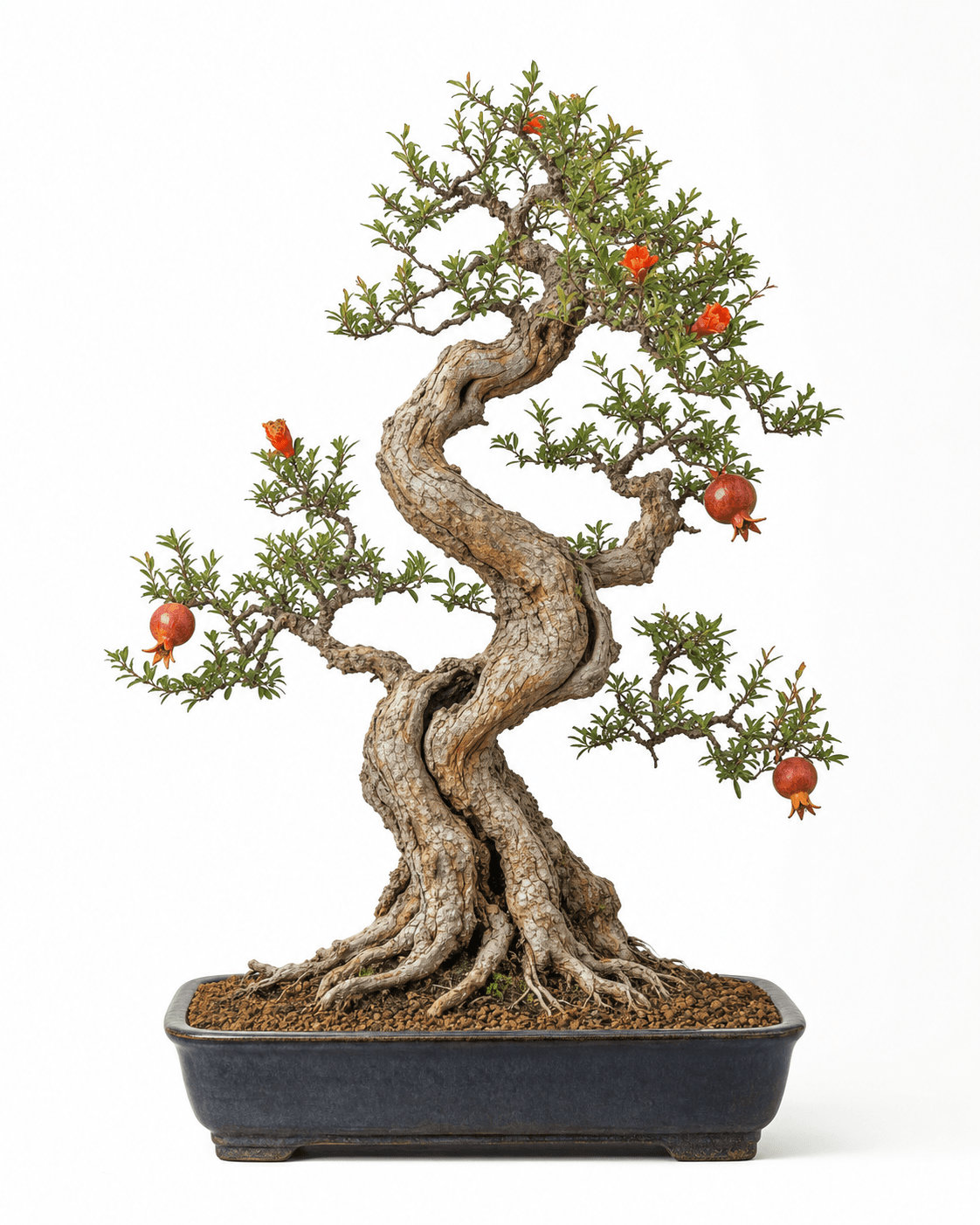
The best pomegranate bonsai look like old fruiting shrubs, with craggy bark, twisted trunks, sparse branch hierarchy, and a few intentional flowers or fruit. Keep developing trees focused on roots, branch structure, and wound closure before asking them to carry a display crop.
Updated June 15, 2026. Written by EntGrove Editorial. Last verified June 15, 2026.
Care fingerprint
Read the species through its shared care pattern.
Repot and structural prune around dormant-to-active transitions; protect new leaves; time refinement work after growth hardens. Use this as the starting point before local conditions and tree strength refine the calendar.
Read the foliage first
Broadleaf stress usually shows in leaf color, leaf size, wilt, scorch, or delayed hardening before it becomes a branch problem.
Match work to dormancy
Deciduous, evergreen, tropical, succulent, and flowering broadleaf trees recover on different calendars.
Protect fine roots
Root work should preserve enough active fine roots for the tree to rehydrate quickly after the operation.
Care cadence
The calendar starts with the tree's seasonal state.
Placement
Timing: Grow outdoors in full sun and air through the warm season. Move the pot into protected cold storage before the root ball approaches hard freeze.
Watch for: Warm indoor weakness, long shaded shoots, roots baking in shallow pots after repotting, and cold snaps below roughly 20 F on containerized trees.
Bonsai Mirai LibraryNC State ExtensionUGA Cooperative ExtensionWatering
Timing: Water by root demand. Expect heavy water use in a full summer canopy, then judge greenhouse or cold-frame trees by soil-particle dryness through winter.
Watch for: Hard drought during flowering, stale wet winter soil, fruit splitting after moisture swings, and dry akadama hidden under damp moss.
Bonsai Mirai LibraryUGA Cooperative ExtensionUF/IFAS ExtensionFertilizing
Timing: Feed according to stage. Development trees need enough nutrition to elongate, heal, and rebuild roots; refined flowering trees feed more deliberately around flower and fruit goals.
Watch for: Coarse extensions from excess nitrogen, weak flower set from depleted reserves, alkaline-water iron lockup, and late soft growth before cold storage.
Bonsai Mirai LibraryUGA Cooperative ExtensionPruning
Timing: Use late-winter bud swell for structural pruning, midsummer for secondary selection after growth matures, and leaf drop for assessment and selected wiring.
Watch for: Spring pruning after leaves open, trifurcations, shoulder tearing, interior shoots wasted by shade, and pinching away the flower and fruit experience on display trees.
Bonsai Mirai LibraryUF/IFAS ExtensionFlowers and fruit
Timing: Let flowers and a few fruit remain only when the tree is strong and the design is in refinement. Remove fruit from young, weak, or structurally developing trees.
Watch for: Fruit load bending branches, energy diverted from roots or wounds, pests attracted to fruit, and trying to build primary structure in a display year.
Bonsai Mirai LibraryUF/IFAS ExtensionUC IPMWiring
Timing: Wire at leaf drop or early spring before leaf push. Use paper-wrapped larger wire or padded guy wires where bark protection matters, then inspect before spring thickening.
Watch for: Brittle old bends, bark lifting under wire, contact scars on trunks, branches pulled outside their natural origin zone, and wire tightening in late April.
Bonsai Mirai LibraryRepotting
Timing: Repot at late-winter bud swell by default. Strong warm-climate trees can use a hardened first-flush fallback, especially when nursery or field stock is being transitioned.
Watch for: Repeating bare-root work after the first transition, upward-facing root cuts, overpotted recovery trees, and combining heavy root work with heavy fruit load.
Bonsai Mirai LibraryPests and disease
Timing: Scout during watering, before spring bud break in wet maritime climates, and through summer fruiting. Correct light, water, and airflow first.
Watch for: Aphids, mealybugs, scales, whiteflies, ants, fruit pests, leaf curl pressure in cold spring rain, fungal fruit issues, and root rot after stale wet soil.
UC IPMBonsai Mirai LibraryWinter protection
Timing: Keep the tree cold enough to stay seasonal, yet protected from root-zone hard freeze, drying wind, and warm greenhouse positions that force early leaf-out.
Watch for: Storage that is too warm, greenhouse overcrowding, dry leafless roots, spring rain on emerging foliage, and cold exposure below roughly 20 F in a pot.
Bonsai Mirai LibraryUGA Cooperative ExtensionUF/IFAS ExtensionSpecies guide
Apply the species profile before copying another tree's calendar.
At a glance
Pomegranate is a heat-loving deciduous fruiting shrub for outdoor seasonal care.
Kew accepts Punica granatum L. in Lythraceae and gives its native range from northeastern Turkey to western and northern Pakistan. NC State describes it as a deciduous woody shrub or small tree, usually much larger in the landscape than in bonsai, with showy orange-red flowers and edible red fruit. Kew POWONC State Extension
The bonsai care specification is narrow: full sun, warm active growth, high summer water demand, draining soil around pH 5.5-7.2, late-winter bud-swell root work, protection below roughly 20 F in a pot, and enough restraint to remove flowers or fruit when the tree needs strength. Bonsai Mirai LibraryUGA Cooperative ExtensionUF/IFAS Extension
Beginner fit depends on placement. A sunny patio, balcony, greenhouse, cold frame, or Mediterranean-style bench can grow pomegranate well. A warm dim room produces soft weak growth, poor flowering, and pest-prone foliage. Bonsai Mirai LibraryUC IPM
Wild habitat
Design from a dry-season fruiting shrub that needs heat, light, and drainage.
Kew places pomegranate from northeastern Turkey through western and northern Pakistan, and UF/IFAS describes the species as best adapted to regions with cool winters and hot dry summers. UGA adds the practical fruiting clue: pomegranate performs best with many days above 85 F and at least 6 hours of direct sun. Kew POWOUF/IFAS ExtensionUGA Cooperative Extension
For care, the wild signal is clear: provide heat and light, then preserve root oxygen. In a shallow bonsai pot, drought-tolerant landscape biology still needs steady water through flowering and fruit swelling. A full canopy and fine root mass can draw water quickly in summer. Bonsai Mirai LibraryUGA Cooperative Extension
For design, the species suggests old orchard and dryland shrub character: upright and outward growth, craggy bark, small twigging, occasional thorns, flowers at the shoot ends, and a branch line that can bend under fruit before rising again. Bonsai Mirai / AsymmetryBonsai Mirai Library
Mirai compares pomegranate habit with olive in its upright and up-out growth. Thin lower branches under stronger upper structure can be anatomically believable on an old fruiting shrub, even when the upper structure carries more visual strength. Bonsai Mirai Library
Reading the tree
Read stage, heat, root strength, and fruit load before choosing work.
Mirai divides pomegranate development into the same phases used for other deciduous bonsai: primary structure, secondary scaffolding, and tertiary ramification. A tree can be refined in the canopy while one branch or root zone remains in development, so each operation needs a stage-specific purpose. Bonsai Mirai Library
The first read is energy. Structural pruning and repotting belong at bud swell, while stored reserves are loaded and before leaves spend them. If leaves have opened and extension is soft, wait for the first flush to harden before secondary pruning or major adjustment. Bonsai Mirai Library
The second read is growth climate. Mirai notes pomegranate is heat-driven and summer-growth dominant, while UGA and UF/IFAS describe the species as most productive in hot dry summers. Cooler climates can grow healthy pomegranates and still produce little fruit. Bonsai Mirai LibraryUGA Cooperative ExtensionUF/IFAS Extension
The third read is display cost. Mirai fruiting-bonsai guidance treats flowers as relatively light cost and fruit as a major energy sink. A tree building roots, closing wounds, or replacing structure should carry few or no fruit. Bonsai Mirai Library
Pruning
Choose structure, flowers, or fruit before pruning a shoot.
Late-winter bud swell is the heavy structural window for low-water-mobility deciduous species such as pomegranate. Mirai places pomegranate with hornbeam, trident maple, tamarisk, elm, and deciduous oaks that can be pruned and wired before leaf push while still leafless. Bonsai Mirai Library
Flowering changes the pruning decision. Mirai spring-pinching guidance steers flower-and-fruit pomegranates away from maple-style pinching. Pinching can be useful when the tree is being grown as a nonflowering ornamental or in a climate where fruiting is unlikely. Bonsai Mirai Library
Summer secondary selection is a pomegranate strength. Once new growth matures, remove three-branch junctions down to two, keep the branch that occupies useful space, and shorten only the unusually strong secondary that has become too thick for its primary. Bonsai Mirai Library
Fruit belongs on refined strong trees. UF/IFAS notes fruit-bearing branches can bend or break without crop-load management, and Mirai fruiting-bonsai method removes fruit from unhealthy or developing trees so energy returns to branch, root, and wound work. UF/IFAS ExtensionBonsai Mirai Library
Repotting
Repot at bud swell by default, then let heat rebuild the root system.
Mirai gives late-winter bud swell as the reliable repotting and structural-pruning moment because stored sugars and starches are still available before leaf expansion consumes them. For pomegranate, a hardened first-flush window can work as a fallback in warm climates because the species responds strongly to heat. Bonsai Mirai Library
First transition from field or nursery stock is the one time to correct structural roots aggressively. Mirai recommends cutting large roots back to finer secondaries, removing downward roots when a plated base is the design goal, and orienting root cuts flat or downward so water sheds away from the wound. Bonsai Mirai Library
Repeat bare-rooting should be avoided after the tree has established in aggregate soil. Mirai pomegranate-styling guidance distinguishes domesticated fine-root systems from freshly field-collected roots still carrying old soil; later repots should protect the fine root mass and avoid restarting the tree each cycle. Bonsai Mirai Library
After root work, protect the tree from wind, cold rain, and drying heat until recovery is visible. Mirai warns that root rebuilding should be the priority after heavy root reduction; stacking root work, heavy structural pruning, and fruit display weakens the response. Bonsai Mirai Library
Soil and pot
Use mineral drainage, akadama for refinement, and a pot that supports the fruiting-shrub image.
UGA says pomegranates prefer well-drained soil, tolerate a range of textures, and grow best around pH 5.5-7.2. UF/IFAS similarly associates optimum growth with well-drained soil around pH 5.5-7.0. UGA Cooperative ExtensionUF/IFAS Extension
For bonsai, the mix should move water quickly while retaining enough moisture for heat and fruiting. Mirai refined deciduous method favors 100 percent akadama when the tree is in a temperate refinement rhythm, while development or hot-climate culture may need more oxygen and a larger water reservoir. Bonsai Mirai Library
Avoid overpotting a newly reduced root system. Mirai warns that excess soil after major root reduction can worsen water and oxygen balance; recovery often works better in a pot sized to the remaining roots or a wooden box that improves aeration. Bonsai Mirai Library
Pot choice should match the season of display. Mirai pomegranate design guidance favors strong darker glazes for masculine twisted material, with container decisions keyed to fall color, winter silhouette, flowers, fruit, and the quieter summer canopy. Bonsai Mirai / AsymmetryBonsai Mirai Library
Climate
Warm climates get fruit; cool climates may get health without a heavy crop.
In hot dry summer regions, pomegranate is in its element as long as the root system can keep up. Mirai says a healthy fine-root mass with full canopy can consume large amounts of water, and UGA notes the crop performs best with sustained heat above 85 F. Bonsai Mirai LibraryUGA Cooperative Extension
In maritime regions, spring rain and cool air complicate new growth. Mirai specifically calls for preventative leaf-curl timing before bud break where infection pressure is predictable, plus rain protection as tender spring foliage emerges. Bonsai Mirai Library
In cold-winter regions, translate landscape hardiness conservatively for a shallow pot. NC State lists Zones 8a-10b, UGA describes cultivar cold limits around 12 F to 7 F, and Mirai uses roughly 20 F as the container protection threshold. NC State ExtensionUGA Cooperative ExtensionBonsai Mirai Library
In very warm Mediterranean or subtropical climates, pomegranate may retain leaves and act semi-evergreen. Mirai still keys structural work to the energy cycle before the next push, using leaflessness as only one cue. Bonsai Mirai Library
Pests
Most pest problems follow weak placement, fruit pressure, wet roots, or spring disease timing.
UC IPM lists common pomegranate pest categories that include aphids, mealybugs, scales, whiteflies, and fruit-associated pests. In bonsai, the first treatment is cultural: sun, airflow, correct water, and removal of unneeded fruit. UC IPMBonsai Mirai Library
Root rot and weak extension usually trace to stale wet media, oversized recovery pots, or cold storage that stays wet. UGA and UF/IFAS both emphasize drainage in soil guidance, and Mirai frames root health as the water-to-oxygen balance. UGA Cooperative ExtensionUF/IFAS ExtensionBonsai Mirai Library
Fruit problems are often management problems. UF/IFAS notes fruit-bearing branches can bend or break without thinning, and UC IPM separates ornamental and fruiting cultivar expectations, which matters when deciding whether fruit display is worth the branch and pest cost. UF/IFAS ExtensionUC IPM
In wet-spring regions, Mirai treats leaf-curl prevention as timing-sensitive. Spray before bud break when the regional pressure is predictable, then protect emerging foliage from cold rain because treatment after infection leaves damage in place. Bonsai Mirai Library
Wiring
Wire at leaf drop, protect thin bark, and respect old-wood limits.
Mirai twisted-pomegranate work places broadleaf flexibility around fall leaf drop. That window exposes structure, lets pruning and wiring interleave in one pass, and gives branches time to thicken into the new position during the following growth cycle. Bonsai Mirai Library
Use wire as little as the design allows. Mirai recommends paper-wrapped larger gauges on broadleaf structural branches, rubber padding at guy-wire contact points, and minimal wraps around trunks because constriction scars can damage the main sugar pathway. Bonsai Mirai Library
Branch bends should stay believable to the branch origin. Mirai notes that branches have a natural rotational direction, a safer vascular crotch for guy-wire contact, and a limited zone around the trunk where repositioning still looks natural. Bonsai Mirai Library
Old branches can be brittle, and previously wired tissue becomes more vulnerable on a second bend. Set major movement early, then build later pomegranate refinement mostly by pruning, secondary selection, and clip-and-grow tertiary work. Bonsai Mirai Library
Propagation
Cuttings and air layers are practical when timed to heat and stored energy.
Mirai propagation guidance groups pomegranate with Mediterranean-climate species that can tolerate large cuttings because they combine internal water mobility with drought-resistant cuticles. Clean cuts, rooting hormone, oxygenated media, and bottom heat improve the odds. Bonsai Mirai Library
Twisted pomegranate restyling work adds a useful detail: large removed trunk sections can be rooted as cuttings with rooting hormone and a heat bed entering winter, using bottom heat to drive callus formation during dormancy. Bonsai Mirai Library
Air layering works best in late spring or early summer after the first flush has elongated, hardened, and begun returning sugars. That timing matches the species heat response and avoids asking a soft new flush to sustain the layer. Bonsai Mirai Library
UGA also lists seed, hard-wood cuttings, soft-wood cuttings, and micropropagation as pomegranate propagation routes. For bonsai, cuttings and layers preserve a chosen trunk character better than seed. UGA Cooperative ExtensionBonsai Mirai Library
Buying
Buy trunk age, compact growth, and clean roots before fruit promises.
The best starter has a useful base, aged bark or twisted trunk movement, short internodes, healthy fine roots, and at least one believable line for an old fruiting shrub. A few nursery flowers are less important than structure that can carry a future display. Bonsai Mirai / AsymmetryBonsai Mirai Library
Inspect root and crown suckers. UF/IFAS describes pomegranate as naturally bushy with many suckers from the root and crown, and those suckers can either build a deliberate clump or steal energy from a single-trunk design. UF/IFAS Extension
Twisted labels such as Neji Zakuro, Neagikan, and Nejikan can be excellent for bonsai because the old-shrub character starts in the trunk. The label is still secondary to scale, root quality, and whether the twist reads as aged. Bonsai Mirai Library
Commercial fruit cultivars are selected for orchard production, while bonsai scale asks for compact internodes, useful roots, small fruit, and believable trunk character. UGA and UF/IFAS both discuss fruit-cultivar performance, while UC IPM separates ornamental cultivars from fruiting types. UGA Cooperative ExtensionUF/IFAS ExtensionUC IPM
Troubleshooting
Diagnose pomegranate problems by symptom, cause, and the next correction.
Weak long shoots with few flowers: likely low light, warm indoor culture, excess nitrogen, or a cool season without enough heat. Move to stronger sun gradually, adjust feeding, and grow the tree hard before expecting display. UGA Cooperative ExtensionBonsai Mirai Library
Leaves wilt or scorch in summer: likely dry roots, overheated small pot, or a recent root reduction. Water in repeated passes, shade the pot during extremes, and avoid pruning until the tree is energy positive again. Bonsai Mirai Library
Roots smell sour or drainage slows: suspect decomposed soil, oversized wet recovery soil, or cold wet storage. Refresh the surface first, then schedule bud-swell repotting if intact particles and percolation are gone. Bonsai Mirai LibraryUGA Cooperative Extension
Flowers appear and no fruit follows: the tree may lack heat, full sun, pollination, or stored strength. Keep health first; a healthy cool-climate pomegranate can be a good bonsai with little fruit. UGA Cooperative ExtensionBonsai Mirai Library
Fruit bends or cracks branches: remove most fruit and keep only a few intentional pieces on strong branches. Future years should decide fruit number before the crop becomes heavy. UF/IFAS ExtensionBonsai Mirai Library
Shoulders tear during pruning: pomegranate needs clean supported cuts at junctions. Use sharp tools, finish large hardwood removals with clean edges, and avoid crushing dense vascular tissue with concave cutters. Bonsai Mirai Library
Design
Style pomegranate as an aged fruiting broadleaf with craggy restraint.
Mirai pomegranate design starts with front selection, root character, trunk twist, and branch hierarchy. Rotate the tree completely before committing; a second front can solve taper, scars, and fruiting display better than the first impression. Bonsai Mirai / AsymmetryBonsai Mirai Library
Branch movement should read as cultivated age. Mirai describes fruiting broadleaf branches as growing up and out, then dog-legging down under fruit and repeated pruning, before lifting again at the tips. Bonsai Mirai Library
Pomegranate can carry craggy, contorted, and hollow character when the trunk age supports it. Mirai also cautions that young nursery stock twisted into extreme movement reads contrived because visible age and form need to agree. Bonsai Mirai Library
Deadwood can add character on aged hollow material when it supports the fruiting-shrub story. Strong old bark, sparse twigging, and a few flowers or fruit usually carry the image best. Bonsai Mirai / AsymmetryBonsai Mirai Library
Cultivars
Small-fruited, ornamental, and twisted forms usually make better bonsai than orchard fruit types.
Mirai works repeatedly with twisted pomegranate material under Neji Zakuro and Neagikan labels, where the trunk itself supplies the age signal. These forms suit bonsai because the movement and scale are part of the source material. Bonsai Mirai LibraryBonsai Mirai / Asymmetry
UC IPM distinguishes ornamental cultivars with large showy flowers and mostly inedible fruit from fruiting cultivars with smaller flowers and edible fruit of varying size. That distinction is useful when deciding whether flowers, fruit, or branch refinement is the point. UC IPM
UGA and UF/IFAS discuss Wonderful as a major fruit cultivar, while also describing regional performance and disease limits. Orchard performance says little about bonsai scale, short internodes, or a useful root base. UGA Cooperative ExtensionUF/IFAS Extension
Dwarf, ornamental, and twisted labels still need normal buying discipline: check grafts or root base, internode length, leaf size, fruit scale, bark age, and whether the branch line can support a believable old shrub. Bonsai Mirai LibraryUC IPM
History
Pomegranate carries ancient fruit culture into a compact old-shrub bonsai vocabulary.
Kew records Punica granatum as an ancient cultivated fruit with a native range across western Asia and adjacent regions. Its long human history gives bonsai a ready cultural image: orchard, courtyard, dryland garden, and old productive shrub. Kew POWO
UGA describes pomegranate as widely grown in Mediterranean-type and warm dry climates, while UF/IFAS frames quality around cool winters and hot dry summers. The bonsai image should carry that climate memory through branch line, bark, flower timing, and fruit restraint. UGA Cooperative ExtensionUF/IFAS Extension
Mirai pomegranate work emphasizes twisted-trunk material, old broadleaf scars, trunk hollows, and branches shaped by fruiting habit. The strongest trees feel cultivated and aged, with miniature fruit serving the story as a supporting detail. Bonsai Mirai / AsymmetryBonsai Mirai Library
Public exhibition canon is smaller than for pines, junipers, maples, and azaleas, but pomegranate earns attention through seasonal contrast: flowers, possible fruit, autumn color, winter silhouette, old bark, and the discipline to keep display load proportional. Bonsai Mirai / AsymmetryBonsai Mirai Library
Species questions
Answer the beginner questions before styling.
Is pomegranate a good beginner bonsai?
Yes, for a grower with full sun, summer heat, and protected cold storage. It is demanding for a low-light indoor setup because weak placement quickly reduces flowers and invites pests.
Can pomegranate bonsai live indoors?
Use outdoor seasonal culture. Indoor time should be brief display or cold protected storage with enough light and airflow to avoid weak, pest-prone growth.
How much sun does pomegranate bonsai need?
Use full sun as the target. UGA recommends at least 6 hours of direct sun for fruit color and productivity, and bonsai refinement also needs strong light for short internodes.
How often should I water pomegranate bonsai?
Water by root demand. In hot weather with a full canopy, strong trees may need very frequent watering. In winter storage, water only when the soil particles and surface indicators show real drying.
When should I repot pomegranate bonsai?
Repot at late-winter bud swell by default. Strong warm-climate trees can also be repotted after the first flush hardens, but avoid stacking heavy root work with heavy fruiting.
When should I prune pomegranate bonsai?
Use late-winter bud swell for structural pruning, midsummer for secondary selection after growth matures, and leaf drop for assessment and wiring. Preserve shoots when flowers or fruit are the display goal.
Should I pinch pomegranate bonsai?
Pinching is usually wrong when flowers and fruit matter. Mirai guidance allows pinching only for ornamental, nonfruiting goals or climates where flowering is unlikely.
Can I wire a pomegranate bonsai?
Yes. Wire at leaf drop or before leaf push, protect soft bark, pad guy wires, and set major bends early because old branches can become brittle.
Should I let my pomegranate bonsai fruit?
Let only a few fruit mature on a strong refined tree. Remove fruit from young, weak, recovering, recently repotted, or structurally developing trees.
Why is my pomegranate bonsai not flowering?
Common causes include low sun, cool summers, weak stored energy, excessive nitrogen, pruning away flowering shoots, or keeping the tree warm and weak indoors through winter.
Sources
Species advice needs source discipline.
Next decisions
Plan the operation before copying the calendar.
A good care note for Pomegranate records the tree's stage, the work done, and the aftercare used. That record matters more than a month-name rule.
Related species
Compare nearby trees before transferring advice.
Japanese maple
Acer palmatum
Trident maple
Acer buergerianum
Amur maple
Acer tataricum subsp. ginnala
Field maple
Acer campestre
Korean hornbeam
Carpinus turczaninovii