
Species guide
Ume Bonsai Care
Prunus mume
Ume, or Japanese apricot, is an outdoor deciduous bonsai grown for fragrant winter flowers on bare wood. The care calendar is built around flower display, post-bloom pruning, an early-summer photoperiod window, and conservative root work.
Prunus mume rewards growers who can keep a tree sunny, cold enough for dormancy, moist without stale soil, and protected when swollen flower buds meet sudden freezes. The species asks for better timing than most beginner deciduous bonsai because old wood back-buds poorly and fruit drains a small container quickly.
Use Ume as a second or third outdoor deciduous tree unless the material is already strong and well-structured. Flowering is a refinement reward; development years often sacrifice bloom so branches, grafts, roots, and energy distribution can be rebuilt.
Updated June 15, 2026. Written by EntGrove Editorial. Last verified June 15, 2026.
Care fingerprint
Read the species through its shared care pattern.
Repot and structural prune around dormant-to-active transitions; protect new leaves; time refinement work after growth hardens. Use this as the starting point before local conditions and tree strength refine the calendar.
Read the foliage first
Broadleaf stress usually shows in leaf color, leaf size, wilt, scorch, or delayed hardening before it becomes a branch problem.
Match work to dormancy
Deciduous, evergreen, tropical, succulent, and flowering broadleaf trees recover on different calendars.
Protect fine roots
Root work should preserve enough active fine roots for the tree to rehydrate quickly after the operation.
Care cadence
The calendar starts with the tree's seasonal state.
Placement
Timing: Grow outdoors in strong sun and moving air through the growing season. Protect the pot and swelling buds when winter weather swings hard.
Watch for: Weak shaded shoots, warm indoor growth, roots drying in cold wind, and open flowers lost after a freeze following warm weather.
NC State ExtensionClemson ExtensionBonsai Mirai LibraryWatering
Timing: Water by root demand. Keep moist mineral particles supplied in active growth, then slow watering in cold dormancy while preserving oxygen.
Watch for: Soured central soil, apical weakening, curled brown leaf edges after cold wet weather, and dry roots while flowers or new leaves are opening.
Bonsai Mirai LibraryNC State ExtensionFertilizing
Timing: Feed for the stage. Development trees can be pushed harder; refined flowering trees ramp through spring, peak before early-summer work, then resume lightly in September.
Watch for: Coarse internodes after heavy fall nitrogen, weak flower buds from depleted trees, and continued feeding after the solstice when refinement needs restraint.
Bonsai Mirai LibraryPost-bloom pruning
Timing: After flowers drop, shorten strong flowered shoots and leave weak or development shoots alone when they need energy.
Watch for: Removing all future engines, cutting weak branches to undeveloped buds, and mistaking flower display for permission to weaken the tree.
Bonsai Mirai LibraryNC State ExtensionEarly-summer refinement
Timing: Use the post-flush hardened window before the summer solstice for prune-plus-partial-defoliation when flowering next year is the goal.
Watch for: Working after roughly July 1, pruning twice when flowers are desired, and second-flush leaves that feel sandpapery rather than smooth.
Bonsai Mirai LibraryWiring
Timing: Wire newly hardened shoots in late spring to early summer. Set branch movement in small increments, keep tips upward, and remove wire early.
Watch for: Loose wire, branch-collar splitting, scars that permanently impair water flow, and fine weak twigs killed by wire stress.
Bonsai Mirai LibraryRepotting
Timing: Repot at bud swell or after flowering before leaf-out, when stored energy is high and leaves have not begun heavy water demand.
Watch for: Bare-rooting, oversized recovery pots, crushing the fine-root sheen, and replacing all sour core soil in a single neglected-tree session.
Bonsai Mirai LibraryFlowers and fruit
Timing: Display flowers on strong refined trees. Remove fruit from bonsai unless fruit is a deliberate and proportionate display choice.
Watch for: Fruit draining a small pot, flower buds killed by sudden freezes, old flower wood retained only for bloom count, and exhausted spurs.
Bonsai Mirai LibraryClemson ExtensionNC State ExtensionPests and disease
Timing: Scout at watering, after pruning, and during cool wet spring weather. Keep vigor, drainage, sanitation, and airflow as the first controls.
Watch for: Aphids, scales, borers, spider mites, tent caterpillars, bacterial canker, brown rot, silver leaf, honey fungus, and peach tree borer on peach-rootstock grafts.
NC State ExtensionClemson ExtensionBonsai Mirai LibraryWinter protection
Timing: Let the tree stay cold and dormant, then shelter the pot and flower buds from hard root freeze, drying wind, and warm-cold cycling.
Watch for: Storage that is too warm, roots that freeze solid in shallow pots, buds pushed early by heat, and flowers damaged by late freezes.
NC State ExtensionClemson ExtensionOregon State Landscape PlantsSpecies guide
Apply the species profile before copying another tree's calendar.
At a glance
Ume is a temperate flowering apricot bonsai where timing decides the display.
Kew accepts Prunus mume in Rosaceae and gives its native range as south-central China to northern Indo-China. NC State describes Japanese flowering apricot as a small deciduous tree with fragrant flowers on bare branches before leaves emerge. Kew POWONC State Extension
The bonsai specification is clear: outdoor dormancy, full sun, moist but draining acidic soil, akadama-based bonsai media, late-winter or post-flower root work, post-bloom pruning, solstice-window refinement pruning, and careful winter bud protection. NC State ExtensionClemson ExtensionBonsai Mirai Library
Its difficulty is structural rather than mysterious. Mirai treats flowering as a refinement outcome: first build a healthy root system, branch framework, and energy balance, then earn the winter flower display. Bonsai Mirai Library
Wild habitat
Read Ume as a temperate East Asian flowering tree with rocky-hill and woodland cues.
Kew places the accepted species from south-central China to northern Indo-China, and NC State describes a native setting in woods and rocky hills. Those habitat clues point toward a tree that wants open light, seasonal cold, and roots that breathe. Kew POWONC State Extension
For care, the wild signal is temperate rather than tropical. The tree should spend the year outside, sleep cold, build strength in sun, and enter winter with buds that have been formed during the previous growing season. NC State ExtensionClemson Extension
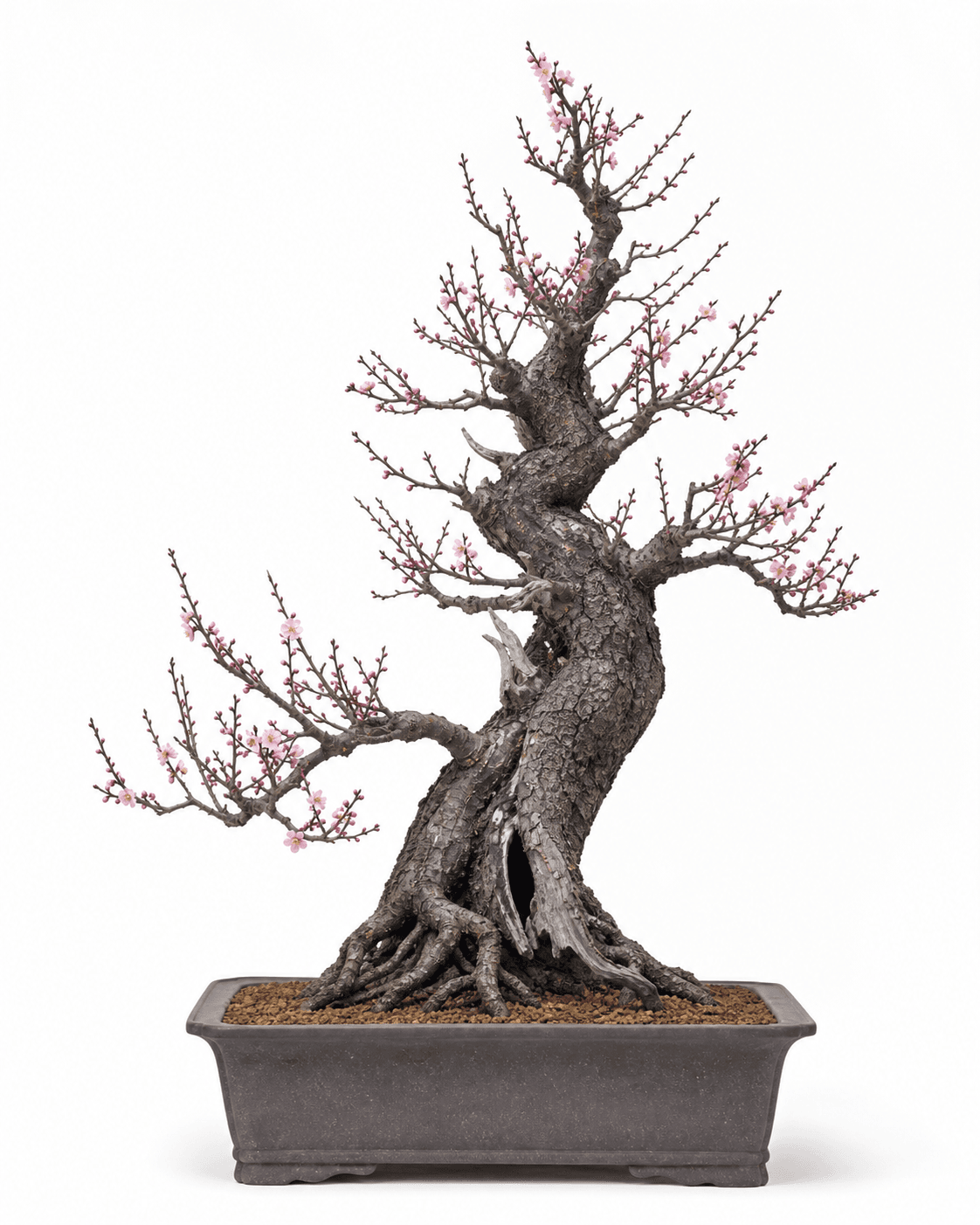
For design, the wild and cultural image is a sparse winter tree, not a dense green mass. Bare branches, old bark, fragrance, upward shoots, occasional hollows, and negative space carry the seasonal character. Bonsai Mirai / AsymmetryBonsai Mirai Library
Clemson adds a practical climate warning: flowers may open from Christmas to March depending on cultivar and weather, and sudden freezes after warm periods can kill open flowers and expanded buds. A good Ume site protects both roots and the winter display. Clemson Extension
Reading the tree
Decide whether this is a flowering year, a development year, or a recovery year.
Mirai separates Ume work by stage. A refined tree uses precise post-bloom and early-summer pruning to produce next-year flower buds. A developing tree may give up flowers so repeated pruning, heavy feeding, grafting, and branch building can happen. Bonsai Mirai Library
The first reading is vigor. Weak branches with only leaf pairs and no elongating shoots should often be left alone; strong branches can be shortened, wired, or partially defoliated. Energy distribution matters more than forcing one desired branch. Bonsai Mirai Library
The second reading is wood age. Young green-to-newly-hardened shoots bend and respond; one- to three-year wood becomes brittle; older lignified wood loses water mobility and often needs grafting or staged renewal instead of hard reduction. Bonsai Mirai Library
The third reading is root sheen. Mirai treats Ume as a sheen-based deciduous broadleaf: preserve the outer fine-root mass, watch for sour central soil, and use apical weakening as a warning that the core water-oxygen balance has failed. Bonsai Mirai Library
Pruning
Use post-bloom pruning and solstice pruning for different goals.
NC State gives the horticultural baseline: Japanese flowering apricot blooms on previous-year wood, and pruning is best done immediately after flowering. That timing preserves the next bud-setting season instead of cutting flower wood late. NC State Extension
Mirai adds the bonsai refinement rule: after flowers drop, strong flowered shoots can be cut back, while weaker branches or branches still in development may be left to gather energy. Equal treatment across unequal branches makes the strong stronger and the weak weaker. Bonsai Mirai Library
The second refinement move happens when the spring flush has hardened and daylight is still long. Mirai places prune-plus-partial-defoliation near the summer solstice, before roughly July 1 in the Northern Hemisphere, to produce a second flush capable of carrying flower buds. Bonsai Mirai Library
Development years follow a different contract. Multiple prunings and stronger feeding can build ramification, but they sacrifice the following flower display. The tree should move between refinement, development, and recovery according to vigor. Bonsai Mirai Library
Repotting
Repot by preserving the fine-root sheen rather than resetting the whole root system.
Mirai places Ume root work at late winter to early spring bud swell, with flowering-before-leafing trees also able to be repotted after bloom and before leaf-out. The key is stored energy before leaves demand water. Bonsai Mirai Library
The handling is more like a conifer than a maple bare-rooting. Keep the outer root mass intact, clean the root ball by zones, replace sour inner sheen only as needed, and stage severe neglected-root correction across more than one repot. Bonsai Mirai Library
Akadama is not optional in the local Mirai Ume method. It gives the particle behavior needed for fine roots, moisture retention, and the ability to read when the central root core has soured. Bonsai Mirai Library
After root work, choose a container that matches the remaining root volume. An oversized recovery pot keeps too much wet soil around weak roots, while a deeper but well-scaled pot gives flowering Ume the reserve it needs without smothering the sheen. Bonsai Mirai Library
Soil and pot
Use akadama-rich mineral soil and a container deep enough for flowering strength.
NC State and Clemson both describe a preference for fertile, acidic, well-drained soil. Bonsai translation narrows that to a granular mineral mix that holds moisture evenly while preserving oxygen through the root mass. NC State ExtensionClemson ExtensionBonsai Mirai Library
Mirai is explicit that Ume needs akadama. Refined temperate trees can lean akadama-heavy; transition trees may need a blend that bridges old and new root systems, usually blending 30 to 50 percent of the new soil into the existing root mass during conversion. Bonsai Mirai Library
Pot depth matters. Mirai notes that deeper containers support flowering and root health better than very shallow literati containers. The visual balance can still stay elegant through color, proportion, and placement. Bonsai Mirai LibraryBonsai Mirai / Asymmetry
For pot pairing, let the seasonal image lead: a quiet darker container can ground pale flowers and old bark, while a lighter or slightly larger container can soften elegant material. Avoid a pot so thin that horticulture loses to silhouette. Bonsai Mirai / AsymmetryBonsai Mirai Library
Climate
Adapt protection to winter buds, potted roots, and summer heat.
In USDA Zone 6 and colder bonsai conditions, the landscape rating should be treated conservatively. NC State lists Zones 6a to 9b, but a shallow pot exposes roots sooner than ground soil and should be protected before severe freeze. NC State ExtensionOregon State Landscape Plants
In mild-winter regions, the danger is often early forcing. Warm spells can swell buds, then a cold snap can remove the display. Clemson specifically warns that sudden freezes following warm weather can kill open flowers and expanded buds. Clemson Extension
In hot climates, full sun remains the growth target when roots are strong, but post-prune and partially defoliated trees need temporary shelter. Mirai notes that reduced foliage lowers evaporative cooling and can overheat recently worked tissue. Bonsai Mirai LibraryNC State Extension
In wet maritime spring climates, avoid large Prunus cuts during cool persistent moisture. Mirai flags vascular pathogen risk under those conditions, so large cuts are best timed to drier, stronger windows. Bonsai Mirai Library
Pests
Treat Ume as a Prunus: drainage, sanitation, and wound timing matter.
NC State lists potential insects including aphids, scales, borers, spider mites, and tent caterpillars. Trees grafted on peach rootstock may also be attacked by peach tree borer. NC State Extension
Disease pressure is also real. NC State names bacterial canker, honey fungus, silver leaf, and brown rot; Clemson broadly warns that ornamental Prunus can face leaf spots, mildew, cankers, twig blight, root rot, viruses, borers, aphids, caterpillars, beetles, and scales. NC State ExtensionClemson Extension
Bonsai prevention starts with culture: full sun, airflow, correct water, an oxygenated root ball, clean tools, and pruning windows that avoid cold wet pathogen entry. A stressed Ume should regain vigor before styling. Bonsai Mirai LibraryClemson Extension
Toxicity and fruit handling deserve ordinary caution. NC State flags leaves, stems, and seeds as toxic to dogs, cats, and horses if ingested, and summer fruit can be messy if it is allowed to fall and rot. NC State Extension
Wiring
Wire young wood, support every bend, and keep branch tips rising.
The best wiring window opens when the spring flush has hardened: leaves darken, cuticles form, and green stems begin to firm. Newly hardened shoots offer flexibility before one- to three-year wood becomes brittle. Bonsai Mirai Library
Use firm, gap-free wraps and support the branch base. Mirai warns that loose wire concentrates force at the weakest point, while tight contact distributes load and reduces sudden breakage. Bonsai Mirai Library
Every bend should end tip-up. Ume is phototropic and vertical in its energy habit; lateral or downward tips often weaken within months, especially on secondary branches. Bonsai Mirai Library
Wire scars are more than cosmetic on Ume. Resin-rich, low-water-mobility Prunus tissue can suffer lasting transport impairment, so remove wire earlier than you might on a forgiving broadleaf. Bonsai Mirai Library
Propagation
Use seed, cuttings, air layers, and grafting with clear bonsai goals.
Kew and NC State both reflect the species large cultivar culture, and NC State notes many cultivated forms. Seed can produce plants, but seed is slow for bonsai and rarely preserves flower color, internode scale, or branch character. Kew POWONC State ExtensionBonsai Mirai Library
Cuttings need species-aware timing and clean technique. Mirai propagation guidance classifies cuttings by wood stage and says slow-rooting or thicker lignified species benefit more from hormone, clean razor cuts, oxygenated media, and controlled moisture. Bonsai Mirai Library
Air layers can solve root placement on suitable branches, but the sphagnum bundle must stay oxygenated. Mirai warns that constantly saturated layers produce callus without roots, while even moss thickness supports radial root distribution. Bonsai Mirai Library
Grafting is central to advanced Ume. Mirai repeatedly frames interior renewal and cultivar display through grafting because old lignified branches lose back-budding capacity and many desirable flower forms are grafted cultivars. Bonsai Mirai LibraryBonsai Mirai / Asymmetry
Buying
Buy trunk age, graft quality, young replacement growth, and strong roots before bloom count.
A nursery tree in full bloom is easy to love, but bonsai value starts with base, trunk movement, bark age, root quality, short internodes, and branches that can end upward. Flowers are seasonal proof, not the whole design. Bonsai Mirai / AsymmetryBonsai Mirai Library
Inspect grafts carefully. Mirai notes that most ornamental flowering Ume are grafted cultivars, often chosen for white, pink, red, single, double, or triple flowers. The graft should support the design rather than interrupt taper or bark continuity. Bonsai Mirai LibraryNC State Extension
Check for useful young growth near the interior. Older wood may need grafting rather than hard cutback, so raw material with replacement shoots and extension options is safer than a long bare branch line loaded only with flowers. Bonsai Mirai Library
NC State says Japanese flowering apricot can be challenging to find in garden centers. When available, cultivars such as Peggy Clarke, Kobai, W.B. Clarke, Contorta, and other named forms should still be judged by root and branch suitability for bonsai. NC State ExtensionClemson Extension
Troubleshooting
Diagnose Ume by timing, bud type, root oxygen, and branch direction.
No flowers: likely late pruning, weak light, heavy development work, poor fall energy, freeze damage to swelling buds, or second-flush growth that became vegetative. Protect buds and choose a refinement year before expecting bloom. NC State ExtensionClemson ExtensionBonsai Mirai Library
Smooth versus sandpapery leaves: Mirai uses leaf texture as a bud diagnostic after early-summer work. Smooth, sheeny leaf bases point toward flower buds; rougher texture points toward vegetative buds. Bonsai Mirai Library
Branch dies after a downward bend: the branch may have lost upward hormonal strength or suffered vascular damage at a brittle attachment. Future wiring should use younger shoots, smaller increments, and tip-up finish. Bonsai Mirai Library
Apical weakness: suspect sour central sheen or poor water-oxygen balance. Plan a staged root-core refresh instead of a full bare-root reset. Bonsai Mirai Library
Leaf edges curl and brown in cool overcast wet weather: Mirai ties that pattern to root suffocation from overwatering. Tilt the pot, improve drainage, and let the substrate breathe before watering again. Bonsai Mirai Library
Flowers open and collapse after a cold snap: the tree may be hardy, while the display is fragile. Clemson warns that sudden freezes after warm weather can kill open flowers and expanded buds. Clemson Extension
Design
Style Ume as an upward, sparse, flowering deciduous tree with accepted deadwood.
Mirai distinguishes Ume from conifer pad design. Branches should rise and arrange informally rather than flatten into shelves, because the physiology and winter-flower character both favor upward, non-planar lines. Bonsai Mirai LibraryBonsai Mirai / Asymmetry
The strongest flowering bonsai are still strong tree forms. Mirai flowering-bonsai critique separates trees designed only to carry flowers from refined bonsai forms where flowers are a seasonal accent. Ume can tempt growers into bloom-count decisions that weaken design. Bonsai Mirai / AsymmetryBonsai Mirai Library
Deadwood is acceptable on aged Ume. Mirai treats hollow trunks, jin, and shari as part of the traditional Ume vocabulary, supported by dense resin-rich Prunus heartwood and old flowering-tree character. Bonsai Mirai Library
Design around the winter silhouette first: trunk base, old bark, sparse branch rhythm, bloom placement, and open space. Leaves, summer density, and fruit should support that image instead of hiding it. Bonsai Mirai / AsymmetryBonsai Mirai Library
Cultivars
Cultivar choice controls flower color, graft reality, habit, and bonsai scale.
Kew records more than 300 known Chinese cultivars, differing mainly in flower color. NC State lists white, pink, rose, and red flowers in single and double forms, with many named landscape cultivars. Kew POWONC State Extension
Useful names for bonsai scouting include Kobai, Peggy Clarke, W.B. Clarke, Contorta, Dawn, Pendula, Rosemary Clarke, and other forms listed by NC State and Clemson. The label matters less than internode length, graft placement, root quality, and branch usability. NC State ExtensionClemson Extension
Most showy flowering forms are grafted in advanced bonsai practice. Track which wood belongs to which cultivar, because future branch replacement, flower color, and grafting strategy depend on that map. Bonsai Mirai Library
Contorted, weeping, double-flowered, and highly fragrant forms can all work, but each changes the design contract. A weeping label still needs upward terminal energy in bonsai; a contorted trunk still needs believable taper and root spread. NC State ExtensionBonsai Mirai Library
History
Ume carries East Asian winter-flower culture into bonsai refinement.
Kew describes mume blossoms as a long-favored subject in East Asian art and poetry, valued for early January to March bloom in parts of China and Japan. It also notes popularity as bonsai and as an essential Japanese-style garden plant. Kew POWO
NC State says the species has been cultivated for over 1500 years and is important in Chinese culture, while also noting extensive Japanese cultivation and up to 300 cultivars. NC State Extension
Mirai flowering-bonsai critique uses Kokufu Ume examples to frame a key design question: whether the tree exists mainly to display flowers or whether flowers complete a refined tree form. Bonsai Mirai / AsymmetryBonsai Mirai Library
For EntGrove care guidance, that history produces a practical standard. The best Ume should read as an old winter tree even without flowers, then use fragrance and bloom as the seasonal confirmation of good timing. Bonsai Mirai / AsymmetryBonsai Mirai Library
Species questions
Answer the beginner questions before styling.
Is Ume a good beginner bonsai?
Ume is best for someone who already grows outdoor deciduous bonsai. It needs sun, dormancy, protected roots, careful pruning, and patience with grafting or branch renewal.
Can Ume bonsai live indoors?
Keep Ume outdoors. It needs seasonal cold, winter rest, strong light, and airflow. Indoor display should be brief and should not interrupt dormancy or bud timing.
When does Ume bonsai flower?
Ume flowers in winter to early spring on bare branches. NC State gives January to February, while Clemson gives a Christmas-to-March range depending on cultivar and weather.
When should I prune Ume bonsai?
Prune after flowering for the spring reset. Refined trees can also be pruned and partially defoliated before the summer solstice to guide the second flush toward flower buds.
Why did my Ume bonsai fail to flower?
Common causes include late pruning, weak sun, excessive development work, depleted fall energy, freeze damage to swelling buds, or second-flush growth that stayed vegetative.
When should I repot Ume bonsai?
Repot at late-winter to early-spring bud swell, or after bloom before leaf-out. Preserve the fine-root sheen and avoid bare-rooting established trees.
What soil should I use for Ume bonsai?
Use an akadama-rich mineral mix that holds even moisture and drains with oxygen. Ume dislikes dry poor soil and also declines in sour, stagnant core soil.
Can I wire Ume bonsai?
Yes. Wire newly hardened green shoots during the strong late-spring to early-summer window, support branch bases, keep tips upward, and remove wire before it scars.
Should I let Ume bonsai fruit?
Fruit should usually be removed from container-grown Ume. Mirai treats fruit as a heavy energy drain, especially on trees in development, recovery, or recent root work.
Is Ume the same as Japanese plum?
Japanese plum and Chinese plum are common labels, but the accepted species is Prunus mume. Kew places it closer to wild apricot than true plum in the practical naming discussion.
Sources
Species advice needs source discipline.
Next decisions
Plan the operation before copying the calendar.
A good care note for Ume / Japanese apricot records the tree's stage, the work done, and the aftercare used. That record matters more than a month-name rule.
Related species
Compare nearby trees before transferring advice.
Japanese maple
Acer palmatum
Trident maple
Acer buergerianum
Amur maple
Acer tataricum subsp. ginnala
Field maple
Acer campestre
Korean hornbeam
Carpinus turczaninovii