
Species guide
Rosemary Bonsai Care
Salvia rosmarinus
Rosemary bonsai care starts with the accepted name Salvia rosmarinus and the old trade name Rosmarinus officinalis. In bonsai culture, handle it as a woody, aromatic, evergreen Lamiaceae shrub from the Mediterranean region that needs outdoor light, dry mineral rhythm, and seasonal growth.
Grow rosemary outdoors in full sun, use sharply draining mineral soil, water thoroughly, then allow a real dry-back before watering again. The central bonsai risk is stale wet soil paired with humid, low-airflow placement.
The local Mirai corpus has one direct Rosmarinus reference inside Mediterranean broadleaf-evergreen repotting method and no dedicated rosemary class. This page is therefore source-depth transparent: species facts come from Kew and NC State, while bonsai technique transfers from Mirai broadleaf-evergreen, Mediterranean, watering, soil, repotting, wiring, energy, and design files.
Updated June 12, 2026. Written by EntGrove Editorial. Last verified June 12, 2026.
Care fingerprint
Read the species through its shared care pattern.
Protect from hard freezes when species demands it, prune with active foliage in mind, and repot when roots can recover without dormancy cues. Use this as the starting point before local conditions and tree strength refine the calendar.
Note: Mediterranean Lamiaceae broadleaf evergreen with aromatic needle-like leaves, square stems, blue-to-white flowers, and dry rocky habitat. Verify Salvia rosmarinus before applying this page because rosemary, sage, lavender, thyme, tea tree, and culinary-herb labels can overlap in trade.
Read the foliage first
Broadleaf stress usually shows in leaf color, leaf size, wilt, scorch, or delayed hardening before it becomes a branch problem.
Match work to dormancy
Deciduous, evergreen, tropical, succulent, and flowering broadleaf trees recover on different calendars.
Protect fine roots
Root work should preserve enough active fine roots for the tree to rehydrate quickly after the operation.
Care cadence
The calendar starts with the tree's seasonal state.
Placement
Timing: Grow outdoors in full sun with moving air. Use light afternoon protection only during heat spikes, recent repot recovery, or when container roots are too hot to rehydrate safely.
Watch for: Leggy shaded shoots, weak flowering, wet foliage at night, cramped herb pots, hot black nursery containers, and indoor windows with still humid air.
NC State Extension: Salvia rosmarinusBonsai Mirai LibraryWatering
Timing: Water thoroughly to runoff, then let the mix dry back before the next full watering. Check both the sunny and shaded sides of the pot before assuming the root ball is ready.
Watch for: Frequent shallow watering, wet clay or peat pockets, dry hydrophobic edges, powdery mildew, root rot, and foliage dullness after overwatering.
Bonsai Mirai LibraryNC State Extension: Salvia rosmarinusFeeding
Timing: Feed moderately during development after active growth starts. In refinement, feed lightly every 6-8 weeks and pause during the first elongation if the goal is shorter internodes.
Watch for: Coarse upright shoots, weak interior branches, excessive nitrogen in shade, and fertilizer applied before a repotted tree pushes strongly.
Bonsai Mirai LibraryPruning
Timing: Use spring and post-flush hardening for most pruning. Clip new shoots after they firm up, while keeping enough green tips to pull water and support lateral buds.
Watch for: Cuts into leafless old wood, removing all active tips from a branch, dense exterior shells, and harvesting-style clipping that ignores branch structure.
Bonsai Mirai LibraryNC State Extension: Salvia rosmarinusRepotting
Timing: Repot in late winter to early spring for Mediterranean broadleaf evergreens, or in spring as growth begins where winters are colder. Preserve functioning roots and anchor hard.
Watch for: Bare-rooting, unanchored stems, wet post-repot soil, late fertilizer, and combining major root work with heavy pruning.
Bonsai Mirai LibraryWiring
Timing: Wire young hardened shoots before they become woody and brittle. Use small-gauge aluminum, guy wires, and staged bends on older trunks.
Watch for: Snapping old wood, wire bite on thin bark, bent shoots with no foliage beyond the bend, and wire hidden by tight needle-like leaves.
Bonsai Mirai LibraryNC State Extension: Salvia rosmarinusPropagation
Timing: Propagate by stem cuttings, layering, division, or seed. Cuttings preserve cultivar habit and leaf scale better than seed.
Watch for: Slow seed germination, mislabeled culinary starts, patented nursery cultivars, and cuttings kept in stale wet media.
NC State Extension: Salvia rosmarinusWinter protection
Timing: Protect bonsai roots before sustained hard freezes. In cold regions, use bright cool shelter rather than a warm dim kitchen windowsill.
Watch for: Frozen roots in wind, warm indoor etiolation, spider mites indoors, mildew from poor airflow, and wet soil during low transpiration.
NC State Extension: Salvia rosmarinusBonsai Mirai LibraryPests and disease
Timing: Inspect through indoor overwintering and humid weather. Culture is the first defense: sun, airflow, drainage, and restrained watering.
Watch for: Aphids, mealybugs, whiteflies, spider mites, powdery mildew, botrytis, root rot, southern blight symptoms, and decline after overwatering.
NC State Extension: Salvia rosmarinusNC State Extension: Southern BlightSpecies guide
Apply the species profile before copying another tree's calendar.
At a glance
Rosemary bonsai is a Mediterranean broadleaf evergreen with herb-shop confusion.
Kew accepts Salvia rosmarinus Spenn. and records Rosmarinus officinalis L. as a synonym. NC State uses the same accepted name while listing the old Rosmarinus label under previous names. Kew POWO: Salvia rosmarinusNC State Extension: Salvia rosmarinus
The plant is an aromatic woody evergreen shrub in Lamiaceae with square stems, opposite needle-like leaves, white-tomentose undersides, spring-to-summer flowers, and small brown nutlets. NC State Extension: Salvia rosmarinus
For bonsai, place it in Broadleaf > Evergreen. The most useful method signals are Mediterranean timing, full sun, high oxygen at the roots, careful dry-back, light-to-moderate feeding, post-flush prune-back, and cautious wiring before old wood stiffens. Bonsai Mirai LibraryNC State Extension: Salvia rosmarinus
The bonsai page should be applied only to woody rosemary. Seedling herbs, soft grocery plants, lavender, thyme, sage, tea tree, and unrelated culinary labels need identification before care transfers. NC State Extension: Salvia rosmarinus
Habitat
Mediterranean scrub ecology explains the full-sun and dry-back rules.
Kew gives the native range as Mediterranean, including southern European, North African, island, and Türkiye records. NC State describes dry rocky areas and coastal adaptation. Kew POWO: Salvia rosmarinusNC State Extension: Salvia rosmarinus
The landscape preference is light, slightly acidic, dry to medium, well-drained soil in full sun. NC State also notes drought, salt, partial shade, heavy-pruning, and broad soil tolerance, with clay, wet humidity, and poor air movement as the practical limitations. NC State Extension: Salvia rosmarinus
For care, translate the wild site into a pot that drains cleanly and then dries enough to pull oxygen back into the root column. Drought tolerance in the ground never means skipping complete bonsai watering. Bonsai Mirai LibraryNC State Extension: Salvia rosmarinus
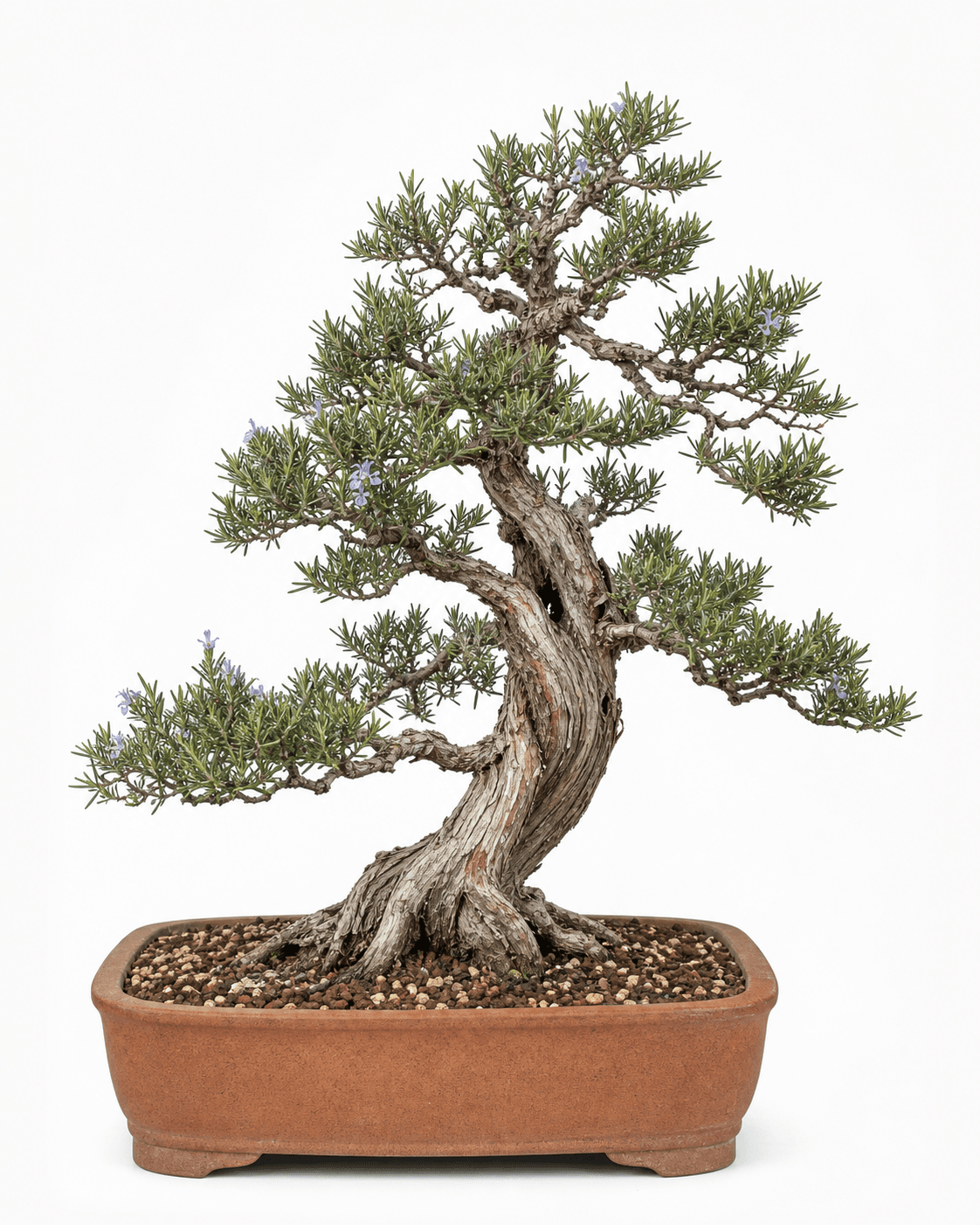
For design, read rosemary as a sun-baked aromatic shrub: fissured gray bark with age, squared young stems, small linear foliage, blue-to-white flowers, and a habit that can be upright, rounded, arching, prostrate, or cascading by cultivar. NC State Extension: Salvia rosmarinusBonsai Mirai / Asymmetry
Reading the tree
Read light, root oxygen, green-tip strength, and cultivar habit before pruning.
Start with the root system. Mirai broadleaf-evergreen watering guidance emphasizes full saturation followed by dry-back, and rosemary punishes the opposite pattern with root rot, botrytis, mildew, and general decline. Bonsai Mirai LibraryNC State Extension: Salvia rosmarinus
Read active green tips before cutting. Rosemary can be clipped into hedges, but bonsai branch building still needs leaves beyond each cut so the branch keeps pulling water and maintaining buds. Bonsai Mirai LibraryNC State Extension: Salvia rosmarinus
Read whether the tree is in development or refinement. Development trees can extend, thicken, and recover from larger branch decisions; refined trees need lighter feeding, shorter shoots, and less foliar removal at one time. Bonsai Mirai Library
Read cultivar habit early. Upright Tuscan Blue behaves differently from prostrate or trailing forms such as Prostratus, Irene, and Severn Sea, so the trunk line should follow the material rather than fight it. NC State Extension: Salvia rosmarinusBonsai Mirai / Asymmetry
Pruning
Prune after growth hardens and keep green tissue on every branch you want to keep.
Use spring for larger cuts on strong trees, then use post-flush pruning after shoots firm and leaves mature. Mirai broadleaf-evergreen method waits for the first flush to become energy positive before refinement pruning. Bonsai Mirai Library
Do not cut rosemary branches back behind all green foliage unless you are willing to lose that branch. The species can tolerate heavy pruning as a landscape shrub, yet bonsai back-budding on old leafless wood is too inconsistent for blind cuts. NC State Extension: Salvia rosmarinusBonsai Mirai Library
For refinement, shorten strong extensions to usable lateral buds, thin congested whorls and crossing shoots, and leave weaker interior twigs with enough leaf mass to gain strength. Bonsai Mirai Library
Flowers usually appear from spring into summer. If flowering matters, prune after the main bloom and keep some short flowering shoots rather than clipping every terminal into a tight culinary-herb dome. NC State Extension: Salvia rosmarinus
Roots
Repot for oxygen and percolation, then protect new roots from wet stagnation.
The strongest direct Mirai signal for Rosmarinus appears in greenhouse-session-oak-repotting: broadleaf-evergreen Mediterranean species, including Rosmarinus in the listed examples, respond to short-day winter timing more than warming temperature alone. Bonsai Mirai Library
Use that claim conservatively. In Mediterranean or mild maritime climates, late winter after the shortest day through early spring can suit rosemary root work. In colder regions, wait until the plant can recover under bright protected conditions. Bonsai Mirai LibraryNC State Extension: Salvia rosmarinus
Repot because percolation has slowed, soil has decomposed, roots have filled the pot, or the design needs a container change. Do not repot on calendar habit if water still enters, drains, and dries correctly. Bonsai Mirai Library
Work the old root mass in stages, avoid bare-rooting strong evergreen foliage, anchor the plant firmly, water once to settle the column, then honor dry-back before the next watering. Bonsai Mirai Library
Soil and pot
Build a dry-loving root system without starving it of water.
NC State gives dry to medium, well-drained soil and tolerance of most soil types except clay. Bonsai soil should sharpen that into stable mineral particles with low compaction and reliable drainage. NC State Extension: Salvia rosmarinus
A 1:1:1 akadama:pumice:lava mix is a safe development baseline for rosemary because it supports drainage, oxygen, and enough moisture for active roots. In hotter, drier regions, raise akadama slightly if watering cannot keep up. Bonsai Mirai Library
For refinement, Mirai broadleaf-evergreen files support akadama-heavy soil when leaf and root scaling are the goal. Use that only after roots are healthy and the grower can manage dry-back without drought collapse. Bonsai Mirai Library
Pot choice should fit the shrub character: modest depth for root buffering, unglazed or quiet glazed surfaces, and shapes that support coastal scrub, old herb garden, cascade, or low wall-spilling habits. Bonsai Mirai / AsymmetryNC State Extension: Salvia rosmarinus
Climate
Warm dry climates make rosemary easier; humid cold climates make roots and airflow the work.
In Mediterranean analog climates, rosemary can live outdoors with strong sun, rapid drainage, and winter rain management. Container culture still needs root protection when cold and wet overlap. Kew POWO: Salvia rosmarinusBonsai Mirai Library
In hot dry regions, the tree may need shade cloth during extreme heat, but only after it receives enough sun to stay compact. Increase watering depth, not frequency, when the pot dries fast. Bonsai Mirai LibraryNC State Extension: Salvia rosmarinus
In humid regions, prioritize air movement, open foliage, and inorganic soil. NC State specifically flags wet humid environments, powdery mildew, botrytis, root rot, and overwatering as common decline paths. NC State Extension: Salvia rosmarinus
In cold regions, overwinter the pot bright, cool, and protected. Warm indoor herb culture often creates weak growth, spider mites, wet soil, and poor light before spring recovery begins. NC State Extension: Salvia rosmarinusBonsai Mirai Library
Pests
Most rosemary pest problems follow weak light, wet roots, or indoor air.
NC State says rosemary is generally pest and disease free, but lists aphids, mealybugs, whiteflies, and spider mites, especially indoors. NC State Extension: Salvia rosmarinus
The disease list is more cultural than mysterious: poor circulation and high humidity can cause powdery mildew, while root rot, botrytis, and overwatering drive many plant declines. NC State Extension: Salvia rosmarinus
Southern blight is worth recognizing because NC State links rosemary to its ornamental disease page. The disease is favored by warm humid conditions and moist acidic soils, and symptoms can start near the lower stem before wilting advances. NC State Extension: Salvia rosmarinusNC State Extension: Southern Blight
The bonsai prevention stack is simple: full sun, moving air, open branch structure, clean tools, fast drainage, no chronic wet moss at the trunk, and quarantine for new nursery herbs before they join the bonsai bench. Bonsai Mirai LibraryNC State Extension: Southern Blight
Wiring
Wire young hardened growth early and treat old rosemary wood as brittle.
Rosemary starts with square green stems that become woody. Wire after shoots harden enough to hold a curve, before the branch becomes a dry rigid lever. NC State Extension: Salvia rosmarinusBonsai Mirai Library
Use aluminum wire, small gauges, and gentle bends. The bark is thin and aromatic, so scars remain visible longer than growers expect on small bonsai. Bonsai Mirai Library
Older trunks and branches are better moved with guy wires, clip-and-grow, subtle torsion, or progressive bending. A branch with no green beyond the bend has little reason to keep the water stream open. Bonsai Mirai Library
Check wire often during warm growth. Needle-like leaves can hide bites until the mark is already permanent. Bonsai Mirai LibraryNC State Extension: Salvia rosmarinus
Propagation
Cuttings are the practical way to preserve bonsai-scale rosemary.
NC State lists division, layering, seed, and stem cutting as propagation strategies and notes that seed is slow to germinate while gardeners often have better results from cuttings, layering, or division. NC State Extension: Salvia rosmarinus
For bonsai, stem cuttings are the most useful because they preserve cultivar habit, leaf size, flower color, and branch density. Start with compact, woody, sun-grown stock rather than soft greenhouse herb plants. NC State Extension: Salvia rosmarinusBonsai Mirai / Asymmetry
Layering can rescue a good cascading top on a poor root base, but it needs careful water-oxygen balance in the layer medium. Mirai broadleaf-evergreen air-layer guidance separates layers at spring movement when roots can take over. Bonsai Mirai Library
Grafting is uncommon for ordinary rosemary bonsai. Reserve it for cultivar preservation or root correction after the plant is strong enough to support a scion and aftercare. Bonsai Mirai / Asymmetry
Buying
Buy woody structure and cultivar habit, not a soft herb pot.
The best candidates are old landscape shrubs, nursery rosemary in full-sun shrub production, prostrate cultivars with trunk movement, and compact cultivars with short internodes and many low shoots. NC State Extension: Salvia rosmarinus
Inspect the lower trunk, root flare, pot drainage, old wood, interior green, branch exits, and pest history. Reject plants with sour peat, root-rot smell, mildew, no interior growth, or brittle straight trunks that need impossible bends. NC State Extension: Salvia rosmarinusBonsai Mirai Library
NC State lists useful forms including Arp, Irene, Officinalis, Prostratus, Salem, Severn Sea, and Tuscan Blue. Choose the cultivar by design: upright shrubs for informal upright, trailing forms for cascade, and compact forms for small bonsai. NC State Extension: Salvia rosmarinus
Keep culinary and bonsai goals separate. A rosemary bonsai may still be aromatic, but frequent harvest-style stripping can weaken branch design, reduce interior buds, and expose old wood with poor regrowth. NC State Extension: Salvia rosmarinusBonsai Mirai Library
Troubleshooting
Most failures trace to wet roots, weak light, old-wood cuts, or indoor stress.
Yellowing, dull foliage, or sudden decline on wet soil: suspect overwatering, root rot, compact organic mix, or poor percolation. Repot only when the tree can recover, and correct watering first. NC State Extension: Salvia rosmarinusBonsai Mirai Library
White coating on foliage: suspect powdery mildew from humid still air. Increase sun and airflow, open the canopy, and avoid wet foliage at night. NC State Extension: Salvia rosmarinus
Fine webbing, pale foliage, or sticky residue indoors: inspect for spider mites, aphids, mealybugs, or whiteflies. Move toward brighter cooler airflow and treat only after identifying the pest. NC State Extension: Salvia rosmarinus
Branch fails after pruning: the cut may have removed all green growth or exceeded the branch strength. Leave active tips during design work and rebuild structure by stages. Bonsai Mirai Library
Weak spring growth after winter: check root freeze, indoor etiolation, wet winter soil, and poor light. Bonsai roots can die before the top shows symptoms, then fail when spring transpiration starts. Bonsai Mirai LibraryNC State Extension: Salvia rosmarinus
Design
Design rosemary as a coastal aromatic shrub with small leaves and old bark.
Start with base, trunk line, defining branch, and apex. Rosemary often has many shoots from a low woody base, so choose the line that creates age before choosing the foliage outline. Bonsai Mirai / Asymmetry
Upright cultivars can become informal upright, slanting, broom-adjacent, or literati shrub designs. Prostrate cultivars naturally support cascade, semi-cascade, exposed-root, wall-spilling, and windswept forms. NC State Extension: Salvia rosmarinusBonsai Mirai / Asymmetry
The design language should stay broadleaf evergreen and Mediterranean: compact aromatic foliage, repeated small branch division, modest flowers, gray bark, and dry exposed movement rather than conifer deadwood drama. Bonsai Mirai / AsymmetryNC State Extension: Salvia rosmarinus
Do not rush refinement. Build a root system first, set primaries while wood is still flexible, then use repeated extension and prune-back to create secondary and tertiary branching. Bonsai Mirai Library
Forms
Cultivar choice controls scale, hardiness, flower color, and design direction.
NC State lists Albus or Albiflorus, Arp, Irene, Marjorca Pink or Marjorca, Officinalis, Prostratus, Salem, Severn Sea, and Tuscan Blue among named varieties. NC State Extension: Salvia rosmarinus
Arp and Salem are useful cold-hardy upright choices where winter protection is still planned. Tuscan Blue grows fast and upright, which can help trunk and primary development before refinement. NC State Extension: Salvia rosmarinus
Irene, Prostratus, and Severn Sea suit low, arching, trailing, cascade, or wall-spilling bonsai designs. Their habit can save years of fighting an upright plant into a low line. NC State Extension: Salvia rosmarinus
Keep Salvia rosmarinus separate from Salvia officinalis, lavender, thyme, savory, tea tree, Leptospermum, Melaleuca, and culinary labels that share silver foliage or aromatic leaves. Kew POWO: Salvia rosmarinusNC State Extension: Salvia rosmarinus
History
Rosemary is older as a garden and culinary plant than as an English-language bonsai subject.
Kew records food, medicine, invertebrate food, environmental, and social uses for Salvia rosmarinus. NC State likewise describes ornamental, culinary, sachet, potpourri, pollinator, container, hedge, and border uses. Kew POWO: Salvia rosmarinusNC State Extension: Salvia rosmarinus
That history creates the main bonsai challenge: many people approach rosemary as a harvestable herb rather than as a woody shrub with a root system, trunk line, branch hierarchy, and seasonal energy budget. Bonsai Mirai / AsymmetryNC State Extension: Salvia rosmarinus
Notable rosemary bonsai are less standardized than olive, boxwood, myrtle, or cork oak in English-language teaching. The opportunity is local: old garden shrubs, dry-climate hedges, and prostrate cultivars can produce convincing Mediterranean bonsai when the root system is handled carefully. Bonsai Mirai LibraryNC State Extension: Salvia rosmarinus
A good rosemary bonsai should make the plant identity obvious through aroma, needle-like evergreen leaves, square young stems, small flowers, gray woody bark, and a dry-scrub structure that remains legible outside bloom. NC State Extension: Salvia rosmarinusBonsai Mirai / Asymmetry
Species questions
Answer the beginner questions before styling.
Can rosemary be grown as bonsai?
Yes. Rosemary can be grown as an outdoor broadleaf evergreen bonsai when it has full sun, fast drainage, careful dry-back watering, green growth on retained branches, and winter root protection.
Is rosemary bonsai indoor or outdoor?
Rosemary is best treated as outdoor bonsai. It can be overwintered in bright cool protection, but warm dim indoor herb culture often leads to weak growth, mites, mildew, and wet roots.
What is the correct botanical name for rosemary bonsai?
Use Salvia rosmarinus. Rosmarinus officinalis is the old name and remains common on trade tags, older care sheets, and culinary-herb labels.
How should I water rosemary bonsai?
Water thoroughly to runoff, then let the soil dry back before watering again. Frequent small waterings keep the root zone wet and oxygen-poor, which is a common failure pattern.
What soil is best for rosemary bonsai?
Use a sharply draining mineral mix. A 1:1:1 akadama:pumice:lava mix is a safe development baseline, while akadama-heavier mixes belong on healthy refined trees with precise watering.
When should rosemary bonsai be repotted?
Repot in late winter to early spring for Mediterranean broadleaf-evergreen timing, adjusted for local cold protection. Repot only when percolation, soil condition, root volume, or design requires it.
Can I cut rosemary back hard?
Hard pruning should be staged and should leave green growth on branches you want to keep. Cuts into leafless old rosemary wood do not reliably produce new buds.
Why is my rosemary bonsai dying indoors?
Common indoor causes are low light, warm still air, spider mites, powdery mildew, wet soil, and weak winter roots. Move the tree toward brighter, cooler, airier protection and correct watering.
Which rosemary cultivars are best for bonsai?
Compact, woody, sun-grown plants are best. Upright forms such as Arp, Salem, and Tuscan Blue suit informal upright work, while Prostratus, Irene, and Severn Sea suit cascade and low designs.
Can I harvest leaves from a rosemary bonsai?
Light trimming is possible on strong trees, but harvest-style stripping can weaken branches and disrupt design. Treat the plant as bonsai first and culinary herb second.
Sources
Species advice needs source discipline.
Next decisions
Plan the operation before copying the calendar.
A good care note for Rosemary records the tree's stage, the work done, and the aftercare used. That record matters more than a month-name rule.
Related species
Compare nearby trees before transferring advice.
English boxwood
Buxus sempervirens
Japanese boxwood
Buxus microphylla
Korean boxwood
Buxus sinica var. insularis
English holly
Ilex aquifolium
Japanese holly
Ilex crenata