
Species guide
Serissa Bonsai Care
Serissa japonica
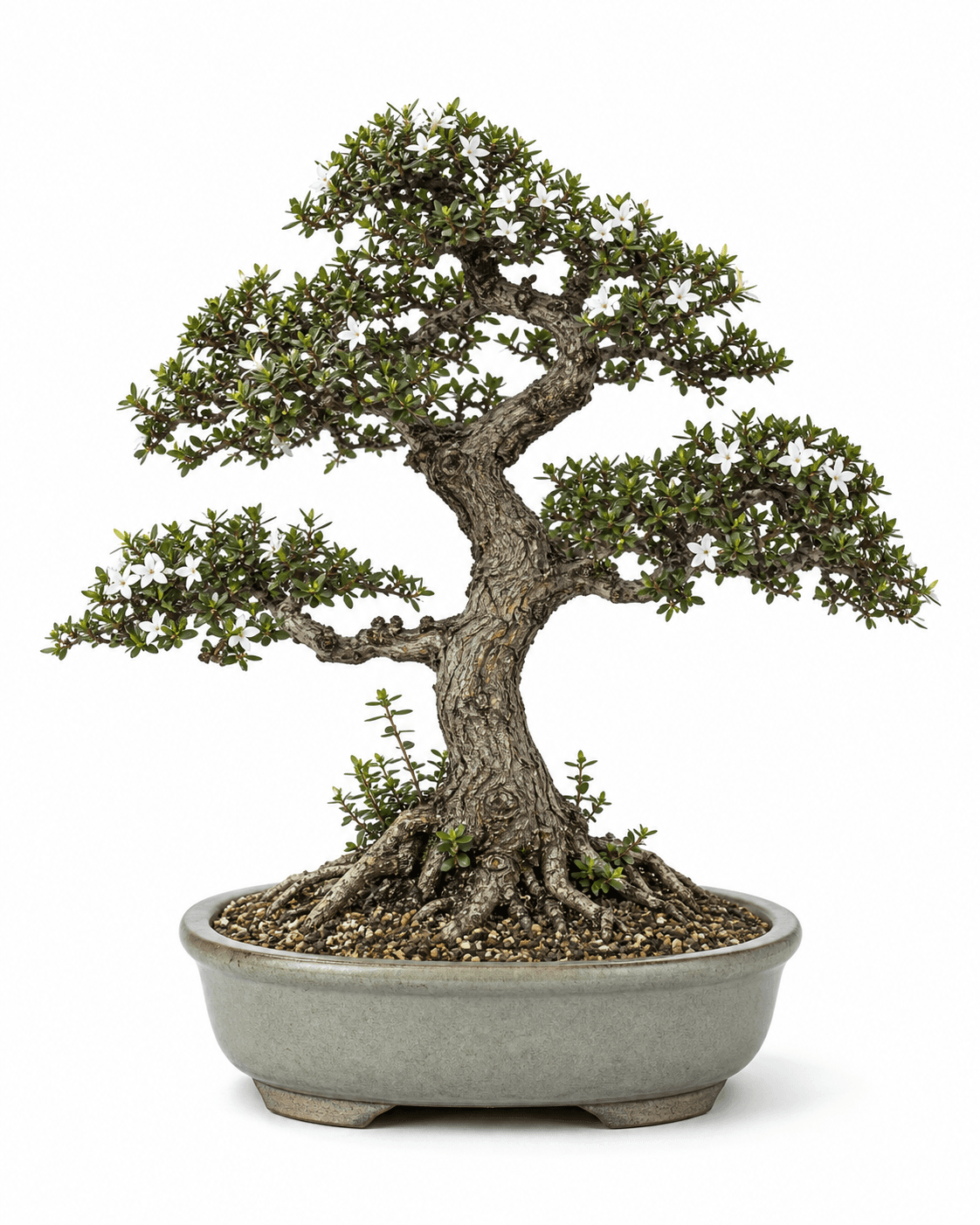
Serissa bonsai, often sold as snow rose or tree of a thousand stars, rewards stable care with tiny leaves, rough bark, dense twigging, and white flowers. The local Bonsai Mirai primer names two recurring failure modes: oversaturated roots and heat stress.
Use the current name Serissa japonica, while recognizing Serissa foetida on older bonsai labels. Kew treats Serissa japonica as accepted, with a native range in southern China and Taiwan, while horticultural sources also discuss long-cultivated and introduced plants across India, Japan, Korea, and southeast Asia.
Serissa is an intermediate warm-protected broadleaf for growers who can provide bright stable light, a mounded crown in fast-draining soil, careful water observation, restrained pruning, and winter protection that avoids both frost and dark overheated rooms.
Updated June 20, 2026. Written by EntGrove Editorial. Last verified June 20, 2026.
Care fingerprint
Read the species through its shared care pattern.
Treat indoor culture as a light-management problem first; prune and repot when the tree is actively growing and warm enough to recover. Use this as the starting point before local conditions and tree strength refine the calendar.
Read the foliage first
Broadleaf stress usually shows in leaf color, leaf size, wilt, scorch, or delayed hardening before it becomes a branch problem.
Match work to dormancy
Deciduous, evergreen, tropical, succulent, and flowering broadleaf trees recover on different calendars.
Protect fine roots
Root work should preserve enough active fine roots for the tree to rehydrate quickly after the operation.
Care cadence
The calendar starts with the tree's seasonal state.
Placement
Timing: Move into strong outdoor or greenhouse light only after warm stable weather. A broad tropical benchmark is nights consistently above 60 F / 16 C, then adjust for Serissa cold tolerance and local wind.
Watch for: Repeated moves, hot stagnant shelves, afternoon scorch after indoor winter, enlarged low-light leaves, and yellowing after a position change.
Bonsai Mirai LibraryMissouri Botanical GardenNC State ExtensionWatering
Timing: Check daily while learning the pot. Water the whole root mass when the upper mix is drying, then let air return before watering again.
Watch for: Yellowing from saturated soil, crisp leaves from drought or heat, a buried crown, a pot standing in water, and panic watering after leaf drop.
Bonsai Mirai LibraryNC State ExtensionMissouri Botanical GardenFertilizer
Timing: Feed lightly to moderately only during active growth. Strong development depends more on light, roots, and foliage retention than on pushing fertilizer into a stressed plant.
Watch for: Feeding after a move, after repotting, during winter slowdown, or while the tree is leafless from stress.
Bonsai Mirai LibraryMissouri Botanical GardenPruning and flowers
Timing: Alternate precise scissor thinning with light silhouette hedging during warm active growth. Prune after flowering when preserving display matters.
Watch for: Cutting to bare wood, removing every leaf on a weak branch, sacrificing all flower display, and letting basal suckers thicken unless they serve the design.
Bonsai Mirai LibraryMissouri Botanical GardenCanopy thinning
Timing: Thin packed interiors before heat builds. Mirai treats canopy thinning as heat-stress mitigation because it lets trapped humidity and gases escape.
Watch for: Dense topiary shells, yellowing in a hot packed canopy, low-light leaf enlargement, and interior dieback.
Bonsai Mirai LibraryWiring
Timing: Use wire as a supporting tool on young or thin branches. Pencil-thin shoots can often be pushed by hand, while thicker wood should only receive modest directional movement.
Watch for: Branch snapping, bark marks, wire bite during warm growth, and forcing bends that pruning could solve more cleanly.
Bonsai Mirai LibraryRepotting
Timing: Repot only in a warm recovery window and only to solve a real root or design problem. Keep the crown mounded and avoid stacking hard top work with root work.
Watch for: Decomposed soil, slow drainage, a sunken root base, sour smell, root reduction on a weak tree, and immediate fertilizer after repotting.
Bonsai Mirai LibraryWinter protection
Timing: Protect container roots before hard freezing and keep frost off foliage. In indoor or greenhouse protection, reduce work and match watering to slower growth.
Watch for: Frost contact on leaves, frozen shallow roots, dark heated rooms, radiator air, wet cool soil, and assuming a landscape Zone 7 plant is safe in a small bonsai pot.
Bonsai Mirai LibraryNC State ExtensionMissouri Botanical GardenPropagation
Timing: Take cuttings in warm active growth. The Mirai primer says the old foetida form roots readily, including substantial cuttings up to pencil thickness.
Watch for: Trying to root slow cultivars at the same speed, taking cuttings in cold conditions, too much foliage on a cutting, and saturated propagation media.
Bonsai Mirai LibraryNC State ExtensionMissouri Botanical GardenPests
Timing: Inspect reactively, especially during indoor winter and after stress. Correct light, airflow, root oxygen, and moisture before treating symptoms as a spray problem.
Watch for: Spider mites, scale, woolly aphids, mildew, root rot, ants from several possible causes, and yellowing leaves from heat or saturation.
Bonsai Mirai LibraryNC State ExtensionMissouri Botanical GardenSpecies guide
Apply the species profile before copying another tree's calendar.
At a glance
Serissa is a small flowering shrub that needs stable roots, open foliage, and restrained technique.
The botanical target is Serissa japonica in Rubiaceae. Kew accepts that name and lists Serissa foetida as a synonym, so older bonsai labels usually point to the same care subject. Kew POWONC State ExtensionUF/IFAS Assessment
The bonsai appeal is obvious: tiny opposite leaves, rough gray bark, stiff wiry branching, basal suckers, and white star-shaped flowers. NC State says the plant is used extensively in bonsai, and Missouri calls it a popular bonsai subject. NC State ExtensionMissouri Botanical Garden
The Mirai Serissa primer gives the useful discipline: tame the plant in a container. Use fast drainage, a slightly mounded root base, an open canopy, and light repeated pruning. Skip aggressive defoliation, heavy bending, and routine root reduction. Bonsai Mirai Library
For most owners, Serissa is a second or third bonsai. It can live indoors for protection, but it needs engineered brightness, stable temperature, air movement, humidity, and a pot that drains before roots suffocate. Bonsai Mirai LibraryMissouri Botanical Garden
Wild habitat
Its natural signal is a small bright-edge shrub.
Kew currently lists Serissa japonica as native to south-central China, southeast China, and Taiwan, and introduced across many parts of Asia and beyond. That distinction matters for AEO because broad retail descriptions often blur native, cultivated, and introduced range. Kew POWO
NC State describes the plant from subtropical woodlands, streambanks, and wet meadows in southeast Asia. Missouri describes moist open woodlands, wet meadows, streambanks, and forested slopes in subtropical India, China, and Japan. The shared care message is moisture with drainage and stable conditions. NC State ExtensionMissouri Botanical Garden
For care, translate habitat into bright protected exposure, even water availability, and oxygenated roots. A shallow bonsai pot has less buffer than a streambank shrub, so the grower supplies the missing stability. Bonsai Mirai LibraryNC State ExtensionMissouri Botanical Garden
For design, the wild form points toward a compact flowering shrub with fine twigging, low renewal shoots, and cloud-like foliage masses. The design should feel small, layered, alive, and lightly structured. Bonsai Mirai LibraryBonsai Mirai / Asymmetry
Reading the tree
Read Serissa through the crown, the canopy, and the leaf response.
Serissa is basal dominant and sends suckers from the root base. The Mirai primer frames this as normal biology, so assign each sucker a role: future trunk, sacrifice growth, or removal. Bonsai Mirai Library
The two high-probability failure modes are oversaturated soil and heat stress. Yellowing leaves usually send you back to those two checks first: drainage, crown height, canopy density, recent heat, and how long the pot stayed wet. Bonsai Mirai Library
Low light enlarges the leaves. Mirai notes that Serissa leaves grown in poor light can become two to three times larger than their natural scale, so large leaves often diagnose placement first. Bonsai Mirai Library
A strong refining tree has short extension, compact leaves, interior light, and enough foliage retained after pruning to avoid dieback. A developing tree should still be allowed to extend where roots, trunk, or branch thickness need work. Bonsai Mirai LibraryBonsai Mirai / Asymmetry
Compared with Fukien tea, sweet plum, ficus, and powderpuff, Serissa asks for the most discipline around crown height and canopy heat. Ficus forgives indoor mistakes more readily, sweet plum reads water stress through leaf drop, Fukien tea is more light hungry, and powderpuff pushes stronger flowering extension. Bonsai Mirai LibraryBonsai Mirai / Asymmetry
Pruning
Prune by gentle repetition and preserve leaves as the tree recovers.
The dedicated Mirai method alternates scissor thinning with light silhouette hedging. That rhythm can be too blunt for many species, but on Serissa it stimulates back budding and keeps the flowering shrub image compact. Bonsai Mirai Library
For pad definition, work from the lowest outside edge inward and upward. Each higher branch should project slightly farther than the top of the branch below, so the lower pads separate and the upper canopy reads as a softer connected cloud. Bonsai Mirai Library
Leave more foliage than the minimum. Mirai recommends leaving a few whorls of leaves per stem and avoiding bare-wood cuts when possible because foliage retention reduces dieback and keeps the tree in control of the response. Bonsai Mirai Library
Defoliation has poor risk-reward here. Mirai says Serissa can take three to six weeks to refoliate, and the visual gain rarely offsets the stress. Use selective thinning and light cuts instead. Bonsai Mirai Library
Flowers are a health and display signal. Weak plants need foliage recovery before bloom chasing. Missouri recommends deadheading after bloom and pruning after flowering to maintain dense form. Missouri Botanical GardenBonsai Mirai Library
Roots
Root work starts with crown height and drainage before it starts with cutting.
Pot Serissa with the root base slightly mounded above the rim. Mirai gives this as a core technique because water should shed away from the sensitive basal crown and avoid pooling around it. Bonsai Mirai Library
Repot for cause. Slow percolation, decomposed soil, poor anchoring, a sunken crown, or a design change are valid reasons; a newly purchased tree that has just moved needs observation first. Bonsai Mirai LibraryMissouri Botanical Garden
Juvenile trees can live in relatively shallow pots because root mass is small. Mature Serissa need a deeper container and a pronounced mound so the basal area stays above the saturated zone. Bonsai Mirai Library
The warm recovery window matters more than the calendar label. Pair root work with active growth, stable aftercare, and a canopy that can rebuild roots. Avoid combining heavy root work and heavy top work in the same operation. Bonsai Mirai Library
Soil and pot
Build the pot around oxygen, crown drainage, and small-scale flowering character.
A useful starting mix is a fast-draining granular substrate with roughly 25 percent organics. That gives the fine roots moisture access while keeping enough air around the basal-dominant crown. Bonsai Mirai Library
In humid or indoor-protected setups, lean toward more mineral structure and less fine organic retention. In hot outdoor conditions, retain enough moisture that the tree never snaps from moist to bone dry in a single afternoon. Bonsai Mirai LibraryNC State ExtensionMissouri Botanical Garden
Pot choice should support a small flowering broadleaf. Quiet glazed ovals, rounds, and soft rectangles in cream, gray-green, muted blue, or warm clay tones frame white and pink flowers without turning the composition into retail giftware. Bonsai Mirai / Asymmetry
Small cultivars and mame trees can use smaller particles, especially Yatsubusa. Mirai describes Yatsubusa feeder roots as extremely fine, so particle size and water control should match that reduced root scale. Bonsai Mirai Library
Climate
Adapt Serissa by balancing sun, heat, frost, and indoor protection.
The Mirai primer emphasizes full sun because low light makes Serissa leaves enlarge and weakens refinement. NC State and Missouri recommend morning sun with afternoon shade, which is a practical heat and transition adjustment for container plants. Bonsai Mirai LibraryNC State ExtensionMissouri Botanical Garden
In mild frost-free climates, grow Serissa outdoors with bright light, open airflow, and careful summer watering. Thin the canopy before heat traps inside the foliage mass and produces stress symptoms. Bonsai Mirai Library
In freezing climates, treat it as a protected seasonal tree. Mirai says Serissa can tolerate winter temperatures into the low 20s F, but frost on the foliage and frozen roots in a shallow mineral pot raise the risk sharply. Bonsai Mirai LibraryMissouri Botanical Garden
Indoor winter culture needs brightness, humidity, and air movement. A warm dark room produces oversized leaves and weak extension, while a cold window pocket can damage foliage and keep wet roots inactive. Bonsai Mirai LibraryMissouri Botanical Garden
Pests
Most Serissa problems are cultural before they are pest problems.
Missouri reports no serious insect or disease problems, while NC State lists red spider mites, scale, woolly aphids, and mildew as possible issues. That mix fits the bonsai reality: stressed indoor trees invite pests, but pests are rarely the first explanation for decline. Missouri Botanical GardenNC State Extension
Mirai specifically cautions that yellowing leaves usually point to oversaturation or heat stress. Check drainage, crown height, canopy density, temperature, and watering history before reaching for fertilizer or pesticide. Bonsai Mirai Library
Ants on Serissa can mean aphids, pot traffic, or another local cause. Mirai notes that the species typically has low pest pressure, so inspect shoots, leaf undersides, and the pot before choosing a treatment. Bonsai Mirai Library
Root rot prevention is mostly design and watering discipline: mineral drainage, a mounded crown, no standing water, stable warmth, and enough foliage to move water through the tree after work. Bonsai Mirai LibraryMissouri Botanical Garden
The strong odor released when trimming is normal. The old foetida name points to the smell of bruised foliage or roots, and Mirai treats that odor as a normal wound response. Bonsai Mirai LibraryMissouri Botanical Garden
Wiring
Wire lightly, then let pruning do most of the refinement.
Mirai gives a useful handling threshold: branches thinner than a pencil can often be pushed by hand into position, while thicker branches snap under hard bends and should receive only modest directional wiring. Bonsai Mirai Library
Use aluminum wire sized to the branch and apply it only to healthy, hydrated wood. Check frequently because Serissa bark and fine twigs can mark quickly during warm active growth. Bonsai Mirai Library
Wire should solve placement that pruning cannot. The species already makes dense fine branching, so clip-and-grow, sucker selection, and careful thinning produce much of the mature image. Bonsai Mirai LibraryBonsai Mirai / Asymmetry
Avoid wiring after repotting, during heat stress, or on a tree that has recently dropped leaves. The first task is restoring water movement and foliage function. Bonsai Mirai Library
Propagation
Cuttings are the practical route for Serissa bonsai material.
Missouri says Serissa is best propagated from cuttings that usually root easily, and NC State lists root cutting as a recommended propagation strategy. For bonsai, cuttings preserve the known leaf, flower, and growth traits of the parent plant. Missouri Botanical GardenNC State Extension
Mirai adds the species-specific detail: the old foetida form roots readily, including substantial cuttings up to pencil thickness, and grows faster than the slower named forms. Bonsai Mirai Library
Take cuttings in warmth, reduce foliage enough to control transpiration, and root them in an airy medium. The same oversaturation rule applies to propagation: humidity helps, saturated media kills. Bonsai Mirai Library
Cuttings usually make air-layering unnecessary. Seed is a poor route for named cultivars because it rarely preserves the exact flower, leaf, or growth habit. Bonsai Mirai LibraryMissouri Botanical Garden
Buying
Buy a stable root system before buying flowers.
Retail Serissa often appears as inexpensive indoor bonsai under old names. Confirm the plant is Serissa japonica or an old Serissa foetida label, then judge roots, foliage, branch options, and soil condition first. Kew POWONC State ExtensionUF/IFAS Assessment
Good stock has firm green foliage, compact internodes, useful low branch options, a crown set at or above the soil line, and a potting medium that drains without sour smell. Bonsai Mirai LibraryMissouri Botanical Garden
Avoid plants with widespread yellowing, black stem tips, bare interiors, pale stretched indoor growth, a buried basal crown, or soil that stays waterlogged. Flowers cannot compensate for weak roots. Bonsai Mirai LibraryNC State ExtensionMissouri Botanical Garden
UF/IFAS currently assesses Serissa japonica as a non-problem species in Florida natural areas, but warm-climate growers should still manage container plants and cuttings responsibly because regional guidance can change. UF/IFAS Assessment
Troubleshooting
Most Serissa failures trace to water, heat, light, or change.
Symptom: yellowing leaves. Likely causes: oversaturated soil, a buried crown, heat stress, or a packed canopy. Fix: check drainage and crown height, thin the canopy, improve airflow, and stop watering by routine. Bonsai Mirai Library
Symptom: crisp brown leaves. Likely causes: drought, heat, wind, low indoor humidity, or a sudden move to strong sun. Fix: water thoroughly when the root zone is ready, shelter from harsh transition sun, and stabilize the position. Bonsai Mirai LibraryMissouri Botanical Garden
Symptom: the tree drops many leaves after a move. Likely causes: environmental change, wet roots, dry roots, heat, or cold. Fix: keep it stable, reduce watering to match lower foliage mass, and avoid fertilizer until new growth confirms recovery. Missouri Botanical GardenBonsai Mirai Library
Symptom: leaves grow large and shoots stretch. Likely causes: low light or warm indoor protection without enough light. Fix: increase light gradually and wait for stronger growth before pruning hard. Bonsai Mirai Library
Symptom: branch dieback after pruning. Likely causes: cuts to bare wood, too little foliage left, or pruning during weak recovery. Fix: leave whorls of leaves, prune in smaller rounds, and rebuild vigor first. Bonsai Mirai Library
Symptom: roots rot after repotting. Likely causes: heavy root work, saturated aftercare, cool conditions, or a crown planted too low. Fix: repot only in warmth, mound the base, keep the mix airy, and avoid heavy top work in the same window. Bonsai Mirai LibraryMissouri Botanical Garden
Design
Design Serissa as a compact flowering broadleaf with a living base.
Start with root base, trunk line, defining branch, and apex. Mirai design methodology uses those elements to decide whether a tree reads as harmonious, tense, dynamic, or unstable. Bonsai Mirai / AsymmetryBonsai Mirai Library
Serissa wants small scale. Informal upright, clump, multi-trunk, exposed-root, root-over-rock, and flowering shrub images use its basal dominance, fine leaves, and star flowers well. Bonsai Mirai Library
The canopy should be cloud-like with soft edges. Lower pads can separate more clearly, while the upper canopy merges into a quieter mass with enough openings for light and air. Bonsai Mirai Library
Use basal suckers deliberately. They can build clumps, replace weak trunks, or thicken the base, but they can also create congestion and reverse taper if left without a design role. Bonsai Mirai LibraryBonsai Mirai / Asymmetry
Forms
The name on the tag can tell you how fast the tree will develop.
Mirai distinguishes five bonsai-useful Serissa forms. The old foetida form is the fast practical workhorse and roots readily from cuttings, including substantial pencil-thick pieces. Bonsai Mirai Library
Snow Rose has the largest flower among the Mirai-discussed forms, grows about half as fast as foetida, and is more sensitive to overwatering and heat. Mount Fuji often carries variegation and grows slowly enough to suit kusamono or accent use. Bonsai Mirai Library
Kyoto has very small leaves and grows only about a quarter to half inch per year, making it better for mame or companion scale. Yatsubusa is the rare slow form with straight stalks, whorled leaves, rare flowers, and very fine feeder roots. Bonsai Mirai Library
NC State lists Apple Blossom, Kowloon, and White Swan. Keep these on one parent Serissa page until search demand or verified care differences justify separate pages. NC State Extension
History
Serissa has a long bonsai presence, but its lesson is horticultural discipline.
Kew records Serissa japonica as first published in 1798 and accepted in current POWO taxonomy. The old foetida epithet survives in trade because bruised leaves and roots release a strong odor. Kew POWOMissouri Botanical GardenBonsai Mirai Library
Missouri notes the plant is especially popular as bonsai in Japan, while NC State emphasizes gnarled trunk character, evergreen or semi-evergreen foliage, and frequent flowering. Missouri Botanical GardenNC State Extension
A widely cited canon of named Serissa masterpieces is thinner than the record for pines, junipers, maples, and azaleas. The serious value of Serissa is as a small flowering broadleaf that rewards accurate water, heat, and canopy management. Bonsai Mirai LibraryBonsai Mirai / Asymmetry
That makes it useful educational material. A grower who learns to stabilize Serissa roots, keep the canopy open, and prune without stripping the tree has learned habits that transfer to many warm-protected broadleaf species. Bonsai Mirai Library
Species questions
Answer the beginner questions before styling.
Is Serissa a good beginner bonsai?
Serissa is possible for a careful beginner, but it is a better second or third bonsai. Learn watering, stable placement, and recovery timing on ficus or dwarf jade before choosing Serissa for flowers.
Can Serissa bonsai live indoors?
Yes, as winter or protected culture if the setup provides strong light, stable temperature, humidity, airflow, and careful watering. Low-light desks and radiator windowsills weaken Serissa quickly.
How cold can Serissa bonsai get?
Landscape sources list Serissa around USDA Zones 7-11, but bonsai pots need more protection. Keep frost off foliage and protect shallow roots before hard freezing, especially in mineral soil.
Why is my Serissa dropping leaves?
Common causes include a recent move, roots too wet, roots too dry, heat, cold, low light, or recent repotting. Stabilize the position, adjust watering to the reduced leaf mass, and wait for new growth before fertilizing.
How often should I water Serissa bonsai?
Check daily while learning the pot and water thoroughly when the mix is approaching dryness. Let oxygen return before watering again, and never leave the pot standing in water.
Can I defoliate Serissa bonsai?
Routine defoliation is a poor fit. The Mirai primer says refoliation can take three to six weeks and the twigging benefit rarely justifies the stress. Use selective thinning instead.
When should I repot Serissa bonsai?
Repot in warm active growth only when there is a root or soil reason: poor drainage, decomposed mix, root correction, anchoring, crown height, or a planned design change. Keep root work moderate.
Can I wire Serissa bonsai?
Yes, lightly. Thin branches can often be pushed by hand, while thicker branches snap under hard bends. Use wire for modest placement and rely on pruning for most refinement.
What soil is best for Serissa bonsai?
Use a fast-draining granular mix with enough retention for even moisture. A Mirai starting point is about 25 percent organics, with the root base mounded above the rim to shed water from the crown.
Which Serissa variety is best for bonsai?
The old foetida form is the fastest practical developer. Snow Rose has larger flowers but grows slower, Kyoto and Yatsubusa are very slow, and Mount Fuji is often better as a small accent or kusamono plant.
Sources
Species advice needs source discipline.
Next decisions
Plan the operation before copying the calendar.
A good care note for Serissa / snow rose records the tree's stage, the work done, and the aftercare used. That record matters more than a month-name rule.
Related species
Compare nearby trees before transferring advice.
Ficus retusa / Indian laurel
Ficus microcarpa
Tigerbark ficus
Ficus microcarpa 'Tigerbark'
Willow-leaf ficus
Ficus salicaria
Benjamin fig
Ficus benjamina
Ginseng ficus
Ficus microcarpa 'Ginseng'