
Species guide
Tea Tree / Manuka Bonsai Care
Leptospermum scoparium
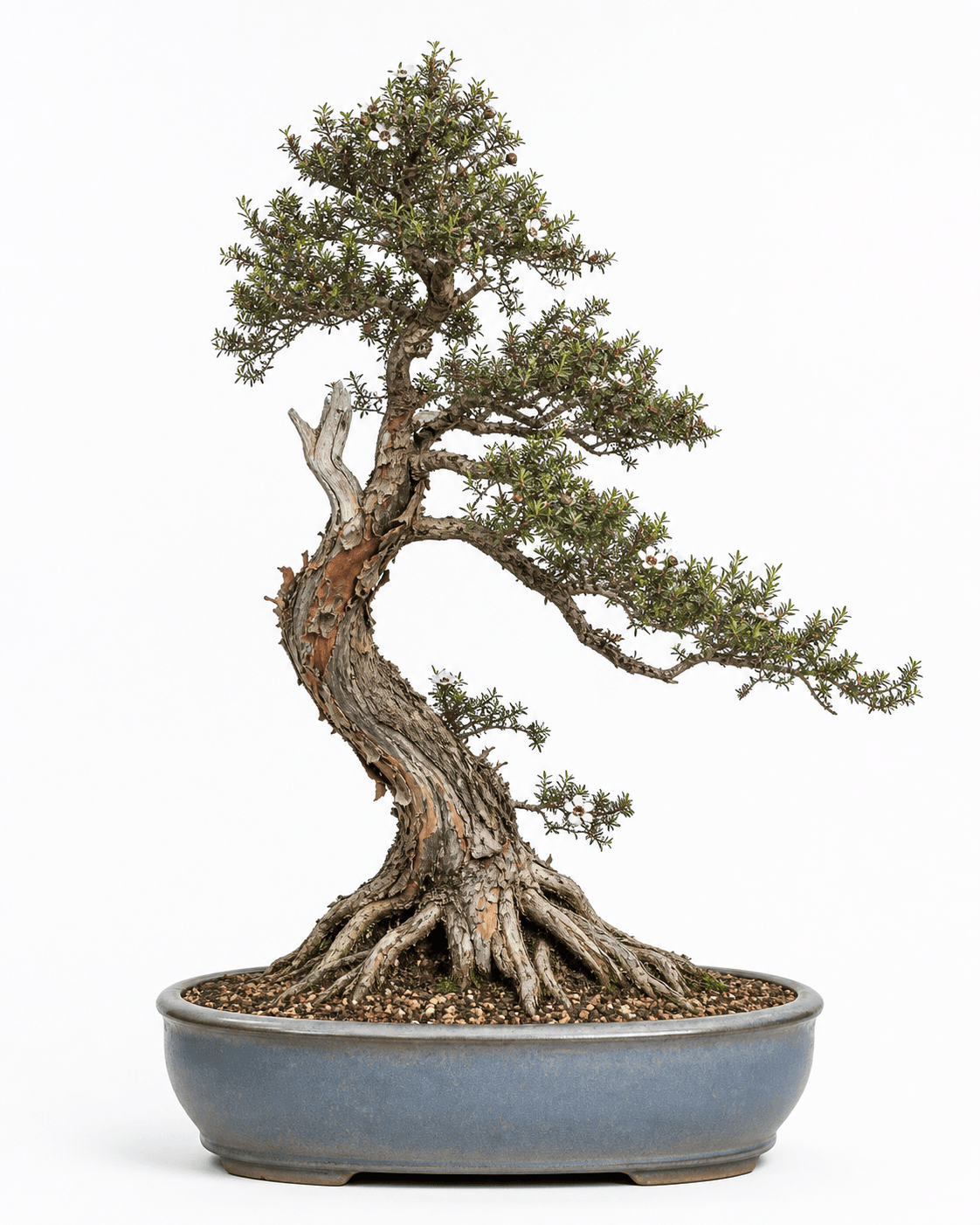
Tea tree or manuka bonsai usually means Leptospermum scoparium, an accepted Myrtaceae species native to southeast Australia, New Zealand, and the Chatham Islands. It is a small-leaved evergreen shrub or small tree with prickly foliage, white to pink flowers, persistent woody capsules, and strong value as coastal or dryland shrub material.
Treat manuka as Broadleaf > Evergreen with small-leaf Myrtaceae nuance: outdoor light, full watering with oxygen return, mineral soil, spring root work, prune-after-growth decisions, conservative old-wood cuts, and frost protection in a bonsai pot. The best bonsai are built from verified labels, small leaves, visible trunk movement, and roots that can be converted slowly.
The source-depth caveat is important. The local Mirai corpus has direct tea-tree material, but the dedicated files cover Leptospermum trinervium and Leptospermum laevigatum rather than Leptospermum scoparium. This page transfers the genus and Myrtaceae method transparently, then grounds exact manuka identity, range, morphology, ecology, and economic history in Kew and the University of Waikato review.
Updated June 12, 2026. Written by EntGrove Editorial. Last verified June 12, 2026.
Care fingerprint
Read the species through its shared care pattern.
Protect from hard freezes when species demands it, prune with active foliage in mind, and repot when roots can recover without dormancy cues. Use this as the starting point before local conditions and tree strength refine the calendar.
Note: Small-leaf Myrtaceae broadleaf evergreen with prickly foliage, flowers, persistent woody capsules, and coastal or scrubland design character. Verify Leptospermum scoparium before applying this page because tea tree can also point to Melaleuca, Kunzea, other Leptospermum species, rosemary, or Camellia sinensis.
Read the foliage first
Broadleaf stress usually shows in leaf color, leaf size, wilt, scorch, or delayed hardening before it becomes a branch problem.
Match work to dormancy
Deciduous, evergreen, tropical, succulent, and flowering broadleaf trees recover on different calendars.
Protect fine roots
Root work should preserve enough active fine roots for the tree to rehydrate quickly after the operation.
Care cadence
The calendar starts with the tree's seasonal state.
Placement
Timing: Grow outdoors in strong light with airflow. Acclimate nursery or greenhouse plants gradually before full sun, especially after shipping or root work.
Watch for: Long weak shoots, pale interiors, scorched new foliage after abrupt exposure, and wind desiccation in small pots.
Bonsai Mirai LibraryUniversity of Waikato: Leptospermum scoparium reviewWatering
Timing: Water to runoff, then wait for the top root zone to regain oxygen. Check daily in warm weather because fine evergreen foliage and small containers change quickly.
Watch for: Dry-looking foliage on wet soil, compact nursery cores, water bypass, root rot from cold wet soil, and stale organic pockets.
Bonsai Mirai LibraryFeeding
Timing: Feed moderately after growth confirms root function. In refinement, reduce nitrogen after the first flush hardens so foliage and internodes stay tighter.
Watch for: Overlong juvenile shoots, coarse soft growth after heavy styling, weak interiors, and fertilizer immediately after repotting.
Bonsai Mirai LibraryPruning
Timing: Use early spring for major structural decisions on strong material, then allow recovery. For ordinary refinement, let growth harden and cut back to visible interior growth or young vigorous wood.
Watch for: Cuts into average mature bare branches, removing every active tip, shearing the outline flat, and pruning weak post-repot trees.
Bonsai Mirai LibraryFlowering
Timing: Expect spring to early-summer flowers depending on climate and cultivar. Reduce flower load on weak or recently repotted trees, and preserve it only where display is worth the energy cost.
Watch for: Flowering shoots that block structure, fruit capsules left on weak branches, and treating flower timing as more important than root recovery.
University of Waikato: Leptospermum scoparium reviewBonsai Mirai LibraryRepotting
Timing: Use spring bud movement as the default root window. Mirai notes late spring as the tail end of tea-tree repotting in temperate timing, so do not wait until heat arrives.
Watch for: Late repotting, full bare-rooting old nursery stock, unanchored trunks, post-repot frost, and styling in the same session as heavy root reduction.
Bonsai Mirai LibraryWiring
Timing: Wire young lignified growth with small-gauge wire after the tree is strong. Use rotational bends, guy wires, and pruning to build movement rather than forcing single-point bends.
Watch for: Brittle old Myrtaceae wood, wire bite hidden by fine leaves, branches bent away from light, and pinning foliage under wire.
Bonsai Mirai LibraryBonsai Mirai / AsymmetryWinter protection
Timing: Protect shallow roots before hard freezes and after late-season heavy pruning. Bright cold shelter is safer than warm indoor storage.
Watch for: Fresh soft autumn flushes exposed to freezing, wet cold organic soil, warm dark rooms, and spring dieback after hidden winter root damage.
Bonsai Mirai LibraryUniversity of Waikato: Leptospermum scoparium reviewPests and disease
Timing: Inspect before buying, before wiring, and through dense summer growth. Keep foliage open enough for light, airflow, and pest checks.
Watch for: Scale, sooty residue, weak interior tips, root rot, stem dieback after bare cuts, and imported nursery stock with unclear labels.
University of Waikato: Leptospermum scoparium reviewBonsai Mirai LibrarySpecies guide
Apply the species profile before copying another tree's calendar.
At a glance
Tea tree bonsai is small-leaf Myrtaceae material with strong coastal and scrubland character.
Leptospermum scoparium is accepted by Kew and placed in Myrtaceae, with a native range across southeast Australia, New Zealand, and the Chatham Islands. Kew POWO: Leptospermum scoparium
The Waikato review gives the working names manuka, kahikatoa, tea tree, and red tea tree, and describes L. scoparium as a variable shrub or small tree with firm bark, small pungent leaves, white to rarely pink or red flowers, and persistent woody capsules. University of Waikato: Leptospermum scoparium review
For bonsai, the useful traits are small foliage, flowers, rough or flaky texture, fast density under good technique, and a coastal or dryland shrub image that can look aged at modest size. Bonsai Mirai LibraryBonsai Mirai / Asymmetry
The practical caution is identity. Leptospermum, Melaleuca, Kunzea, Callistemon, rosemary, and Camellia sinensis can all be called tea-related plants in trade or search language, so verify Leptospermum scoparium before applying this page. Kew POWO: Leptospermum scopariumPlantNET / Telopea: Leptospermum revision
Habitat
Wild manuka teaches the bonsai priorities: light, resilience, low fertility, and root oxygen.
Kew places the species in southeast Australia, New Zealand, and the Chatham Islands. The Waikato review adds that it is naturally present from southern New South Wales to western Victoria, widespread in Tasmania, and widespread through New Zealand. Kew POWO: Leptospermum scopariumUniversity of Waikato: Leptospermum scoparium review
Ecologically, L. scoparium is important in extreme environments and disturbed successions. The Waikato review describes permanent dominance on sites that can be too wet, dry, cold, exposed, infertile, or unstable for climax forest. University of Waikato: Leptospermum scoparium review
In a bonsai pot, that ecology becomes a water-oxygen problem. The species may tolerate harsh wild sites, but container roots need thorough watering, fast drainage, and oxygen return. Bonsai Mirai LibraryUniversity of Waikato: Leptospermum scoparium review
For design, favor scrubland and coastal readings: low old trunks, wind-influenced direction, exposed roots over stone, compact flower-bearing branchlets, and foliage masses that feel narrow and directional rather than broad and maple-like. Bonsai Mirai / AsymmetryBonsai Mirai Library
Reading the tree
Read identity, root state, young growth, and live vein before cutting.
Start with the label. Kew treats Leptospermum scoparium as accepted and lists older synonyms including Melaleuca scoparia, so old nursery names can mislead growers who are trying to separate Leptospermum from true Melaleuca. Kew POWO: Leptospermum scoparium
Read the roots before styling. Old nursery plants and collected shrub material can carry compact organic cores, uneven water entry, and roots that need staged conversion before the crown can be refined. Bonsai Mirai Library
Read growth habit by the active tips. Mirai tea-tree method describes strong terminal tips suppressing interior buds, with interior response improving after tip reduction on young or vigorous growth. Bonsai Mirai Library
Read old wood conservatively. Direct Mirai tea-tree work warns that reliable back-budding on bare mature branches is limited, so branch selection should keep living shoots, younger wood, or visible buds wherever possible. Bonsai Mirai Library
Pruning
Prune to visible growth, manage flowers as an energy load, and avoid bare old-wood guesses.
For first styling on strong tea-tree material, Mirai places heavy structural work at the start of spring, when stored reserves are moving into the flush. After that work, keep enough foliage to power recovery. Bonsai Mirai Library
For refinement, let the flush harden, then cut back to visible interior growth, viable young wood, or branchlets with preformed buds. Use sharp scissors because small Myrtaceae branchlets respond poorly to crushed cuts. Bonsai Mirai Library
Flowers are part of the tree identity. The Waikato review describes white, rarely pink or red flowers, usually solitary, about 8-12 mm across. Keep flowers for display only when branch structure and root strength can afford the cost. University of Waikato: Leptospermum scoparium reviewBonsai Mirai Library
Fruit capsules should be read as strength and identity signals, then reduced if they sit on weak shoots or recently worked branches. Bonsai energy goes first to roots, branch structure, and interior foliage. University of Waikato: Leptospermum scoparium reviewBonsai Mirai Library
Roots
Repot in spring and convert nursery roots gradually.
Use spring bud movement as the default root window. Mirai tea-tree coverage also notes late spring as the tail end of tea-tree repotting in temperate timing, which makes late work risky as heat arrives. Bonsai Mirai Library
Open old soil in stages. Keep a functioning portion of the root system, remove compacted or sour pockets over successive repots, and secure the trunk so fine roots can rebuild without movement. Bonsai Mirai Library
After repotting, place the tree bright and protected, avoid hot wind and freezing nights, water thoroughly, and wait for new growth before heavy fertilizer, wiring, or another foliage reduction. Bonsai Mirai Library
Because L. scoparium varies by population and site history, avoid rigid root schedules. Let water entry, drainage, root density, and recovery rate decide whether the next repot is needed in two, three, or four years. University of Waikato: Leptospermum scoparium reviewBonsai Mirai Library
Soil and pot
Use mineral oxygen first, then refine pot size after roots are trustworthy.
A practical development mix is 1:1:1 akadama:pumice:lava. Increase pumice when old nursery soil remains, when the tree is weak, or when cool wet weather threatens oxygen. Bonsai Mirai Library
Refined, vigorous trees can move toward akadama-heavy soil when the grower can water precisely and the root system is already distributed through the pot. Bonsai Mirai Library
Pot choice should follow habitat and trunk: quiet unglazed containers for scrubland age, rougher stone-adjacent settings for coastal or exposed designs, and restrained glazes only when flowers carry the display. Bonsai Mirai / Asymmetry
Use more depth during conversion than the final image may require. Tea tree roots must first occupy reliable soil before the tree can be asked to live in a shallow exhibition container. Bonsai Mirai Library
Climate
Adapt by root temperature, wind, water demand, and frost recovery.
In mild coastal climates, tea tree can grow outdoors with strong light, airflow, and wind management. Expect faster drying in small pots even when the landscape plant tolerates exposure. University of Waikato: Leptospermum scoparium reviewBonsai Mirai Library
In hot dry regions, protect newly repotted or heavily styled trees from afternoon heat while roots recover. Once established, shift gradually toward brighter exposure to keep internodes short. Bonsai Mirai Library
In cool wet regions, drainage is the main safety valve. Shelter old nursery-root material from prolonged cold rain until the root ball has been converted into mineral soil. Bonsai Mirai LibraryUniversity of Waikato: Leptospermum scoparium review
In freezing climates, overwinter bright and cold with root protection. Mirai broadleaf-evergreen guidance warns that root damage may only show after spring foliage begins demanding water. Bonsai Mirai Library
Pests
Dense fine foliage hides scale, sooty residue, and root problems.
The Waikato review notes that commercial and ornamental development has been shaped by disease and variation questions, and the species is associated with essential oils, honey, and ornamental shrub use. University of Waikato: Leptospermum scoparium review
For bonsai, inspect dense interiors for scale, sooty residue, mites, weak tips, dead branchlets, and old wet soil. Small leaves can hide trouble until light and sap flow are already reduced. Bonsai Mirai Library
Root rot risk rises when a drought-tolerant or low-fertility shrub is kept cold, wet, and organic in a pot. Correct water movement and oxygen before treating foliage symptoms as isolated problems. Bonsai Mirai Library
Use sanitation after pruning, especially on imported nursery stock or plants with unknown pest history. Remove dead tips, clean tools, improve airflow, and treat only after identifying the actual pest or disease. Bonsai Mirai Library
Wiring
Use rotation, small wire, and frequent checks on brittle Myrtaceae wood.
Mirai tea-tree styling emphasizes rotational bends rather than single-point folds. Roll the line into movement and let new tissue thicken around that line over time. Bonsai Mirai Library
Use smaller wire on fine branches. Mirai small-leaf Myrtaceae guidance favors control with the smallest workable gauge so foliage is not crushed and wire scars are easier to prevent. Bonsai Mirai Library
Old Myrtaceae wood gives little warning before it breaks. Use guy wires, clip-and-grow, gradual bends, and foliage placement instead of forcing large branch moves. Bonsai Mirai LibraryBonsai Mirai / Asymmetry
Check wire often. Fine evergreen foliage hides bite, and a branch that is wired into shade can weaken even when the bend itself looks successful. Bonsai Mirai Library
Propagation
Cuttings preserve good leaves and flowers; seed creates variation worth tracking.
Seed is practical when genetic variation is welcome. The Waikato review emphasizes high variability in L. scoparium, including growth form, leaf size, leaf density, stem and foliage color, and flowering time. University of Waikato: Leptospermum scoparium review
Cuttings are the cleaner route for compact foliage, known flower color, and cultivar preservation. Keep the source label because tea tree trade names can be mixed across Leptospermum, Kunzea, and Melaleuca. University of Waikato: Leptospermum scoparium reviewPlantNET / Telopea: Leptospermum revision
Air-layering can be tested on vigorous material with a good trunk line, especially where the original root system is poor. Start with a nonessential branch before risking the main trunk. Bonsai Mirai Library
Grafting is uncommon for ordinary manuka bonsai. Reserve it for root correction, cultivar preservation, or advanced repairs after the tree is strong and the design need is specific. Bonsai Mirai / Asymmetry
Buying
Buy the trunk and roots, then verify the tea-tree label.
Good candidates are nursery shrubs, old container plants, cutting-grown cultivars, and legal landscape removals with a visible trunk, small leaves, interior shoots, and clear Leptospermum scoparium identity. Kew POWO: Leptospermum scopariumBonsai Mirai / Asymmetry
Inspect water entry, pot weight after watering, root flare, lower trunk, branch exits, interior growth, scale, and old soil smell. A flowered hedge ball without base movement is poor bonsai material. Bonsai Mirai LibraryBonsai Mirai / Asymmetry
Prefer compact forms with short internodes and proportional flowers. Keep labels such as Red Damask, Ruby Glow, Nanum, Kiwi, Nichollsii Nanum, Silver Sheen, or local New Zealand selections with the plant until identity is settled. University of Waikato: Leptospermum scoparium review
Red flags include a generic tea tree tag, Melaleuca or Kunzea confusion, dead shaded interiors, stale wet soil, severe scale, no visible trunk, and recently forced greenhouse growth before winter. PlantNET / Telopea: Leptospermum revisionBonsai Mirai Library
Troubleshooting
Most manuka bonsai failures trace to label confusion, roots, bare old-wood cuts, or frost timing.
Yellowing or dull foliage with wet soil: suspect oxygen loss, compact nursery soil, cold wet conditions, or root damage. Improve watering and shelter now, then repot in the correct window. Bonsai Mirai Library
Branch dies back after pruning: the cut may have been made into bare mature wood without a viable bud or young shoot. Rebuild from living interior growth and avoid repeating the same cut pattern. Bonsai Mirai Library
Soft autumn growth before frost: heavy late-season pruning may have triggered new flush. Protect the tree until that growth hardens and reduce late heavy work next year. Bonsai Mirai Library
No flowers: check vigor, light, pruning time, cultivar, and whether flower-bearing shoots were cut too early. Keep display goals secondary until roots and branch structure are strong. University of Waikato: Leptospermum scoparium reviewBonsai Mirai Library
Advice conflict: verify whether the plant is Leptospermum scoparium, another Leptospermum, Kunzea, Melaleuca, rosemary, or tea plant. Shared common names create real care mistakes. Kew POWO: Leptospermum scopariumPlantNET / Telopea: Leptospermum revision
Design
Design manuka from coastal direction, fine foliage, flowers, and old scrubland structure.
Start with base, trunk line, defining branch, and apex. The tree can read as coastal shrub, wind-influenced small tree, old flowering thicket, or stone-rooted scrub material. Bonsai Mirai / AsymmetryUniversity of Waikato: Leptospermum scoparium review
Mirai coastal tea-tree design separates wind-influenced structure from a frozen gust. Build long-term directional response, crossing lines, counter-movement, and a smaller exposed apex. Bonsai Mirai LibraryBonsai Mirai / Asymmetry
Use foliage as narrow ribbons or pointed masses rather than round pom-poms. Pruning carries much of the design because the branchlets are fine and dense. Bonsai Mirai Library
Deadwood can work when the trunk already shows it, but it should follow natural cracks, twist, and live-vein behavior. Add shari only after foliage has recovered from prior structural work. Bonsai Mirai LibraryBonsai Mirai / Asymmetry
Forms
Manuka is variable, so cultivar labels and local provenance matter.
The Waikato review emphasizes that L. scoparium is highly variable, with genetic components to leaf morphology, growth habit, flowering time, and other traits. University of Waikato: Leptospermum scoparium review
For bonsai, variation is useful only when the plant has small leaves, short internodes, flowers that suit the scale, and roots that can be managed in a pot. Bonsai Mirai / AsymmetryBonsai Mirai Library
Common garden labels include compact, red-flowered, pink-flowered, white-flowered, and silvery-leaved selections. Treat each as a trait package rather than assuming the cultivar name alone makes good bonsai. University of Waikato: Leptospermum scoparium review
Keep L. scoparium separate from L. laevigatum coastal tea tree, L. trinervium paperbark tea tree, Kunzea, and Melaleuca. Direct Mirai files on related tea trees support method, but exact species identity still matters. Bonsai Mirai LibraryPlantNET / Telopea: Leptospermum revisionKew POWO: Leptospermum scoparium
History
Manuka carries ecological, cultural, honey, oil, and ornamental history before it reaches bonsai.
The Waikato review calls L. scoparium the most widespread and important indigenous shrub species in New Zealand and notes its varied economic development in the indigenous flora. University of Waikato: Leptospermum scoparium review
The same review identifies ornamental shrubs, essential oils, and honey as the main economic products derived from the species, while also emphasizing conservation of genetic variation. University of Waikato: Leptospermum scoparium review
As bonsai material, manuka belongs to the newer small-leaf Myrtaceae testing ground rather than the older Japanese canon. That makes source honesty, records, and local observation especially valuable. Bonsai Mirai LibraryBonsai Mirai / Asymmetry
A mature manuka bonsai should make its identity legible through small prickly leaves, flowering branchlets, persistent capsules when kept, coastal or scrubland movement, and restrained structure that separates it from generic tea-tree nursery stock. University of Waikato: Leptospermum scoparium reviewBonsai Mirai / Asymmetry
Species questions
Answer the beginner questions before styling.
Can tea tree or manuka be grown as bonsai?
Yes. Leptospermum scoparium can work as an outdoor broadleaf evergreen bonsai when it has strong light, mineral drainage, careful spring root work, conservative pruning, and winter root protection.
Is tea tree bonsai the same as Melaleuca?
No. Tea tree is a shared common name. This page covers Leptospermum scoparium. Melaleuca, Kunzea, Callistemon, rosemary, and Camellia sinensis need separate identification before care advice transfers.
Is manuka an indoor bonsai?
Use outdoor culture as the baseline. Indoor placement is limited to brief display or bright cold protection because manuka needs sun, airflow, and seasonal rhythm.
When should I repot tea tree bonsai?
Repot in spring as buds begin to move. Work old nursery roots in stages, anchor firmly, and shelter the tree from heat, wind, and frost until new growth confirms recovery.
What soil is best for manuka bonsai?
Use oxygen-rich mineral soil. A 1:1:1 akadama:pumice:lava mix is a practical development baseline, with more pumice when roots are weak or old organic soil remains.
How should I prune tea tree bonsai?
Cut back to visible interior growth, young vigorous wood, or branchlets with viable buds after growth hardens. Avoid guessing on bare mature wood because reliable back-budding is limited.
Can I defoliate manuka bonsai?
Use selective leaf and shoot reduction on vigorous trees only. Routine full defoliation is too risky for source-depth-limited, small-leaf Myrtaceae material unless the tree has proven strong recovery.
Why is my tea tree dropping branch tips?
Common causes are root oxygen problems, a compact old soil core, pruning into bare old wood, pest pressure, frost after soft growth, or strong tips pulling resources from weaker branchlets.
Should I let manuka flower as bonsai?
Yes, when the tree is healthy and branch structure can carry it. Remove or reduce flowers and capsules on weak, recently repotted, or structure-building branches.
Does manuka bonsai need winter protection?
Yes in most bonsai containers. Protect shallow roots before hard freezes, especially after late-season pruning or repotting, and use bright cold shelter instead of warm low-light indoor storage.
Sources
Species advice needs source discipline.
Next decisions
Plan the operation before copying the calendar.
A good care note for Tea tree / manuka records the tree's stage, the work done, and the aftercare used. That record matters more than a month-name rule.
Related species
Compare nearby trees before transferring advice.
English boxwood
Buxus sempervirens
Japanese boxwood
Buxus microphylla
Korean boxwood
Buxus sinica var. insularis
English holly
Ilex aquifolium
Japanese holly
Ilex crenata