
Species guide
Winged Elm Bonsai Care
Ulmus alata
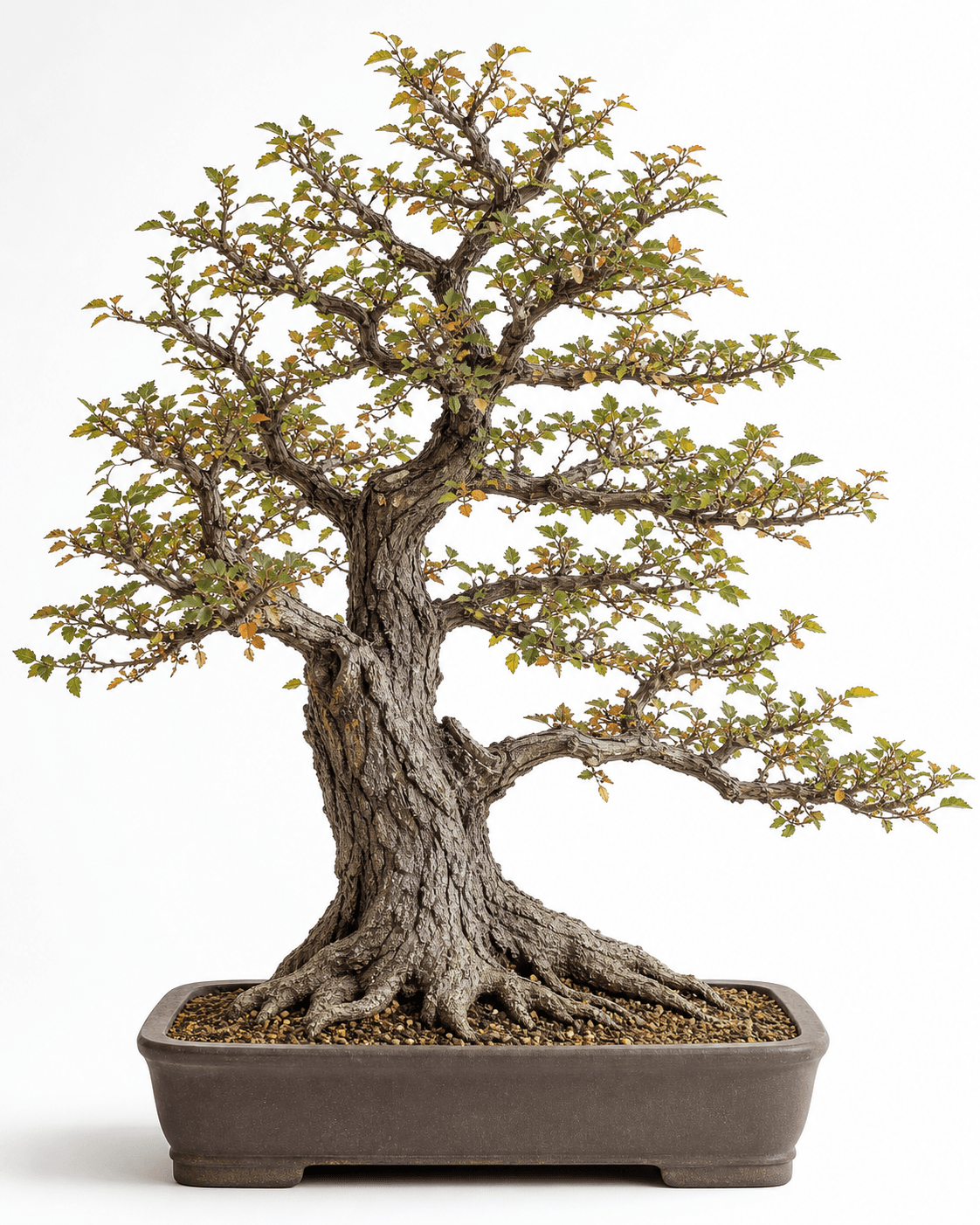
Winged elm bonsai care starts with treating Ulmus alata as an outdoor warm-temperate deciduous elm with corky wings, fast open-grown growth, and a strong need for repeated structural pruning. Give it sun, water with oxygen, spring bud-swell root work, early branch selection, and close checks for elm disease.
The local Mirai corpus has direct winged-elm and Ulmus alata mentions plus stronger transferable elm method in deciduous structural development, field-grown elm styling, Chinese elm summer work, elm wiring, root-sheen, watering, soil, propagation, energy, and design files. Kew, USDA Forest Service Silvics, NC State, Virginia Tech, and UF/IFAS ground taxonomy, range, hardiness, morphology, seed, pruning, and disease evidence.
The main failure points are warm indoor culture, confusing winged elm with Chinese elm or other native elms, deep shade, letting multiple shoots swell into coarse junctions, dry or stale bonsai soil, damaging the elm root sheen, wire bite hidden by corky ridges, and missing Dutch elm disease, phloem necrosis, powdery mildew, mites, or scale.
Updated June 18, 2026. Written by EntGrove Editorial. Last verified June 18, 2026.
Care fingerprint
Read the species through its shared care pattern.
Repot and structural prune around dormant-to-active transitions; protect new leaves; time refinement work after growth hardens. Use this as the starting point before local conditions and tree strength refine the calendar.
Note: Winged elm is a native central and southeastern U.S. elm with corky ridges or wings on young twigs; keep it separate from Chinese elm, Siberian elm, cedar elm, American elm, slippery elm, and zelkova until the label is verified.
Read the foliage first
Broadleaf stress usually shows in leaf color, leaf size, wilt, scorch, or delayed hardening before it becomes a branch problem.
Match work to dormancy
Deciduous, evergreen, tropical, succulent, and flowering broadleaf trees recover on different calendars.
Protect fine roots
Root work should preserve enough active fine roots for the tree to rehydrate quickly after the operation.
Care cadence
The calendar starts with the tree's seasonal state.
Placement
Timing: Keep outdoors year-round with sun, air movement, rain, and winter dormancy. Protect the container from hard freezes, drying wind, and repeated freeze-thaw outside the mild side of its range.
Watch for: Warm-room extension, late soft shoots, winter twig dieback, and treating landscape hardiness as unprotected pot hardiness.
Kew POWONC State ExtensionUF/IFAS ExtensionBonsai Mirai LibraryLight and heat
Timing: Use full sun when watering and root health are reliable. In sustained hot wind or severe summer heat, cool the pot and use temporary afternoon protection rather than permanent shade.
Watch for: Long internodes, weak interior buds, oversized leaves, scorched pot edges, and a top canopy that shades lower branches.
USDA Forest Service SilvicsNC State ExtensionUF/IFAS ExtensionBonsai Mirai LibraryWatering
Timing: Water thoroughly when the upper soil begins to dry and the lower root zone still has moisture. Spring extension, full sun, large leaves, wind, and shallow pots shorten the interval quickly.
Watch for: Hard dry-down, stale wet nursery cores, hydrophobic edges, late-day flagging, and using drought tolerance in the ground as a reason to dry a bonsai pot hard.
USDA Forest Service SilvicsNC State ExtensionBonsai Mirai LibraryFertilizer
Timing: Feed by stage once growth resumes. Push development trees after leaf-out, moderate trees in secondary building, refine lightly after the first flush hardens, and reduce nitrogen before autumn hardening.
Watch for: Runaway extension, excess potassium patterns in elm, fertilizer during heat or root stress, weak yellowing from roots, and late soft growth.
Bonsai Mirai LibraryPruning
Timing: In development, let selected shoots extend for thickness, then thin junctions before four or more shoots create swelling. In refinement, prune hardened shoots back to viable buds and leave weak areas longer.
Watch for: Same-point swelling, unchecked elm dieback, large cuts without stub and seal logic, removing too much leaf mass from weak branches, and corky bark hiding poor cut placement.
Bonsai Mirai LibraryUF/IFAS ExtensionWiring
Timing: Wire structural branches selectively while the tree is vigorous and the wood can still move. Check wire during active thickening, then shift older corky sections to guy wires, branch weights, or clip-and-grow.
Watch for: Wire bite within a few months, bark scars hidden by wings, gray bark splitting to green phloem during a bend, cracked older branches, and wire crossing the trunk on mature rough bark.
Bonsai Mirai LibraryVirginia Tech DendrologyNC State ExtensionRepotting
Timing: Repot as buds swell and warmth returns. Preserve the root sheen under the base, correct heavy roots in stages, open the surface, sides, and bottom for oxygen, and anchor the tree firmly.
Watch for: Circling nursery roots, compacted field soil, pot lift, slow drainage, weak upper branches, destroyed fine roots under the trunk, and stacking root work with major styling.
Bonsai Mirai LibraryUSDA Forest Service SilvicsSeed, pest, and disease checks
Timing: Inspect from spring flowering through leaf drop. Clean seed when refinement or bench hygiene matters, remove dead elm wood near the bench, and isolate suspect wilt or vascular symptoms for local diagnosis.
Watch for: Spring samaras, flagging, sudden wilt, powdery mildew, mites, scale hidden in corky ridges, phloem necrosis, Dutch elm disease, and stressed trees attracting secondary pests.
USDA Forest Service SilvicsNC State ExtensionUF/IFAS ExtensionSpecies guide
Apply the species profile before copying another tree's calendar.
At a glance
Winged elm is a corky-barked native elm for outdoor bonsai.
The botanical name is Ulmus alata Michx. in Ulmaceae. Common labels include winged elm, cork elm, wahoo, witch elm, and small leaf elm. Kew gives the native range as the central and southeastern United States. Kew POWOUSDA Forest Service SilvicsNC State Extension
Use it as an outdoor deciduous bonsai. NC State lists USDA Zones 6a through 9b, full sun to partial shade, 1 to 3 inch leaves, and two wide corky ridges or wings on stems. UF/IFAS lists a 45 to 70 foot landscape tree, 2 to 4 inch leaves, fast growth, a pyramidal, vase, oval, or upright crown, early spring flowers, and samaras shortly after flowering. NC State ExtensionUF/IFAS ExtensionVirginia Tech Dendrology
The best bonsai scale is medium to large, with broom, informal upright, clump, twin-trunk, multi-trunk, raft, and native deciduous images favored over tiny shohin targets. Difficulty is intermediate because early pruning, root-sheen preservation, wire monitoring, disease checks, and species identification all matter. Bonsai Mirai LibraryBonsai Mirai / AsymmetryUSDA Forest Service Silvics
Wild habitat
The wild tree explains the toughness, sun demand, and open crown.
USDA Silvics describes winged elm as a very hardy small-to-medium tree across the southern Midwest and southeastern United States. It grows on fertile moist sites, dry poor sites, silty uplands, tight terrace flats, abandoned fields, upland clay, intermittent streams, moist lower slopes, middle and upper slopes, and sandy bottomlands. USDA Forest Service SilvicsKew POWO
For care, the wild lesson is broad tolerance inside a smaller bonsai margin. UF/IFAS calls the species adaptable from wet sites to dry rocky ridges, and NC State lists dry-soil and wet-soil resistance. A bonsai pot still turns that tolerance into a daily water and oxygen calculation. UF/IFAS ExtensionNC State ExtensionBonsai Mirai Library
For design, read the open-grown tree. USDA Silvics describes a short bole, ascending branches, an open round-topped crown, lacy or somewhat drooping habit, rapid growth in the open, and persistent corky wings. UF/IFAS adds that crowns vary from pyramidal to vase, oval, and upright forms. Bonsai design should preserve that native elm character rather than forcing a conifer-pad silhouette. USDA Forest Service SilvicsUF/IFAS ExtensionBonsai Mirai / Asymmetry
Reading the tree
Use development vigor, then slow it before corky structure gets coarse.
Mirai separates development from refinement by the work the tree still needs to do. Development uses extension for trunk girth, branch thickness, wound closure, roots, and vascular expansion. Refinement uses hardened flushes, viable buds, repeated cutback, and energy balance to divide strength into smaller twigs. Bonsai Mirai Library
Winged elm needs this distinction because the same traits that make it promising can also make it coarse. Mirai winged-bark guidance says major structural reductions on winged or corky-barked species should happen while bark is still young, so callus and later bark formation can blend the cut. Bonsai Mirai Library
Read health from bud count, interior bud survival, leaf size, internode length, soil smell, branch response after pruning, and how fast the pot dries. Elm is a dieback-prone group in the Mirai corpus, so random branch loss often means root-sheen stress, stale soil, overextension, or poorly timed large cuts before it means simple hunger. Bonsai Mirai LibraryNC State Extension
Pruning
Prune before elm vigor turns into swollen junctions.
In structural development, let selected shoots extend to build trunk, wound closure, and primary branches, then thin crowded junctions early. Mirai deciduous guidance says four or more shoots at one vigorous elm junction create inverse swelling and knuckling that later work cannot cleanly reverse. Bonsai Mirai Library
UF/IFAS landscape guidance reinforces the same structural point: young winged elm needs regular pruning to eliminate double and multiple trunks, select better branch angles, and build a central trunk with spaced lateral limbs. In bonsai, that becomes trunk-line selection, primary branch spacing, and early decisions about broom, clump, or informal upright direction. UF/IFAS ExtensionBonsai Mirai Library
In refinement, wait for the spring flush to harden and then cut strong shoots back to the first leaves with viable buds. Mirai small-leaf elm method relies more on pruning than broad leaf removal; larger winged elm leaves can receive selective leaf reduction only in strong zones after root work has recovered and the new flush is energy positive. Bonsai Mirai LibraryVirginia Tech DendrologyUF/IFAS Extension
Large cuts need elm dieback logic. Leave a stub, seal fresh cambium, let natural recession show the final cut line, then refine later. On winged bark, follow the natural collar and bark pattern rather than making a geometric cut across the visual grain. Bonsai Mirai Library
Roots
Protect the elm root sheen and fix native-material roots in stages.
Mirai treats elm as a sheen-sensitive broadleaf deciduous group. The fine-root layer under the root flare governs water movement and branch retention. Damaging that area on a weak elm can trigger branch shedding regardless of how carefully the top was styled. Bonsai Mirai Library
Repot as buds swell and warmth returns. Mirai says elms respond later than many deciduous trees because they need heat to break dormancy. Hydrate before work, mist exposed roots if they dry, open the top, sides, and bottom, and preserve the interior root column unless health forces deeper correction. Bonsai Mirai Library
The original root mass can vary widely. USDA Silvics places winged elm on silty uplands, tight terrace flats, upland clay, sandy bottomlands, dry slopes, and moist lower slopes. Nursery, volunteer, and collected material can arrive with circling roots, compact field soil, or uneven heavy roots, so correct the base before the branch design becomes too refined. USDA Forest Service SilvicsBonsai Mirai Library
Treat roots like branches. Cut heavy roots back to finer secondary roots over staged repots, anchor the tree firmly, and avoid repeating major root work before recovery is clear. A tree that rocks in the pot cannot rebuild fine roots. Bonsai Mirai Library
Soil and pot
Use moisture-retentive aggregate soil with enough depth to move water.
Winged elm soil should convert habitat flexibility into bonsai balance. Mirai soil fundamentals define useful bonsai substrate by oxygen, structure, water availability, and nutrient retention. Akadama supplies fine-root and nutrient value, pumice buffers water, and lava preserves air space. Bonsai Mirai LibraryUSDA Forest Service Silvics
Development trees can use an open deciduous aggregate such as akadama, pumice, and lava, or regional equivalents that hold moisture without suffocating roots. Field-dug or weak material may recover better in pumice-forward media while fine roots rebuild. Refined, vigorous deciduous trees can move toward akadama-forward soil when watering and repot timing are dependable. Bonsai Mirai Library
Pot shape should follow stage. Mirai elm root-sheen guidance favors deeper rather than merely wider containers when the fine-root layer under the base needs gravity-driven water movement and oxygen. A shallow show pot belongs after roots are flat, fine, and predictable. Bonsai Mirai Library
Design-wise, unglazed warm brown, gray, or muted ochre rectangles and ovals usually suit corky native elm bark. A broom or broad deciduous crown can carry a quieter oval, while a rugged volunteer or clump can tolerate a deeper rectangle with more visual weight. Bonsai Mirai / AsymmetryUSDA Forest Service Silvics
Climate
Adapt by pot exposure, not by moving the tree indoors.
In the warm southeastern and lower Midwest range, full sun and heat are usable only when the pot stays evenly moist and oxygenated. UF/IFAS lists high drought tolerance in the landscape, but the bonsai container heats and dries faster than ground soil. UF/IFAS ExtensionBonsai Mirai Library
In colder edge climates, keep the tree dormant and protect container roots. Landscape hardiness of Zones 6a through 9b does not mean exposed bonsai roots can tolerate repeated freeze-thaw, dry wind, or sun-warmed pots that wake too early. NC State ExtensionUF/IFAS ExtensionBonsai Mirai Library
In humid regions, prioritize airflow, spacing, and foliage density control. NC State lists powdery mildew, cankers, leaf spots, beetles, borers, caterpillars, leaf miners, and scale among problems on stressed trees, and UF/IFAS notes that scale can be missed in thick corky bark. NC State ExtensionUF/IFAS Extension
In arid or windy regions outside the natural humidity band, use morning sun, afternoon pot protection during heat spikes, mulch or shade cloth around containers, and more frequent water checks. Reduce work when leaf flagging shows the tree is spending energy on survival. USDA Forest Service SilvicsBonsai Mirai Library
Pests and diseases
Treat disease pressure as part of native elm ownership.
Dutch elm disease is the highest-consequence risk. NC State calls winged elm particularly susceptible, UF/IFAS says it can kill trees, and USDA Silvics names Dutch elm disease and phloem necrosis as major native-elm diseases transmitted by insects. NC State ExtensionUF/IFAS ExtensionUSDA Forest Service Silvics
Powdery mildew is more often a vigor and airflow issue than a death sentence. Mirai elm guidance connects powdery mildew with humidity and poor airflow, and NC State lists powdery mildew, cankers, leaf spots, beetles, borers, caterpillars, leaf miners, and scale, especially on stressed trees. Bonsai Mirai LibraryNC State Extension
Scale deserves special attention because the bark helps hide it. UF/IFAS warns that scale insects can infest branches and are often missed along thick, corky twigs. Inspect under winged ridges, at branch collars, near old wire marks, and on weak shaded shoots. UF/IFAS ExtensionVirginia Tech Dendrology
Use prevention first: sun, airflow, correct water, clean dead twigs, disinfected tools after suspect disease cuts, and local extension guidance for vascular wilt symptoms. A bonsai bench with other elms should treat flagging branches and stained sapwood as quarantine issues. USDA Forest Service SilvicsNC State ExtensionUF/IFAS Extension
Wiring
Wire early, selectively, and with respect for corky ridges.
Mirai deciduous wiring guidance is selective. Structural wire sets the backbone, then clip-and-grow and directional pruning build tertiary ramification. On rough-barked elm, wiring every twig works against the informal deciduous image and increases hidden damage. Bonsai Mirai LibraryBonsai Mirai / Asymmetry
Use wire while branches are young enough to move. Mirai winged-bark guidance says very young wiring can influence where bark later forms, while older winged or corky bark should be crossed carefully or avoided. Virginia Tech describes corky twig wings that can protrude one-half inch. Bonsai Mirai LibraryVirginia Tech Dendrology
On mature rough-barked elm, keep wire off the trunk where possible and use a few well-anchored structural wires at discrete contact points. Mirai warns that elm wire can bite within three to four months during active growth, and that gray bark splitting to green phloem signals a bend has reached its limit. Bonsai Mirai Library
Copper can be useful on thick-barked structural elm branches because it holds with fewer wraps, but aluminum, guy wires, branch weights, and clip-and-grow may be safer on smaller or brittle sections. Check under corky wings rather than relying on a surface glance. Bonsai Mirai LibraryNC State Extension
Propagation
Seed is easy; cuttings and layers are bonsai tools when timing is right.
Seed is the documented species route. USDA Silvics says flowers appear before leaves in March and April, fruit ripens in April, seeds disperse the same month, and first seedling leaves can appear within one week after germination. UF/IFAS says seed sown immediately after harvest germinates quickly and easily. USDA Forest Service SilvicsUF/IFAS Extension
Mirai elm method supports cuttings as a practical propagation tool: thumb-sized elm cuttings can root under mist, bottom heat, and a well-aerated medium, while larger cuttings need tighter humidity and heat. Keep foliage limited so transpiration does not outrun new roots. Bonsai Mirai Library
Air layering is useful when a volunteer, nursery tree, or swollen junction has a better top than base. Mirai cautions that quality layers can require multiple seasons to build radial roots worth separating, and rushing separation creates a nebari problem that persists for years. Bonsai Mirai Library
Grafting is mainly a repair technique on winged elm: root grafts can improve a one-sided base, approach grafts can add missing low branches, and thread grafts can fill interior gaps. Match vigor, immobilize the union, and give the tree a full growing season or more before relying on the graft. Bonsai Mirai LibraryBonsai Mirai / Asymmetry
Sourcing
Buy base, roots, and identity before corky texture.
Good material can come from seedlings, volunteers, native-plant nurseries, landscape stock, and ethically removed young trees in its range. USDA Silvics says winged elm can invade openings, old fields, and rangelands, survives grazing as bushes, and sprouts prolifically, which helps explain why local material may be available. USDA Forest Service Silvics
Start inspection at the soil line. Look for radial roots, taper, bark age, a usable first branch, low buds, and branch angles that can become a believable elm. UF/IFAS says form varies greatly from one tree to the next, so be selective in nursery stock. UF/IFAS ExtensionBonsai Mirai / Asymmetry
Corky wings are attractive only when the structure underneath is sound. Reject material with severe root girdling, sour compacted soil, irreversible inverse taper, no low buds, hidden scale in corky ridges, active wilt, flagging branches, dead attached elm wood, or heavy large cuts already made in old winged bark. NC State ExtensionUF/IFAS ExtensionBonsai Mirai Library
Confirm the species. Virginia Tech compares winged elm with American elm, cedar elm, slippery elm, and field elm; NC State also notes confusion with Chinese elm, zelkova, river birch, and American hornbeam. Identity changes hardiness, indoor claims, disease assumptions, leaf size, and timing. Virginia Tech DendrologyNC State Extension
Troubleshooting
Diagnose winged elm from roots, light, pruning, and disease risk.
Sudden flagging or branch wilt should trigger disease caution. Isolate the tree from other elms, inspect for vascular staining, remove dead elm wood from the bench area, and use local extension guidance before treating it as ordinary leaf drop. USDA Forest Service SilvicsNC State ExtensionUF/IFAS Extension
Random twig or branch dieback usually points to root-sheen damage, stale soil, poorly timed large cuts, unchecked extension starving interior shoots, or vascular disease. Check drainage, root smell, pruning history, wound sealing, and branch distribution before adding fertilizer. Bonsai Mirai LibraryUSDA Forest Service Silvics
Long internodes and weak inner buds usually mean shade, excessive nitrogen, or top dominance. Move toward stronger light when roots can support it, thin crowded junctions, and reduce fertilizer after the first flush hardens in refinement. USDA Forest Service SilvicsUF/IFAS ExtensionBonsai Mirai Library
Wire bite on winged branches can hide under corky ridges. Remove or relax wire early, then use guy wires, clip-and-grow, or pruning to continue shape changes. Dead strips under a wing often signal the check came too late. Bonsai Mirai LibraryVirginia Tech DendrologyNC State Extension
Powdery leaf coating, yellow mite stippling, or scale in branch ridges calls for airflow, water correction, mechanical removal where practical, and regionally appropriate controls. Repeated spray dependency usually means the tree is stressed at roots, light, or spacing. NC State ExtensionUF/IFAS ExtensionBonsai Mirai Library
Design
Design winged elm as a native deciduous tree with corky age language.
Start with base, trunk line, defining branch, and apex. Mirai design methodology asks what the tree already offers before styling begins. With winged elm, the useful signals are native range, corky branch texture, small-to-medium leaves, an open crown, and strong response to early pruning. Bonsai Mirai / AsymmetryBonsai Mirai LibraryUSDA Forest Service Silvics
Deciduous branch structure should move up and out, then divide into rounded terminal masses. Mirai broadleaf design guidance treats flat conifer pads as a poor fit for elm character; the trunk should feel larger because the foliage subdivides into secondary and tertiary zones. Bonsai Mirai LibraryBonsai Mirai / Asymmetry
Strong styles include broom, informal upright, twin-trunk, clump, raft, multi-trunk, and naturalistic native deciduous images. A field-edge or dry-slope source can support a compact rugged image, while moist-site material often asks for a broader crown and more generous root mass. USDA Forest Service SilvicsUF/IFAS ExtensionBonsai Mirai / Asymmetry
Use deadwood sparingly. Mirai broadleaf design treats deciduous deadwood as a hollow or scar language rather than lasting conifer jin and shari. Winged elm age should come from bark, scars, trunk movement, branch hierarchy, and a winter silhouette that still reads as elm. Bonsai Mirai Library
Forms
Most labels are common names; Lace Parasol is the named form to know.
Kew accepts Ulmus alata and lists one heterotypic synonym, Ulmus pumila Walter, as a later illegitimate homonym rather than the modern Siberian elm name. That makes label checking important when older nursery or regional names appear. Kew POWO
Common labels such as cork elm, wahoo, witch elm, and small leaf elm should stay with Ulmus alata only when leaf, twig, bark, flower, fruit, and source history agree. Small leaf elm can easily mislead a bonsai buyer toward Chinese elm assumptions. USDA Forest Service SilvicsNC State ExtensionVirginia Tech Dendrology
NC State lists Lace Parasol as a cultivar or form. Treat it as a sourcing note until the individual tree proves useful: bonsai value still depends on roots, base, branch placement, internodes, health, and whether the form preserves winged elm character at scale. NC State ExtensionBonsai Mirai / Asymmetry
History
Winged elm is better known as native forest and landscape material than as a standardized bonsai subject.
USDA Silvics published the winged elm species chapter in 1990 and frames it as a hardy southern and southeastern U.S. tree with modest commercial value, occasional southern landscape planting, wildlife seed and twig value, and mixed elm lumber use. USDA Forest Service Silvics
That background matters for bonsai because the material is local, resilient, and underused. It offers a native alternative to imported or retail elms for growers who want corky texture, spring seed, outdoor dormancy, and a deciduous image tied to the southeastern landscape. USDA Forest Service SilvicsBonsai Mirai / Asymmetry
Public sources checked for this rebuild emphasize forest, landscape, and dendrology evidence more than a widely cited named winged elm bonsai standard. The strongest examples should come from long-term local cultivation, early root correction, young-bark structural reductions, and design choices that keep the tree recognizably Ulmus alata. Bonsai Mirai LibraryBonsai Mirai / AsymmetryUSDA Forest Service Silvics
Identity
Separate winged elm from other elm and zelkova labels.
Winged elm is Ulmus alata. Chinese elm in bonsai usually means Ulmus parvifolia, Siberian elm is Ulmus pumila, cedar elm is Ulmus crassifolia, American elm is Ulmus americana, slippery elm is Ulmus rubra, field elm is Ulmus minor, and zelkova is a separate genus. Kew POWOVirginia Tech Dendrology
Use several traits together. Virginia Tech gives alternate 2 inch doubly serrate leaves with an uneven base, March to April flowers, April to May hairy samaras, red-brown buds, zigzag twigs, and conspicuous corky wings. NC State gives 1.5 to 3.5 inch rough leaves and two wide corky ridges or wings on stems. Virginia Tech DendrologyNC State Extension
Source history matters. A volunteer from a southeastern field edge, a nursery tree labeled cork elm, and a retail bonsai labeled small leaf elm can be very different plants. Confirm identity before using disease, indoor-outdoor, pruning, or repotting advice from any elm page. USDA Forest Service SilvicsNC State ExtensionVirginia Tech Dendrology
Species questions
Answer the beginner questions before styling.
Is winged elm a good beginner bonsai?
Winged elm suits an outdoor beginner who can water reliably, prune often, and inspect for elm disease. It is intermediate because root sheen, dieback-prone cuts, hidden wire bite, and early structural choices need attention.
Can winged elm bonsai live indoors?
Grow winged elm outdoors for long-term culture. It needs sun, air movement, seasonal dormancy, and outdoor light intensity. Indoor display should be brief and followed by a return to outdoor conditions.
What other names refer to winged elm?
EntGrove uses Ulmus alata Michx. Common labels include winged elm, cork elm, wahoo, witch elm, and sometimes small leaf elm. Confirm the plant before applying Chinese elm or cedar elm advice.
How do I identify winged elm?
Look for alternate doubly serrate elm leaves with uneven bases, March to April flowers, spring samaras, and corky ridges or wings on twigs and branches. Use several traits because older wood may show wings unevenly.
How much sun does winged elm bonsai need?
Use full outdoor sun when water and roots are reliable. Temporary afternoon protection can help during severe heat, hot wind, or recovery, while permanent low light weakens ramification and lengthens internodes.
How often should I water winged elm bonsai?
Water when the upper soil begins to dry and the lower root zone still has moisture, then water thoroughly. Foliar mass, pot size, soil, sun, wind, and heat decide the interval.
When should I prune winged elm bonsai?
In development, let chosen shoots extend to build thickness, then thin crowded junctions before they swell. In refinement, prune hardened shoots back to viable buds and leave weaker areas with more foliage.
When should I repot winged elm bonsai?
Repot as buds swell and warmth returns. Preserve the fine-root sheen under the base, open the root mass for oxygen, correct heavy roots in stages, and anchor the tree firmly.
What soil works best for winged elm bonsai?
Use a deciduous aggregate mix that holds moisture while preserving oxygen. Development trees can use akadama, pumice, and lava or regional equivalents; refined trees can move toward akadama-forward soil when watering and repot timing are reliable.
Why are branches dying back on my winged elm?
Common causes include root-sheen damage, stale or compacted soil, unchecked extension starving interior branches, large cuts without stub and seal logic, wire bite, or vascular disease. Check roots, drainage, pruning history, and disease symptoms before adding fertilizer.
Sources
Species advice needs source discipline.
Next decisions
Plan the operation before copying the calendar.
A good care note for Winged elm records the tree's stage, the work done, and the aftercare used. That record matters more than a month-name rule.
Related species
Compare nearby trees before transferring advice.
Japanese maple
Acer palmatum
Trident maple
Acer buergerianum
Amur maple
Acer tataricum subsp. ginnala
Field maple
Acer campestre
Korean hornbeam
Carpinus turczaninovii