
Species guide
Swiss Stone Pine Bonsai Care
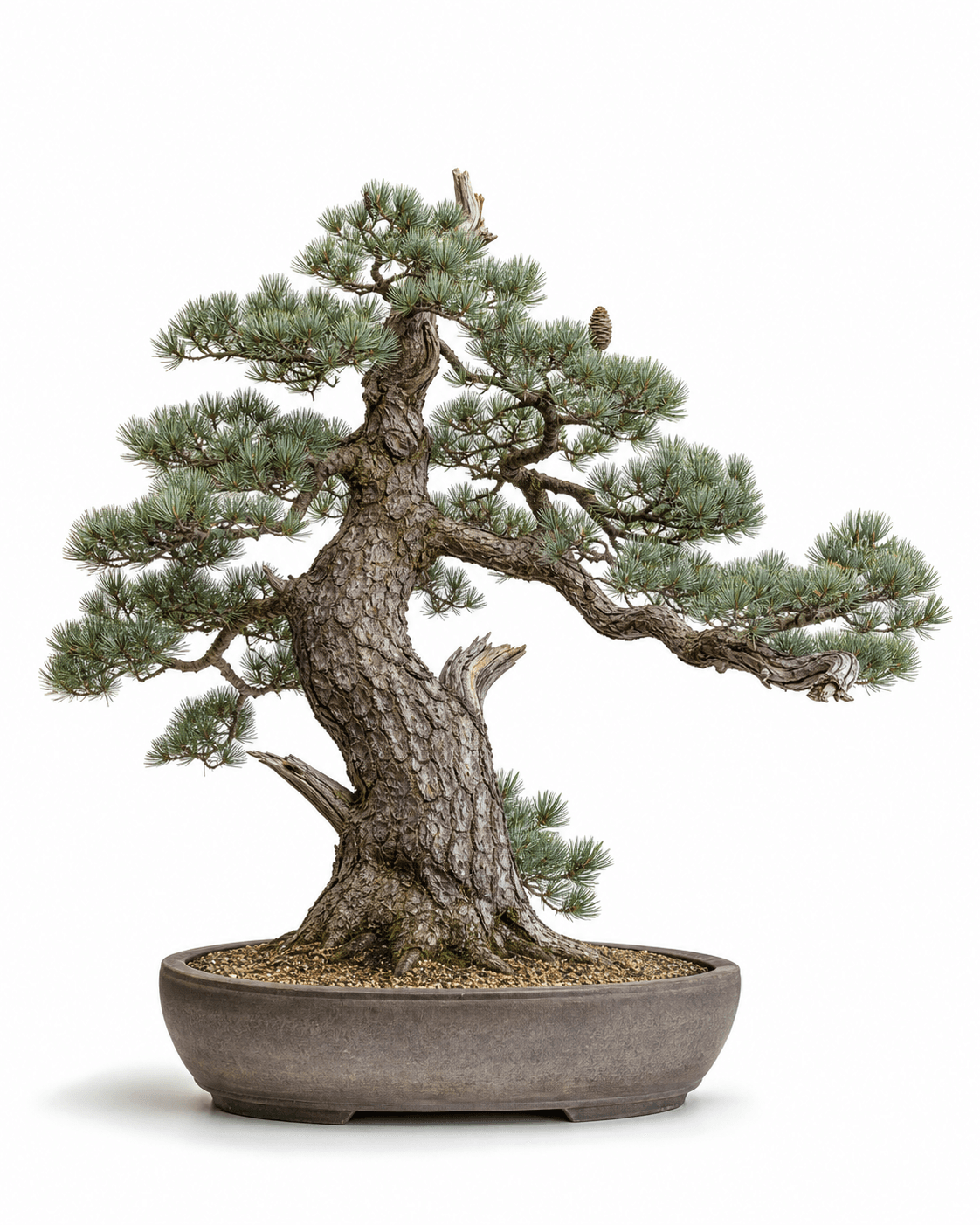
Pinus cembra
Swiss stone pine bonsai is an outdoor, cold-climate, five-needle pine project. Treat verified Pinus cembra as Pine > Long-Needle Single-Flush: preserve needle mass, wait for sheath drop before refinement pruning, keep roots oxygen-rich, and avoid annual Japanese black pine decandling schedules.
The local Mirai corpus has one direct Cembra mention and stronger transferred coverage from five-needle pine files. Kew, RHS, EUFORGEN, the European Atlas, NC State, Oregon State, UConn, Purdue, and the Gymnosperm Database ground the accepted name, Swiss stone and Arolla labels, alpine habitat, hardiness, pests, cultivars, edible seeds, and nutcracker ecology.
Updated June 8, 2026. Written by EntGrove Editorial. Last verified June 8, 2026.
Care fingerprint
Read the species through its shared care pattern.
Do not default to Japanese black pine decandling; manage vigor through timing, needle balance, light, and conservative pruning. Use this as the starting point before local conditions and tree strength refine the calendar.
Identify flush behavior
Single-flush, multiflush, white pine, and compact pine groups have different pruning windows and different risk levels.
Avoid default decandling
Japanese black pine methods do not transfer safely to every pine, especially slow, weak, collected, or five-needle trees.
Use needles as strength data
Needle length, color, age, and density help show where vigor is strong, weak, or becoming shaded.
Care cadence
The calendar starts with the tree's seasonal state.
Placement
Timing: Grow outdoors in full sun with airflow. Give the pot winter protection in hard freeze-thaw regions and protect roots from reflected heat in warm summers.
Watch for: Warm indoor storage, hot humid benches, black nursery pots on pavement, weak shaded candles, and southern heat that keeps roots active when the tree wants cool recovery.
NC State ExtensionRHSBonsai Mirai LibraryWatering
Timing: Water the whole rootball, then wait for oxygen to return before watering again. During spring candle elongation, keep the tree hydrated rather than withholding water for needle control.
Watch for: Damp nursery cores inside dry bonsai mix, sour organic pockets, summer heat over wet roots, and weak candles after repeated shallow watering.
Bonsai Mirai LibraryPurdue Arboretum ExplorerDevelopment feeding
Timing: Feed steadily while building roots, branch structure, and interior buds. Development trees keep their needles and extensions because those needles build the vascular tissue that funds back budding.
Watch for: Starving a young Swiss stone pine for short needles, removing old needles before branches are dense, and cutting before the tree has a strong root system.
Bonsai Mirai LibraryRefinement pruning
Timing: On refined branches, prune after the papery sheaths drop from the five-needle clusters. The useful cutback window is short, roughly two to three weeks after sheath drop.
Watch for: Spring candle pinching, late cuts after stems harden, bud selection on weak branches, and pruning behind every current-year needle.
Bonsai Mirai LibraryNeedle management
Timing: Remove dead or naturally abscising older needles and needles that block wiring or pad clarity. Preserve healthy second-year needles and enough 360-degree needle distribution around each shoot.
Watch for: Needle plucking for energy balance, stripping weak shoots, removing old needles from developmental branches, and pulling clusters backward against the shoot.
Bonsai Mirai LibraryRepotting
Timing: Repot in early spring as buds begin to move. Keep the tree tied down firmly, preserve enough roots and needles for recovery, and wait before combining repotting with heavy styling.
Watch for: Bare-rooting old material, loose tie-downs, cutting roots and foliage in the same season, and fertilizing hard before new roots are active.
Bonsai Mirai LibraryPests and disease
Timing: Inspect in spring, after heat waves, after wiring, and before winter storage. NC State lists caterpillars, borers, bark beetles, miners, scale, mealybugs, sawfly, blights, rots, canker, and rusts.
Watch for: Sudden branch flagging, resin at entry holes, scale clusters, needle blights under long snow cover, wind injury, and root decline after hot wet weather.
NC State ExtensionEuropean Atlas of Forest Tree SpeciesSpecies guide
Apply the species profile before copying another tree's calendar.
At a glance
Swiss stone pine is a slow alpine five-needle pine for outdoor growers.
Pinus cembra is the Swiss stone pine or Arolla pine of the Alps and Carpathians. In bonsai, the safest working model is long-needle single-flush five-needle pine: build strength first, preserve needles, prune after sheath drop, and keep roots breathable. Kew POWO general informationBonsai Mirai Library
The page is intentionally transparent about source depth. Mirai mentions Cembra directly in a long-needle pine comparison, then the method comes from broader five-needle pine files. Public botanical and forestry sources fill in range, hardiness, ecology, pests, cultivars, and cone behavior. Bonsai Mirai LibraryEUFORGEN technical guidelinesNC State Extension
For beginners, the main mistake is copying Japanese black pine timing. Swiss stone pine should keep more needle mass, avoid routine decandling, and receive refinement pruning only after current-year needles have hardened. Bonsai Mirai Library
Wild habitat
The wild model is high-elevation continental forest, cold air, edible seeds, and clustered regeneration.
Kew summarizes the native range as the Alps and Carpathians. EUFORGEN describes a comparatively small natural range in the subalpine belt of the continental Alps and higher Carpathian patches, often associated with Pinus mugo, Larix decidua, and Picea abies. Kew POWO general informationEUFORGEN technical guidelines
EUFORGEN records natural forest elevations mostly from 1500 to 2400 m in the Alps, with single trees from 1200 to 2850 m, and lower Carpathian bands from 1300 to 1700 m with single trees from 900 to 1985 m. This is cold, bright, slow, high-mountain material. EUFORGEN technical guidelines
The seed story matters for design. EUFORGEN and the Gymnosperm Database describe European nutcracker caching as the main seed-dispersal system, with clusters sometimes arising from more than one cached seed. That supports clump, grove, twin-trunk, and uneven forest images. EUFORGEN technical guidelinesThe Gymnosperm Database
Translate that ecology into care by favoring cool roots, full light, oxygen, conservative timing, and design that feels like a high-elevation old pine rather than a dense ornamental hedge. Bonsai Mirai LibraryBonsai Mirai / Asymmetry
Reading the tree
Read sheath drop, needle age, candle strength, and root recovery before cutting.
Five-needle pine work starts with a timing signal. Mirai uses sheath drop, when the papery sheath at the base of each needle cluster falls away, as the point when current-year needles have hardened and refinement cuts can be made. Bonsai Mirai Library
Development and refinement should be separated branch by branch. A branch with sparse interior buds needs extension and foliage. A branch with multiple strong shoots at one junction may be ready for shortening or bud selection. Bonsai Mirai Library
Needles are the battery. Mirai warns that removing healthy needles from long-needle single-flush pines forces the tree to replace lost photosynthetic mass, often with longer needles and weaker back-budding results. Bonsai Mirai Library
Read the climate response too. NC State calls Swiss stone pine a cooler-climate specimen that struggles in southern heat and humidity, so weak candles after summer may reflect root heat or humidity stress rather than a pruning need. NC State Extension
Pruning
Use five-needle sheath-drop pruning and leave decandling out of routine care.
Refinement pruning happens after sheath drop. Cut back this year's shoot only where at least one current-year needle cluster remains behind the cut, because buds form from retained needle sites. Bonsai Mirai Library
The cutback window is narrow. Mirai gives the reliable window as roughly two to three weeks after sheath drop, with four weeks as an outer edge before the stem hardens and fall timing becomes safer. Bonsai Mirai Library
Spring candle pinching belongs on different pines. On long-needle single-flush pines, pinching during candle elongation can leave the remaining needles longer and coarser. Bonsai Mirai Library
Routine decandling is unsafe for this page. The sources reviewed support five-needle long-needle timing for Pinus cembra, with no direct evidence for Mediterranean outlier decandling or annual multi-flush work. Bonsai Mirai Library
Repotting
Repot in spring, preserve oxygen, and convert nursery roots in stages.
Use early spring movement as the default repotting window. The tree should have swelling buds, an intact needle mass, and enough root strength to recover before summer heat or winter freeze. Bonsai Mirai Library
Old nursery stock can hide a dense organic core. Keep enough core to preserve active roots, then improve percolation over several repots rather than forcing a full bare-root conversion. Bonsai Mirai LibraryPurdue Arboretum Explorer
Tie-downs matter on pine roots. A Swiss stone pine that rocks after repotting tears new root tips and loses the recovery window. Secure the trunk and root mass before filling the final soil layer. Bonsai Mirai Library
After repotting, keep the foliage bright but protect the pot from drying wind, hard freeze, and hot reflected surfaces. Resume stronger pruning only after root growth and water use confirm recovery. Bonsai Mirai LibraryNC State Extension
Soil and pot
Use a mineral pine mix and a pot that supports cool-root alpine character.
Mirai five-needle pine method favors a high-oxygen mineral mix. A practical starting point is equal akadama, pumice, and lava, screened so very fine particles do not collapse pore space. Bonsai Mirai Library
Oregon State says the Columnaris form does best in well-drained, loamy, slightly acid soil, and Purdue says Pinus cembra performs poorly on alkaline or poorly drained soils. In bonsai, that becomes drainage first, with water chemistry watched in alkaline regions. Oregon State Landscape PlantsPurdue Arboretum Explorer
Pot choice should follow the tree image. Formal or columnar cultivar material can take a quiet oval or rectangle, while high-mountain clump and forest images often read better in a slab, crescent, or subdued unglazed container. Bonsai Mirai / AsymmetryNC State Extension
Avoid oversized shallow pots too early. Swiss stone pine is slow, and root reduction should follow branch development rather than force a finished silhouette before the root system is ready. Bonsai Mirai Library
Climate
Cold is easier than heat; container roots still need protection.
RHS H6, NC State Zones 4a to 7b, UConn Zone 3, and Oregon State Zone 4 all point to strong cold tolerance in the ground. In a bonsai pot, roots freeze faster and should be protected from repeated freeze-thaw swings. RHSNC State ExtensionUConn Plant DatabaseOregon State Landscape Plants
Warm humid climates are harder. NC State specifically notes poor performance in southern heat and humidity, so growers in warm zones should use morning sun, bright afternoon airflow, shaded pots, and careful summer watering. NC State Extension
In cold continental regions, protect recently repotted trees from drying winter wind and deep pot freeze. The foliage can tolerate cold better than a shallow root system that was just reduced. Bonsai Mirai LibraryRHS
In maritime climates, the risk often shifts to winter wetness. Keep the tree bright and ventilated, raise the pot off saturated benches, and choose particle sizes that return oxygen quickly. Bonsai Mirai LibraryPurdue Arboretum Explorer
Pests and diseases
Watch heat stress, root disease, bark insects, snow molds, and needle blights.
NC State says Pinus cembra is resistant to most pests and diseases, while still naming caterpillars, borers, bark beetles, miners, scale, mealybugs, sawfly, blights, rots, canker, rusts, and wind damage as possible problems. NC State Extension
The European Atlas adds alpine disease context: prolonged snow cover can favor browning needle diseases from Phacidium infestans, Gremmeniella abietina, and Herpotrichia juniperi, especially on young plants. European Atlas of Forest Tree Species
The same atlas names a larch bud moth form that specializes in defoliating Arolla pine during outbreaks. In bonsai, defoliation risk should trigger recovery culture, needle preservation, and local diagnosis before pruning. European Atlas of Forest Tree Species
Purdue lists susceptibility to Zimmerman moth, pine shoot moth, and bud moth. Treat resin, frass, webbing, or dead shoot tips as diagnosis problems, then improve vigor and airflow while seeking local pest guidance. Purdue Arboretum Explorer
Wiring
Wire for alpine structure while protecting needles, bark, and branch shoulders.
Wire when branches are flexible enough to move without tearing and when the tree has enough roots and needles to recover. Avoid stacking heavy wiring immediately after repotting or heat stress. Bonsai Mirai Library
Use the wire to expose buds laterally and organize light through the crown. The goal is a branch structure that keeps lower and interior growth productive, not just a temporarily neat silhouette. Bonsai Mirai LibraryBonsai Mirai / Asymmetry
Five-needle pines need needle protection during wiring. Remove only dead, abscising, crossing, or below-pad needles needed for wire path and visibility; leave healthy needles that are feeding weak areas. Bonsai Mirai Library
Check wire often once the tree resumes growth. Slow trees can still bite suddenly on vigorous branches, and old bark or plated tissue should not be scarred by forgotten wire. Bonsai Mirai Library
Propagation
Seed is natural, slow, and provenance-sensitive; grafting is a sourcing detail.
EUFORGEN says Swiss stone pine is monoecious and wind-pollinated, with reproductive maturity in natural stands usually delayed until 40 to 60 years. Seed production occurs every 2 to 3 years, with abundant mast years less frequent. EUFORGEN technical guidelines
The cones stay closed and hold heavy wingless seeds. European nutcrackers harvest, cache, and disperse them, sometimes creating clustered seedlings from one cache. EUFORGEN technical guidelinesThe Gymnosperm Database
NC State lists seed as the recommended propagation strategy. Seedlings are slow, but they give the cleanest roots and avoid graft-union questions in bonsai material. NC State ExtensionPurdue Arboretum Explorer
Grafted cultivar material can be useful if the graft is low, clean, and compatible with the design. Cuttings and air layers should be treated as experimental for bonsai planning. Bonsai Mirai LibraryNC State Extension
Buying
Buy a confirmed Pinus cembra label, a recoverable root system, and climate fit.
Good material has a confirmed Pinus cembra label, five needles per fascicle, healthy retained old needles, strong buds, an even rootball, and no active scale, borer signs, canker, or sour soil. Kew POWONC State ExtensionBonsai Mirai Library
Label confusion is common. Swiss stone pine, Italian stone pine, Siberian stone pine, Japanese stone pine, Korean white pine, and generic pine-nut seedlings are separate decisions. Use the Latin name when technique matters. Kew POWO general informationKew POWOKew POWO
Nursery cultivars can be good candidates if their habit suits the design. Columnar forms may already have a trunk line, but they can also carry straight, dense, hedge-like growth that needs years of branch selection. NC State ExtensionOregon State Landscape Plants
Collected or old landscape material should come with legal provenance and a recovery history. Slow high-elevation pines can decline after root disturbance, so buy evidence of active roots before dramatic trunk character. Bonsai Mirai LibraryEUFORGEN technical guidelines
Troubleshooting
Match symptoms to roots, climate, timing, pests, or needle loss.
Symptom: long coarse needles after spring work. Likely cause: spring candle pinching or excessive early fertilizer on a long-needle single-flush pine. Fix by waiting for sheath drop and balancing with pruning, not stress.
Symptom: weak interior branches. Likely cause: too little needle mass, shading, over-cleaning, weak roots, or excessive tip dominance. Grow and feed before refinement cuts.
Symptom: crown thins after summer heat. Likely cause: root heat, humidity, wet soil, or heat-stressed roots. Shade the pot, improve airflow, and stabilize watering before pruning.
Symptom: branch flagging with resin or frass. Likely cause: borer, bark beetle, moth, wire injury, or root loss feeding that branch. Inspect before cutting.
Symptom: browning after long snow cover. Likely cause: snow mold or needle disease pressure. Improve winter ventilation, remove debris, and seek local diagnosis before new styling work.
Symptom: no back buds after repeated cleanup. Likely cause: removing the needles that fund vascular growth. Let shoots extend, preserve healthy old needles, and rebuild strength.
Design
Design from alpine age, cold wind, nutcracker clusters, and slow high-country growth.
Young Swiss stone pine is often narrow and pyramidal, while older trees open into a rounder or flatter crown. NC State, UConn, and Purdue all describe this shift from dense young form to older openness. NC State ExtensionUConn Plant DatabasePurdue Arboretum Explorer
The alpine story supports compact upright trunks, exposed bends, flattened old crowns, clumps from cached seeds, and forests with uneven spacing. Let the tree read as slow and cold rather than lush. EUFORGEN technical guidelinesBonsai Mirai / Asymmetry
Deadwood should be restrained and pine-like. Broken tops, dead branch stubs, and weathered scars can fit a high-elevation image, while bright carved contrast usually overpowers the soft five-needle foliage. Bonsai Mirai LibraryBonsai Mirai / Asymmetry
Scale matters. Five-needle foliage, closed cones, slow growth, and heavy old needles make Swiss stone pine easier as medium or large bonsai than as tiny shohin material. NC State ExtensionBonsai Mirai Library
Forms
Cultivar names describe habit; the care calendar still follows Pinus cembra.
NC State lists Chalet, Columnaris, Compacta, Glauca, Herman, Nana, Pygmaea, Silver Whispers, and Stricta. Many are selected for dense, columnar, blue-green, compact, or dwarf landscape habits. NC State Extension
Oregon State notes Columnaris as a narrow, densely columnar, pyramidal, slow-growing form, with the name used since 1897 for several clones and sometimes confused with Stricta. Oregon State Landscape Plants
UConn describes the species as narrow and dense when young, becoming more open and somewhat flat-topped with drooping branches when mature. That mature shift can guide cultivar styling even when the starting stock is columnar. UConn Plant Database
Use cultivar labels as growth-habit clues, then read the actual root quality, branch density, internodes, graft line, and heat tolerance before committing to a design. Bonsai Mirai LibraryNC State Extension
History
Swiss stone pine carries alpine utility, nut history, and old-tree presence.
The European Atlas describes Arolla pine as slow-growing and long-lived, with high-quality aromatic wood used historically for furniture, building, carving, toys, marquetry, flooring, and regional crafts. European Atlas of Forest Tree Species
EUFORGEN frames the species as protective high-elevation forest, helping reduce avalanche and soil-erosion risk where it forms pure or mixed stands near the treeline. EUFORGEN technical guidelinesEuropean Atlas of Forest Tree Species
The Gymnosperm Database notes the edible seeds, nutcracker mutualism, and dendrochronology importance of Pinus cembra, including a reported 701-year crossdated specimen from the Eastern Carpathians. The Gymnosperm Database
As bonsai, Swiss stone pine sits in the European alpine-pine conversation. The most convincing designs respect slow growth, cold habitat, retained needles, and the quiet mass of old high-country conifers. Bonsai Mirai LibraryBonsai Mirai / Asymmetry
Species questions
Answer the beginner questions before styling.
Can Swiss stone pine be grown as bonsai?
Yes. Swiss stone pine can be grown as outdoor bonsai when it has full sun, cold dormancy, oxygen-rich soil, careful watering, and long-needle single-flush timing.
Can Swiss stone pine bonsai live indoors?
Keep Swiss stone pine outdoors. It needs strong light, airflow, seasonal temperature change, and winter dormancy. Indoor display should be brief.
Is Swiss stone pine a five-needle pine?
Yes. Pinus cembra carries needles in bundles of five and should be handled with five-needle long-needle pine timing in bonsai.
Should I decandle Swiss stone pine?
Avoid routine decandling. The reviewed Mirai evidence supports sheath-drop pruning and needle preservation, not annual black-pine decandling or Mediterranean outlier decandling.
When should Swiss stone pine be pruned?
Refinement pruning is best shortly after sheath drop, when current-year needles have hardened. Development branches should often be allowed to extend and feed the root system.
What soil works for Swiss stone pine bonsai?
Use a mineral, high-oxygen pine mix such as equal akadama, pumice, and lava with fines screened out. Watch alkaline water and poorly drained organic cores.
How cold hardy is Swiss stone pine bonsai?
The species is very cold hardy in the ground, with sources listing RHS H6, USDA Zones 4a to 7b, Zone 4, and Zone 3 contexts. Bonsai pots still need root protection in severe freeze-thaw.
Is Swiss stone pine the same as Italian stone pine?
They are separate species. Swiss stone pine is Pinus cembra, a cold alpine five-needle pine. Italian stone pine is Pinus pinea, a Mediterranean pine with different outlier timing.
Which pests matter most?
Watch caterpillars, borers, bark beetles, miners, scale, mealybugs, sawfly, moths, blights, rots, canker, rusts, snow-mold needle diseases, and wind damage.
Is Swiss stone pine good for small bonsai?
Usually it is better for medium and larger bonsai. The slow growth, five-needle foliage, closed cones, and alpine old-tree character need room to read well.
Sources
Species advice needs source discipline.
Next decisions
Plan the operation before copying the calendar.
A good care note for Swiss stone pine records the tree's stage, the work done, and the aftercare used. That record matters more than a month-name rule.
Related species
Compare nearby trees before transferring advice.
Ponderosa pine
Pinus ponderosa
Jeffrey pine
Pinus jeffreyi
Bishop pine
Pinus muricata
Sugar pine
Pinus lambertiana
Eastern white pine
Pinus strobus